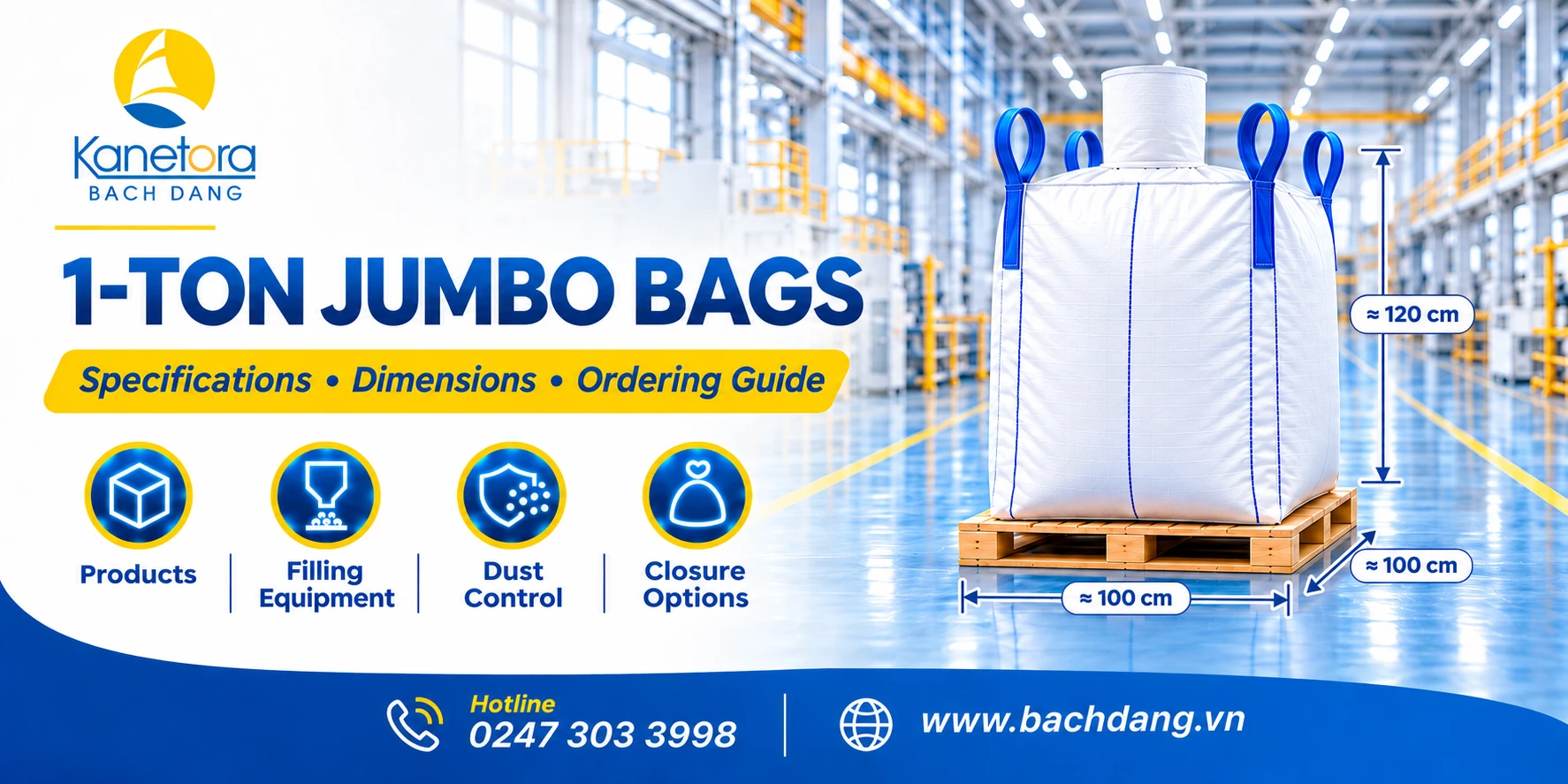


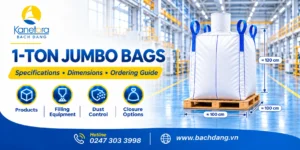
1-ton Jumbo Bags (1000kg FIBC Bags) are widely used industrial packaging solutions for storing, handling, and transporting dry bulk materials, including powders, granules, plastic resins, minerals, and construction materials.
With a Safe Working Load (SWL) of 1,000 kg, these flexible bulk containers help manufacturers and exporters improve packaging efficiency, streamline material handling, and optimize logistics operations.
However, not all 1-ton Jumbo Bags share the same dimensions or construction.
A Jumbo Bag designed for plastic resin pellets may require a completely different configuration from one intended for cement, mineral powders, food ingredients, or industrial chemicals.
So, what are the typical dimensions of a 1-ton Jumbo Bag? Which specifications should buyers consider? What affects pricing, and how can businesses order custom FIBC bags directly from a manufacturer?
In this guide, Kanetora Bach Dang, an industrial packaging manufacturer in Vietnam, explains the key technical and commercial considerations to help businesses select the right 1000kg bulk bag for their applications.
1. What Is a 1-Ton Jumbo Bag?
A 1-ton Jumbo Bag, also known as a 1000kg FIBC Bag, Bulk Bag, Big Bag, or Flexible Intermediate Bulk Container, is an industrial bulk packaging solution designed with a Safe Working Load of 1,000 kg.
These bags are typically manufactured from woven polypropylene (PP) fabric and equipped with lifting loops, filling openings, and discharge systems according to specific material-handling requirements.
Key Features of 1-Ton Jumbo Bags
Typical design characteristics include:
- Safe Working Load (SWL): 1,000 kg.
- Material: Woven polypropylene (PP).
- Construction: U-Panel, 4-Panel, Circular, or Baffle.
- Lifting system: Commonly four lifting loops.
- Top options: Open Top, Filling Spout, or Duffle Top.
- Bottom options: Flat Bottom or Discharge Spout.
- Optional protection: Fabric coating or polyethylene (PE) inner liner.
- Safety Factor (SF): Selected according to the intended application and applicable testing requirements.
A 1-ton Jumbo Bag can be customized for different industrial applications rather than being limited to a single standard configuration.
Common Applications
1-ton FIBC bags are frequently used for:
- PP, PE, and PET plastic resins.
- Industrial chemicals.
- Cement and construction materials.
- Minerals and stone powders.
- Food ingredients.
- Animal feed ingredients.
- Fertilizers.
- Agricultural commodities.
Buyers can explore additional products through Kanetora Bach Dang’s Industrial Packaging Solutions.
2. What Are the Typical Dimensions of a 1-Ton Jumbo Bag?
One of the most common questions from industrial buyers is:
What size is a 1-ton Jumbo Bag?
There is no single standard dimension suitable for every 1,000 kg bulk packaging application.
The appropriate bag dimensions depend on several factors:
- Bulk density of the material.
- Required filling weight.
- Filling and discharge methods.
- Filled bag shape and stability.
- Pallet dimensions.
- Warehouse storage conditions.
- Container loading requirements.
- Lifting and transportation equipment.
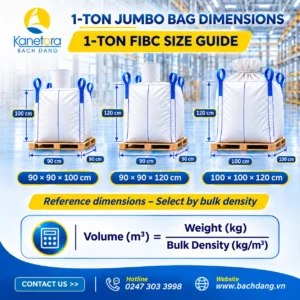
2.1. Common Reference Dimensions for 1000kg Jumbo Bags
The following dimensions are illustrative configurations that can serve as a starting point for technical evaluation.
| Bag Dimensions (L × W × H) | Approximate Geometric Volume | General Considerations |
|---|---|---|
| 90 × 90 × 100 cm | 0.81 m³ | May suit relatively high-density materials |
| 90 × 90 × 120 cm | 0.972 m³ | A reference configuration for industrial bulk materials |
| 95 × 95 × 120 cm | 1.083 m³ | May suit materials with moderate bulk density |
| 100 × 100 × 120 cm | 1.20 m³ | Provides greater geometric capacity |
| 100 × 100 × 130 cm | 1.30 m³ | May be considered for lower-density materials |
Important: These dimensions are examples for preliminary planning. They are not universal FIBC standards or confirmed stock specifications.
The actual usable capacity depends on bag construction, filling level, material behavior, and deformation after filling.
The final design should be reviewed and approved based on the customer’s specific requirements.
2.2. How to Calculate the Required Jumbo Bag Volume
Bulk density is one of the most important parameters when determining suitable Jumbo Bag dimensions.
The basic calculation is:
Required Material Volume (m³) = Material Weight (kg) / Bulk Density (kg/m³)
For example:
A manufacturer needs to package 1,000 kg of industrial raw material with a bulk density of 800 kg/m³.
The required material volume is:
1,000 / 800 = 1.25 m³
Therefore, the selected FIBC must provide sufficient usable capacity for approximately 1.25 m³ of material.
However, the geometric volume alone should not determine the final bag dimensions.
Additional factors include:
- Allowable filling level.
- Bag height after filling.
- Sidewall bulging.
- Pallet stability.
- Lifting conditions.
- Container loading configuration.
- Material flow characteristics.
Two products with the same filling weight may require significantly different FIBC dimensions.
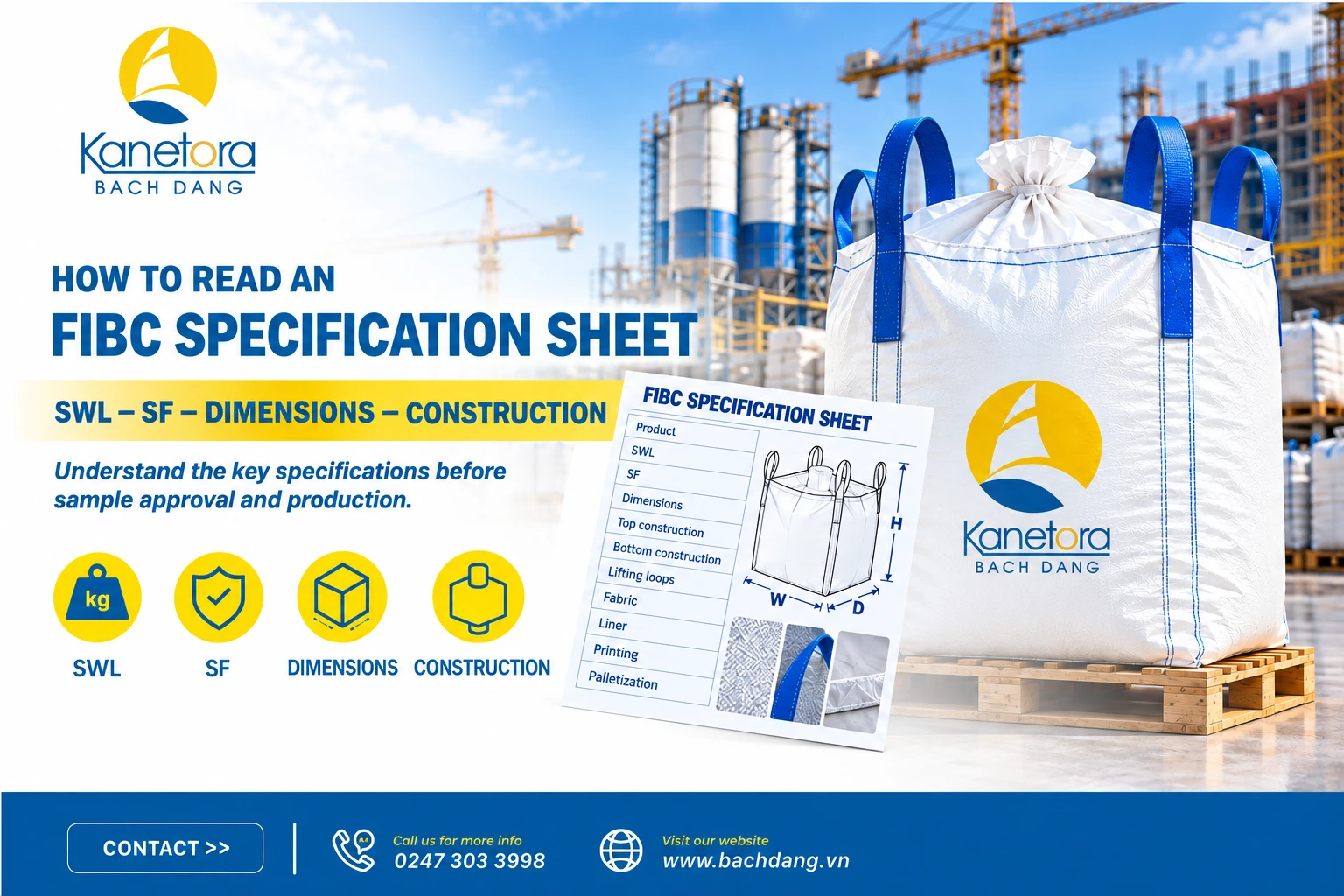
For further technical guidance, read How to Read an FIBC Specification Sheet: SWL, SF, Dimensions and Tolerances.
3. Technical Specifications of 1-Ton Jumbo Bags
In addition to dimensions, buyers should evaluate the overall FIBC construction.
A suitable 1000kg Jumbo Bag must meet the required loading capacity while remaining compatible with the filling, lifting, storage, and discharge systems used in daily operations.
3.1. Woven PP Fabric and GSM
The main body of a Jumbo Bag is generally manufactured from woven polypropylene fabric.
Fabric specifications are selected according to the intended application and performance requirements.
Important parameters include:
- Fabric weight (GSM).
- Tensile strength.
- Weaving density.
- Seam strength.
- Resistance to handling stresses.
- UV resistance when outdoor exposure is expected.
It is important to understand that a higher GSM does not automatically guarantee a higher load capacity.
The performance of an FIBC depends on its complete construction, including fabric, lifting loops, stitching, and reinforcement.
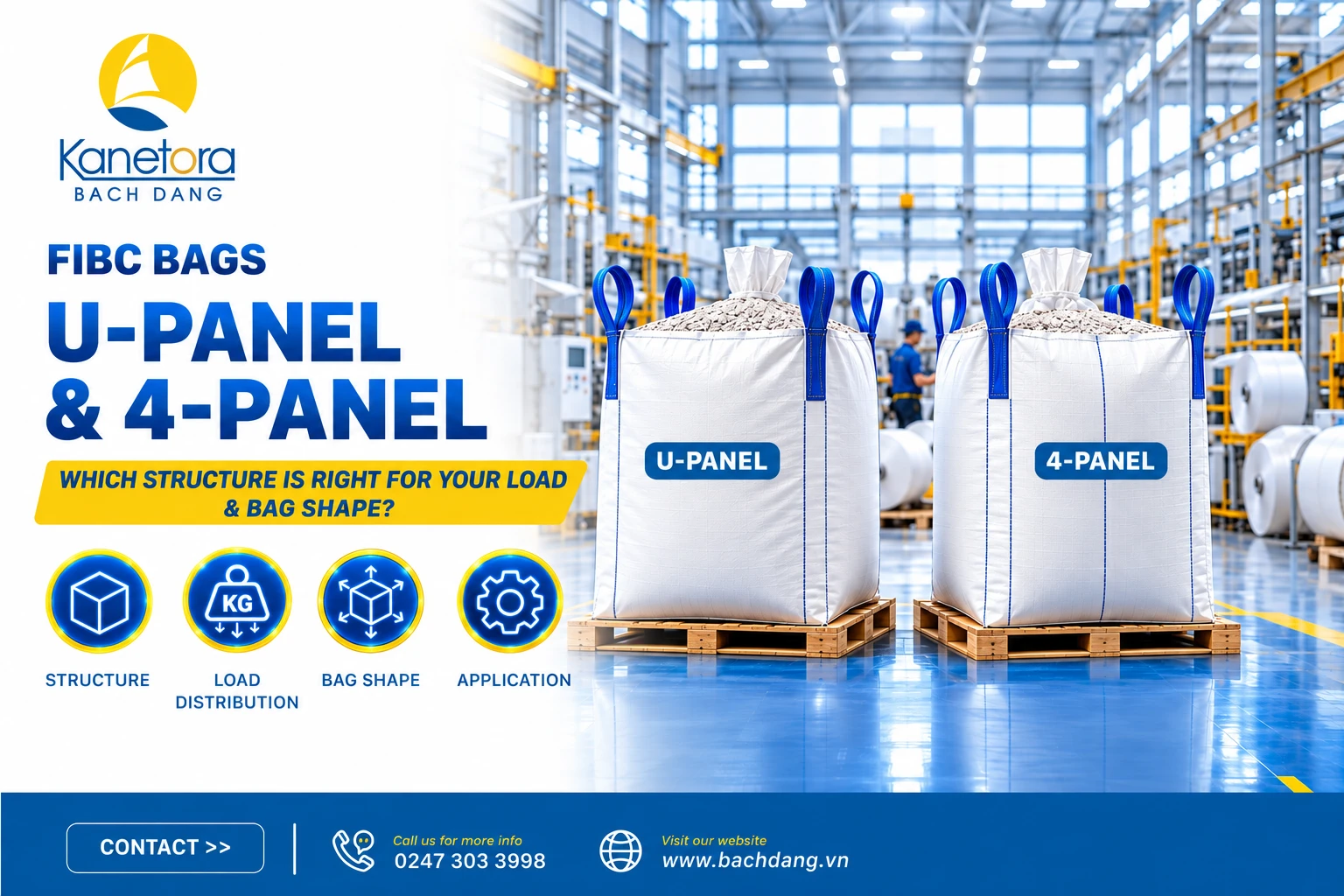
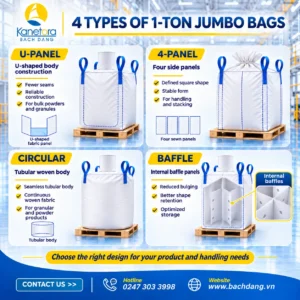
3.2. Jumbo Bag Construction Types
1-ton Jumbo Bags can be manufactured using different body constructions.
| Construction | Main Characteristics | Typical Applications |
|---|---|---|
| U-Panel | U-shaped fabric section combined with side panels | General industrial bulk materials |
| 4-Panel | Body assembled from four side panels | Applications requiring defined panel construction |
| Circular | Tubular woven fabric body | Powders, granules, and bulk commodities |
| Baffle | Internal panels help limit sidewall bulging | Warehouse and container space optimization |
Each construction offers different design characteristics.
For example, U-Panel and 4-Panel bags can both provide reliable performance when properly engineered and tested.
Baffle bags incorporate internal panels that help maintain a more rectangular shape after filling.
The best option depends on the material properties, required SWL, filling method, and logistics conditions.
For a detailed comparison, see U-Panel vs 4-Panel FIBC Bags: Design and Load Comparison.
Buyers seeking improved shape retention can also explore Baffle FIBC Bags from Kanetora Bach Dang.
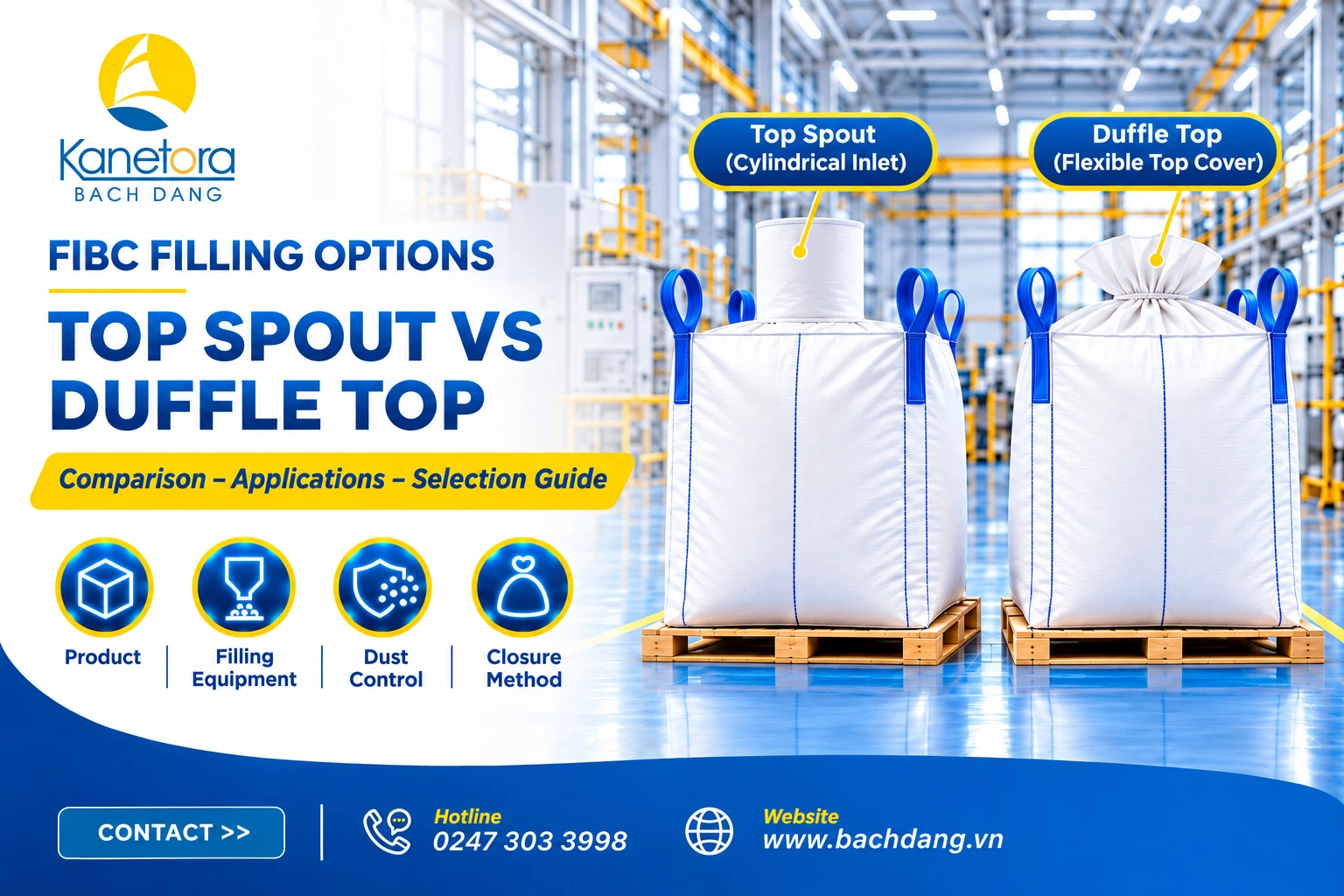
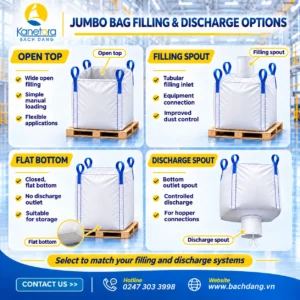
3.3. Filling Options
Different filling systems require different FIBC top constructions.
Open Top
An Open Top FIBC provides a wide opening for material loading.
This configuration may be suitable for applications requiring flexible filling operations.
Filling Spout
A Filling Spout uses a cylindrical inlet designed to connect with a filling hopper or other loading equipment.
The spout dimensions should match the customer’s filling system.
Duffle Top
A Duffle Top incorporates an extended fabric section that can be closed after filling.
It provides flexibility in applications requiring a larger filling opening with a closable top.
The selection of a filling system should consider:
- Filling equipment.
- Material flow.
- Dust generation.
- Closure requirements.
- Operational efficiency.
For additional guidance, read FIBC Filling Options: Top Spout vs Duffle Top.
3.4. Discharge Options
The bottom construction determines how material is released from the bag.
Flat Bottom
A Flat Bottom FIBC has a closed base without a dedicated discharge outlet.
This design may be suitable for applications where controlled bottom discharge is unnecessary.
Discharge Spout
A Discharge Spout allows material to flow through a cylindrical outlet at the bottom of the bag.
This configuration is commonly used where the FIBC must connect with a hopper or material-handling system.
The discharge design should consider:
- Material flowability.
- Spout diameter.
- Discharge equipment.
- Closure system.
- Dust control.
- Product retention.
Selecting the correct discharge configuration can improve operational efficiency and reduce unnecessary material handling.
4. Does a 1-Ton Jumbo Bag Need a PE Inner Liner?
Not every 1-ton Jumbo Bag requires an inner liner.
The need for a liner depends on the properties of the packaged material and the level of protection required.
When Should Buyers Consider a Liner?
An inner liner may be beneficial when handling:
- Moisture-sensitive materials.
- Fine powders.
- Products prone to leakage through woven fabric.
- Hygiene-sensitive ingredients.
- Materials requiring additional protection from environmental exposure.
A liner can be manufactured from polyethylene or other suitable materials, depending on the application.
Coating vs Inner Liner
These two options serve different purposes.
Fabric Coating
A coating is applied to woven PP fabric to improve selected protective characteristics, including resistance to dust leakage.
Inner Liner
An inner liner is a separate internal layer designed to provide additional product protection.
A coated fabric and a PE liner should not automatically be considered equivalent in moisture or gas-barrier performance.
The appropriate solution depends on the required protection level and supporting technical tests.
5. Understanding the Load Capacity of a 1-Ton Jumbo Bag
When purchasing a 1000kg FIBC Bag, buyers should clearly distinguish between two important parameters:
- Safe Working Load (SWL).
- Safety Factor (SF).
5.1. What Does SWL 1000kg Mean?
Safe Working Load refers to the maximum load an FIBC is designed and approved to carry under its specified conditions of use.
For a bag marked:
SWL: 1,000 kg
The normal filling weight must not exceed 1,000 kg.
The bag’s physical size or apparent strength does not justify exceeding its approved SWL.
5.2. What Is the Difference Between SF 5:1 and SF 6:1?
Safety Factor relates to the performance requirements applied to a particular FIBC design during testing.
For example:
- 1,000 kg SWL with SF 5:1.
- 1,000 kg SWL with SF 6:1.
These configurations involve different design and testing requirements.
However:
SF 5:1 does not mean that a 1-ton Jumbo Bag can safely transport 5 tons of material.
Similarly, SF 6:1 does not permit a 1-ton bag to carry 6 tons.
The approved operating load remains the specified SWL.
The appropriate safety factor should be determined according to the intended use, applicable standards, and testing requirements.
For more information, explore FIBC Quality Control and Testing at Kanetora Bach Dang.
6. Choosing 1-Ton Jumbo Bags for Different Industries
Although 1-ton Jumbo Bags share the same nominal SWL, their technical requirements can vary significantly between industries.
| Industry | Key Packaging Considerations | Recommended Design Focus |
|---|---|---|
| Plastic resins | Granular materials, contamination control, filling efficiency | Suitable top, bottom, liner, and lifting configuration |
| Cement and construction | Fine powders, dust generation, relatively high bulk density | Dust control, appropriate dimensions, seam integrity |
| Food ingredients | Hygiene, contamination prevention, traceability | Food Grade FIBC and suitable liner |
| Industrial chemicals | Chemical compatibility, dust, electrostatic hazards | Appropriate FIBC classification and safety requirements |
| Fertilizers | Moisture sensitivity and material flow | Coating, liner, and closure selection |
| Minerals | Bulk density, abrasion, heavy handling | Fabric construction, stitching, SWL, and discharge design |
6.1. Jumbo Bags for Cement and Construction Materials
Cement, limestone powder, and other mineral-based products require careful evaluation of bulk density, dust leakage, and discharge conditions.
A suitable Jumbo Bag must provide adequate load-bearing performance while remaining compatible with the filling and unloading processes.
Read more: Jumbo Bags for Cement and Construction Materials: What Should Buyers Consider?.
6.2. Food Grade Jumbo Bags
For products such as sugar, starch, flour, and other dry food ingredients, packaging requirements extend beyond load capacity.
Important considerations include:
- Production hygiene.
- Foreign-material control.
- Contamination prevention.
- Food-contact material suitability.
- Traceability.
- Quality documentation.
Read more: Food Grade Jumbo Bags: Hygiene and Contamination Control.
6.3. Jumbo Bags for Industrial Chemicals
For chemical powders and granules, buyers should evaluate the material’s physical and hazardous properties before selecting an FIBC.
Where flammable dust or gases may be present, appropriate electrostatic-control measures may be necessary.
Depending on the application, Type C or Type D FIBCs may need to be considered.
Explore Type C vs Type D Anti-Static Jumbo Bags for further technical information.
Anti-static performance and UN certification for dangerous goods are separate considerations and should be evaluated independently.
7. What Factors Affect the Price of 1-Ton Jumbo Bags?
There is no universal fixed price for all 1-ton Jumbo Bags.
Even when two bags have the same SWL of 1,000 kg, their manufacturing costs may differ considerably.
7.1. Bag Dimensions
Larger bags generally require more material, although actual costs also depend on construction and production efficiency.
7.2. Fabric Specifications
Fabric GSM, tensile strength, weaving construction, and reinforcement requirements influence the overall cost.
7.3. Filling and Discharge Systems
A basic Open Top bag may have a different production cost from one equipped with specialized filling and discharge spouts.
7.4. Coating and Liner Requirements
Additional protective features may increase material and manufacturing costs.
7.5. Technical and Compliance Requirements
Food Grade, anti-static, and UN-certified designs may require specialized materials, production controls, testing, and documentation.
7.6. Order Quantity
Order volume, purchasing frequency, and design standardization can influence manufacturing efficiency and unit pricing.
7.7. Printing and Packaging
Customized logos, warning symbols, product labels, packing methods, and delivery conditions should also be considered.
For an accurate quotation, buyers should provide a complete technical specification rather than requesting a price based only on the term “1-ton Jumbo Bag.”
8. What Information Is Required When Ordering 1-Ton Jumbo Bags?
Preparing complete technical information helps manufacturers develop suitable packaging solutions and reduce unnecessary design revisions.
The following checklist can be used when requesting a quotation.
| Information Category | Details Required |
|---|---|
| Product | Material name, physical form, special characteristics |
| Bulk Density | kg/m³ |
| Filling Weight | 1,000 kg per bag or other required weight |
| Dimensions | Preferred dimensions or pallet limitations |
| Construction | U-Panel, 4-Panel, Circular, Baffle |
| Top Design | Open Top, Filling Spout, Duffle Top |
| Bottom Design | Flat Bottom, Discharge Spout |
| Lifting System | Number of loops, loop length, handling method |
| Protection | Coating, PE liner, or additional requirements |
| Compliance | Food Grade, anti-static, UN, if applicable |
| Printing | Logo, product information, handling symbols |
| Quantity | Estimated order volume |
| Delivery | Destination, delivery requirements, target date |
If an existing Jumbo Bag is already in use, providing a physical sample or technical drawing can help the manufacturer better understand the application.
Specifications and acceptance criteria should be agreed upon before mass production.
For additional purchasing guidance, read 10 Common Mistakes When Ordering Jumbo Bags for the First Time.
9. Custom 1-Ton Jumbo Bag Manufacturing at Kanetora Bach Dang
Kanetora Bach Dang is an industrial packaging manufacturer based in Cau Mai, My Loc area, Ninh Binh Province, Vietnam.
The company manufactures a range of industrial packaging solutions, including:
- FIBC Jumbo Bags.
- Food Grade FIBC Bags.
- Baffle Jumbo Bags.
- FIBCs with inner liners.
- Anti-static FIBC Bags.
- UN-certified FIBC configurations.
- Block Bottom Valve Bags.
- Multilayer PE Films.
According to its 2026 company introduction, the factory has a reported FIBC production capacity of approximately 300,000 bags per month.
9.1. Integrated Manufacturing Operations
Kanetora Bach Dang operates an integrated FIBC manufacturing process covering:
- Polypropylene yarn extrusion.
- Lifting belt weaving.
- Fabric weaving.
- Fabric coating.
- Cutting and printing.
- Sewing and assembly.
- Cleaning and inspection.
- Final packing.
This integrated production structure supports quality control across multiple manufacturing stages.
For a closer look at the production process, visit Inside the Export-Standard FIBC Jumbo Bag Manufacturing Process.
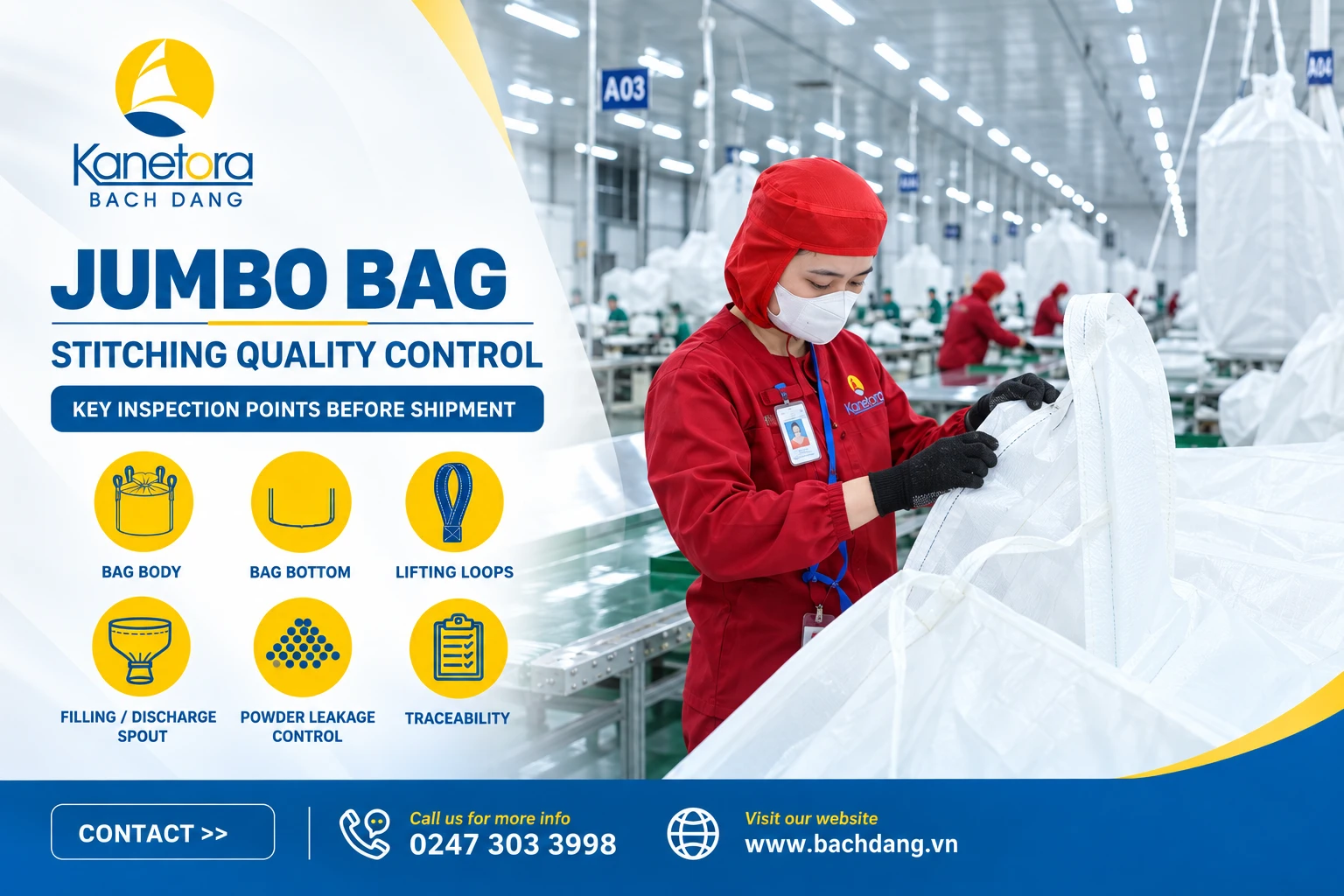
9.2. Quality Control and Testing
Quality assurance is an essential part of FIBC manufacturing.
Kanetora Bach Dang’s production and testing systems support evaluations of:
- Fabric tensile strength.
- Stitching quality.
- Lifting loop performance.
- Complete FIBC load-bearing performance.
- Selected liner properties.
- UV resistance.
For 1-ton Jumbo Bags, the performance of the complete lifting and load-bearing structure is particularly important.
Testing requirements should be established according to the approved FIBC specification and applicable standards.
9.3. Customized FIBC Solutions
Rather than applying a single specification to every industry, Kanetora Bach Dang evaluates customer requirements based on:
- Material characteristics.
- Bulk density.
- Required filling weight.
- Filling and discharge equipment.
- Lifting and handling conditions.
- Product protection requirements.
- Warehouse and transport conditions.
- Destination market requirements.
Buyers can learn more about Kanetora Bach Dang’s Industrial Packaging Factory in Vietnam.
10. How to Order Custom 1-Ton Jumbo Bags
For industrial buyers, ordering FIBC bags should follow a structured process.
Step 1: Submit Product Information
The buyer provides the material name, bulk density, filling weight, and intended application.
Step 2: Review the FIBC Configuration
The manufacturer evaluates the required dimensions, body construction, lifting loops, filling system, discharge system, and additional features.
Step 3: Confirm Technical Specifications
Both parties agree on the product specification, including critical dimensions, construction details, performance requirements, and inspection criteria.
Step 4: Request a Quotation
Pricing is prepared based on the approved design, order quantity, testing requirements, packing method, and delivery conditions.
Step 5: Sample Development and Approval
Where required, samples can be developed and reviewed before mass production.
Step 6: Manufacturing, Inspection, and Delivery
The bags are manufactured according to the agreed specifications and inspected under the applicable quality plan before shipment.
This approach helps buyers reduce specification errors and improve consistency between orders.
11. Frequently Asked Questions About 1-Ton Jumbo Bags
1. What are the standard dimensions of a 1-ton Jumbo Bag?
There is no single standard dimension suitable for every 1-ton Jumbo Bag. The appropriate size depends on the material’s bulk density, required filling volume, pallet dimensions, and transportation conditions. Reference dimensions may include 90 × 90 × 120 cm, 95 × 95 × 120 cm, or 100 × 100 × 120 cm. These are illustrative configurations, not universal specifications.
2. Can a 1-ton Jumbo Bag hold more than 1000kg?
A Jumbo Bag rated at SWL 1,000 kg should not be filled beyond its approved Safe Working Load. If a higher filling weight is required, an appropriately designed and tested FIBC with a higher SWL must be selected. A Safety Factor of 5:1 or 6:1 does not mean that a 1-ton bag can safely carry 5 or 6 tons.
3. Can a 1-ton Jumbo Bag have a discharge spout?
Yes. A 1-ton Jumbo Bag can be manufactured with either a Flat Bottom or a Discharge Spout, depending on the unloading method and material characteristics. A Discharge Spout is commonly used when materials need to be released into a hopper or processing equipment. The outlet dimensions and closure design should match the unloading system.
4. Does a 1-ton Jumbo Bag require a PE liner?
Not necessarily. A polyethylene (PE) inner liner is commonly considered for moisture-sensitive products, fine powders, hygiene-sensitive materials, or applications requiring additional protection. Liner materials and construction should be selected according to the specific product requirements.
5. How much does a 1-ton Jumbo Bag cost?
The price of a 1-ton Jumbo Bag depends on its dimensions, fabric GSM, body construction, lifting loops, filling and discharge options, coating, and liner requirements. Order quantity, printing, testing requirements, and delivery conditions can also affect pricing. Buyers should provide a detailed technical specification and estimated order quantity to receive an accurate quotation.
6. Can 1-ton Jumbo Bags be printed with company logos?
Yes. Jumbo Bags can be customized with company logos, product information, handling instructions, warning symbols, and traceability details. Printing requirements should be confirmed during the design approval process before production.
7. Can I order custom-sized 1-ton Jumbo Bags?
Yes. Kanetora Bach Dang provides customized FIBC solutions based on material properties, operational requirements, manufacturing capabilities, and applicable technical standards. Buyers can submit their preferred dimensions, bulk density, filling methods, lifting requirements, and transportation conditions for evaluation.
12. Conclusion: Choosing the Right 1-Ton Jumbo Bag
1-ton Jumbo Bags are versatile industrial packaging solutions for a wide range of dry bulk materials.
However, a 1,000 kg load rating alone is not sufficient to determine the right bag design.
Buyers should evaluate the complete packaging system, including:
- Bulk density.
- Bag dimensions.
- Body construction.
- Filling and discharge options.
- Lifting system.
- Safe Working Load.
- Safety Factor.
- Product protection requirements.
- Storage and transport conditions.
The right 1-ton Jumbo Bag should do more than hold 1,000 kg of material. It should support safe handling, efficient filling and discharge, reliable storage, and consistent transportation performance.
With integrated manufacturing capabilities and in-house quality control operations, Kanetora Bach Dang provides customized FIBC solutions for industrial customers in Vietnam and international markets.
Contact Kanetora Bach Dang for 1-Ton Jumbo Bag Quotations
KANETORA BACH DANG JOINT STOCK COMPANY
- Factory Location: Cau Mai, My Loc Area, Ninh Binh Province, Vietnam.
- Email: info@kanetora.com
- Website: https://bachdang.vn
Looking for a reliable 1-ton Jumbo Bag manufacturer in Vietnam?
Send us your product information, bulk density, required dimensions, and estimated order quantity.
Our team will review your requirements and help identify a suitable FIBC configuration for your application.