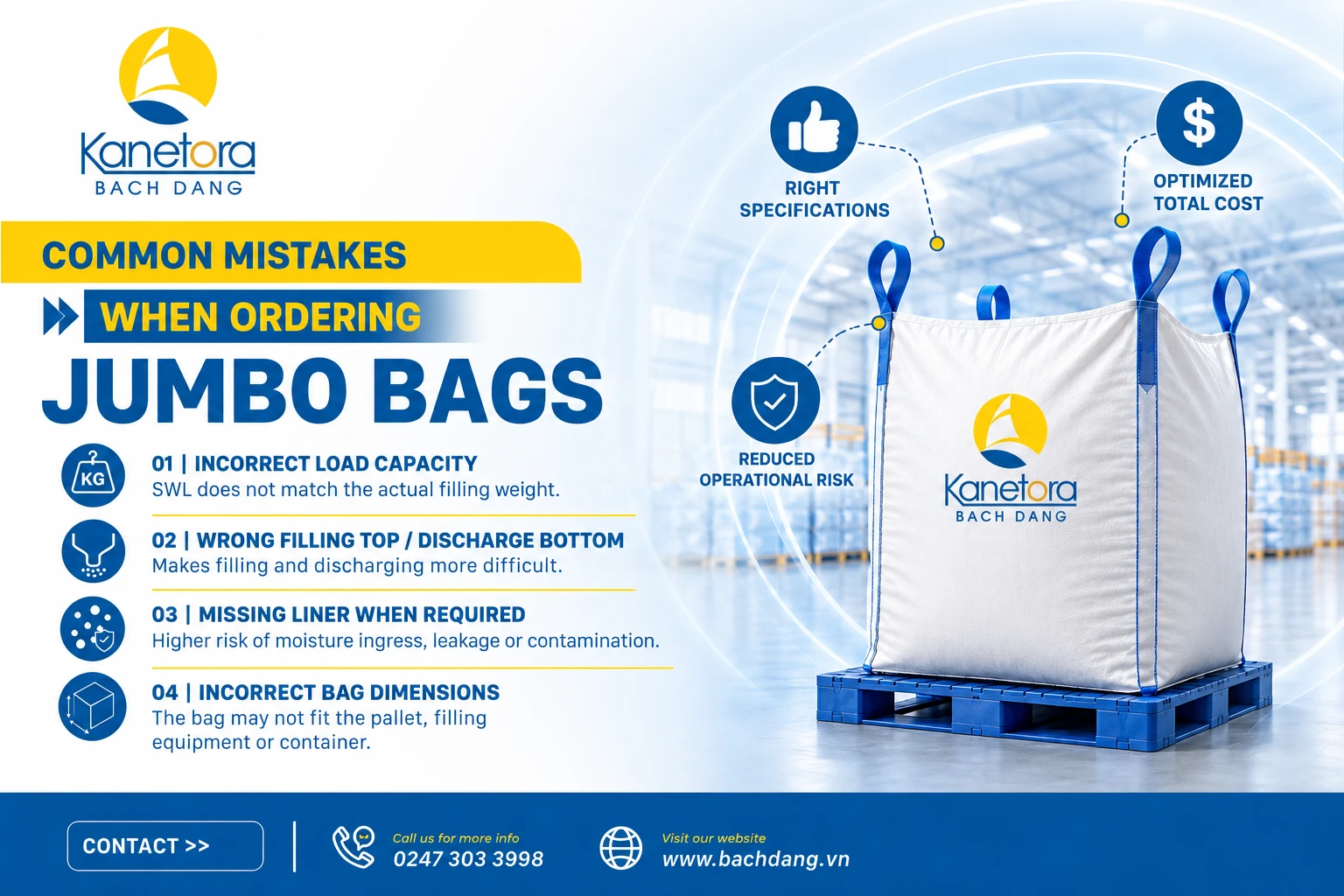


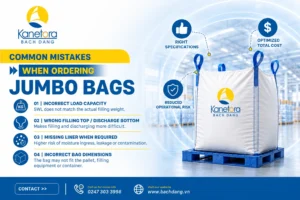
Ordering Jumbo Bags, also known as FIBCs or bulk bags, may initially seem straightforward: define the required loading capacity, choose a size, and request a quotation.
In practice, however, a complete FIBC specification involves much more than the nominal bag capacity.
Two bags both described as “1-ton Jumbo Bags” may require completely different designs depending on whether they are intended for plastic resin, minerals, cement, food ingredients, chemicals, or other bulk materials.
Differences may involve:
- bag dimensions;
- fabric weight;
- coated or uncoated fabric;
- inner liner;
- filling system;
- discharge system;
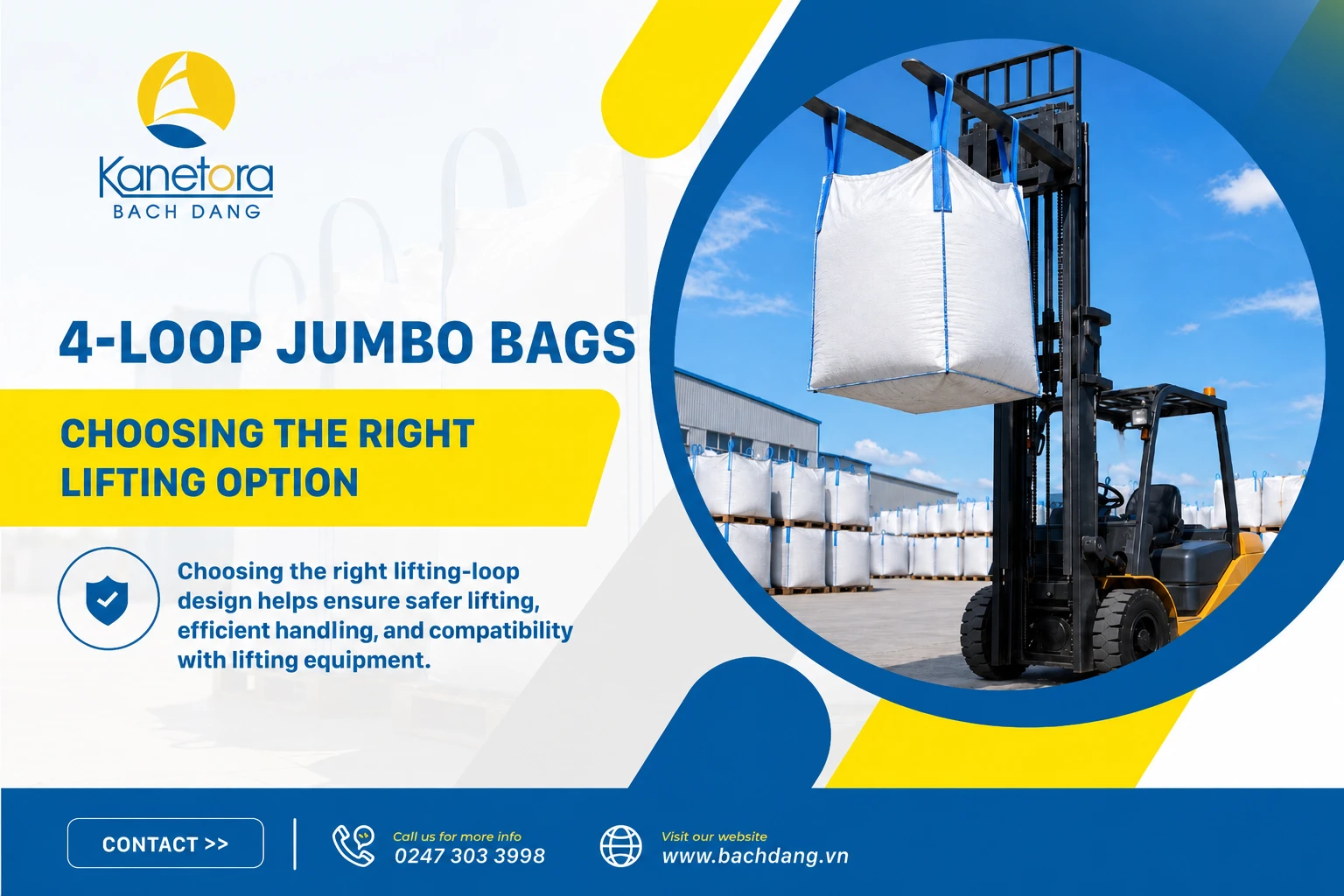
- lifting loops;
- electrostatic protection;
- hygiene requirements;
- transportation method;
- export market requirements.
A specification error at the beginning of the purchasing process can result in poor filling performance, inefficient container loading, difficult discharge, excessive bulging, or compliance issues at the destination market.
If your company is ordering custom FIBC bags for the first time, the following are some of the most common mistakes to avoid.
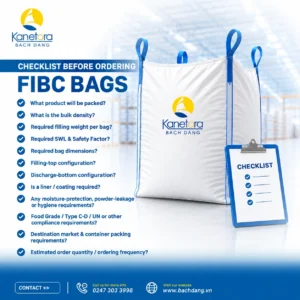
Quick Checklist: What Information Should You Provide When Ordering Jumbo Bags?
Before asking an FIBC manufacturer for a quotation, buyers should ideally prepare the following information:
| Information | What to Define |
|---|---|
| Product | Powder, granules, minerals, food, chemicals, etc. |
| Bulk density | Bulk density of the material |
| Filling weight | 500 kg, 1,000 kg, 1,250 kg, etc. |
| Bag dimensions | Length × width × height |
| SWL | Safe Working Load |
| Safety Factor | According to the intended application |
| Bag construction | U-Panel, Circular, 4-Panel, Baffle, etc. |
| Filling option | Open top, duffle top, filling spout, etc. |
| Discharge option | Flat bottom, discharge spout, full-open bottom, etc. |
| Liner / coating | If moisture, dust, contamination, or barrier protection is required |
| Lifting loops | Based on handling equipment |
| Storage conditions | Indoor, outdoor, warehouse, container, etc. |
| Special requirements | Food Grade, UN, Type C, Type D, etc. |
| Order quantity | Estimated quantity per order |
| Destination | Export market or delivery destination |
If some of these parameters are not yet available, the manufacturer can usually help develop the bag specification based on the cargo characteristics and actual operating conditions.
1. Saying Only “I Need a 1-Ton Jumbo Bag”
This is one of the most common mistakes made by first-time FIBC buyers.
A request such as:
“We need a 1,000 kg Jumbo Bag.”
provides only part of the information needed to design the bag.
An FIBC should be selected based on both filling weight and bulk density.
For example, 1,000 kg of a high-density mineral may occupy significantly less volume than 1,000 kg of a lightweight powder.
If the bag dimensions are selected based only on weight:
- the bag may be too large for the actual cargo volume;
- the bag may not fill properly;
- the filled bag may lose its intended shape;
- pallet space may be used inefficiently;
- container capacity may be wasted;
- or the selected bag may simply not provide enough volume.
What Should You Send to the Manufacturer?
Instead of:
Please quote a 1-ton Jumbo Bag.
A more useful RFQ would be:
Product: PP resin pellets
Filling weight: 1,000 kg/bag
Bulk density: xxx kg/m³
Filling method: xxx
Discharge method: xxx
Container type: 20FT / 40FT
This gives the manufacturer enough information to recommend a more appropriate design.
You can also refer to our guide on FIBC SWL, Safety Factor and Top Lift Testing to better understand how loading capacity should be specified.
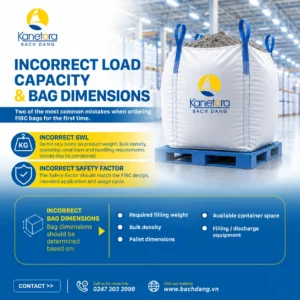
2. Confusing SWL with Maximum Breaking Capacity
SWL – Safe Working Load refers to the maximum safe working load specified for a particular FIBC design.
If a bag has:
SWL = 1,000 kg
this does not mean that it should be routinely filled with 1,100 or 1,200 kg simply because the bag may physically withstand more.
Likewise, a 5:1 Safety Factor does not mean that a 1,000 kg SWL bag may be used to carry 5,000 kg.
Safety Factor relates to the design and testing requirements of the FIBC. It is not the allowable filling weight during normal use.
Actual performance depends on the complete bag construction, including:
- body fabric;
- base fabric;
- lifting loops;
- seam construction;
- loop attachment;
- overall bag design;
- handling method;
- intended usage cycle.
Therefore, buyers should specify the required SWL and operating conditions, rather than simply asking for “thicker fabric” or “stronger loops.”
3. Choosing Bag Dimensions Before Calculating Bulk Density
Another common mistake is deciding the FIBC dimensions before determining the actual volume of the product.
A buyer may request:
90 × 90 × 120 cm – 1,000 kg.
But the key question is whether the product actually occupies the volume available in that bag.
As a basic calculation:
Required Volume ≈ Filling Weight / Bulk Density
The final FIBC dimensions should then be evaluated together with:
- actual filling level;
- expected bag bulging;
- pallet dimensions;
- container height;
- filling equipment;
- warehouse layout;
- stacking requirements.
For applications where warehouse and container space efficiency is important, a Baffle Jumbo Bag may be considered.
Baffle FIBCs use internal panels to reduce excessive bulging and help maintain a more square-shaped profile when filled.
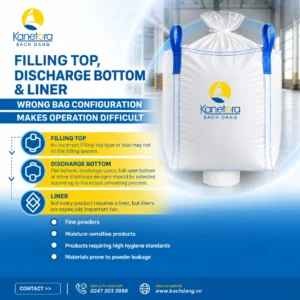
4. Selecting the Filling and Discharge Design Based Only on Appearance
FIBCs are available with many filling and discharge configurations.
Common Filling Options Include:
- Open Top;
- Duffle Top;
- Filling Spout;
- customized filling designs.
Common Discharge Options Include:
- Flat Bottom;
- Discharge Spout;
- Conical Discharge;
- Full Open Bottom;
- specialized closure systems.
However, no single design is suitable for every product or production line.
For example, if a factory uses a filling pipe, choosing an open-top bag may create more dust and reduce filling efficiency.
Similarly, if the filling spout diameter does not match the filling machine, operators may face significant difficulties during production.
For discharge systems, buyers should consider:
- whether the material flows freely;
- whether the product tends to bridge or compact;
- required discharge speed;
- hopper dimensions;
- operator access;
- discharge opening requirements.
Kanetora Bach Dang offers multiple filling and discharge configurations according to different applications. Its product range includes open-top, duffle-top, filling-spout, flat-bottom and multiple discharge designs. PROFILE 2025 PAKAGING 2-compres…
5. Assuming Coating and Inner Liner Are the Same
These two concepts are often confused.
Coating
Coating is applied to the woven polypropylene fabric surface.
Depending on the design, coating can help reduce powder leakage through the woven structure and improve protection against external conditions.
Inner Liner
An inner liner is a separate plastic film inserted inside the FIBC.
A liner may be required for applications involving:
- moisture protection;
- dust control;
- contamination control;
- improved product protection;
- electrostatic control in certain applications;
- enhanced barrier performance.
Kanetora Bach Dang provides a variety of liner solutions, including standard liners, tabbed liners, baffled liners, conductive liners, and aluminum barrier films. PROFILE 2025 PAKAGING 2-compres…
For plastic resin and moisture-sensitive materials, liner selection should be evaluated together with product characteristics, filling methods, and storage conditions.
6. Not Describing the Cargo Characteristics Clearly Enough
The term “powder” alone is not sufficient.
Different powders can behave very differently during filling, transportation, and discharge.
An FIBC manufacturer may need to know whether the cargo:
- is powder or granules;
- has fine or coarse particle size;
- has low or high bulk density;
- flows freely;
- absorbs moisture;
- creates dust;
- is corrosive;
- presents combustible dust risks;
- requires food-contact packaging;
- is classified as dangerous goods.
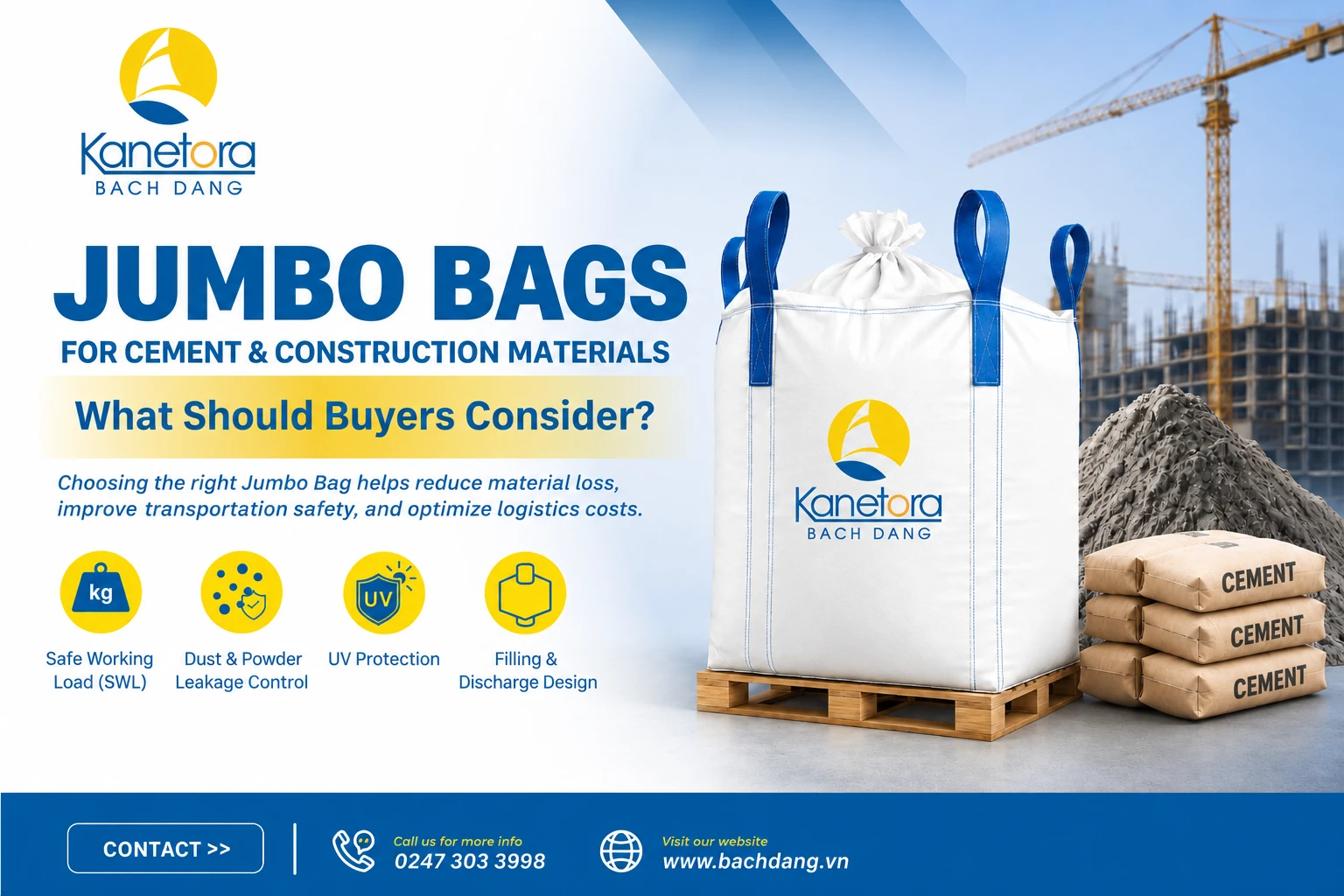
For example, cement and mineral powders may require additional attention to dust control, seam construction, coating, liners and discharge design.
You can read more in our article on Jumbo Bags for Cement and Construction Materials.
By comparison, plastic pellets may have good flow characteristics but may require different controls for moisture, cleanliness and liner performance.
The more accurately the cargo is described, the more accurately the FIBC can be specified.
7. Ignoring Electrostatic Risks
Electrostatic protection is particularly important in industries such as:
- chemicals;
- pharmaceuticals;
- plastic resins;
- industrial powders;
- food powders;
- environments containing flammable vapors or gases.
During filling and discharging, friction between the material, liner and bag surface can generate electrostatic charges.
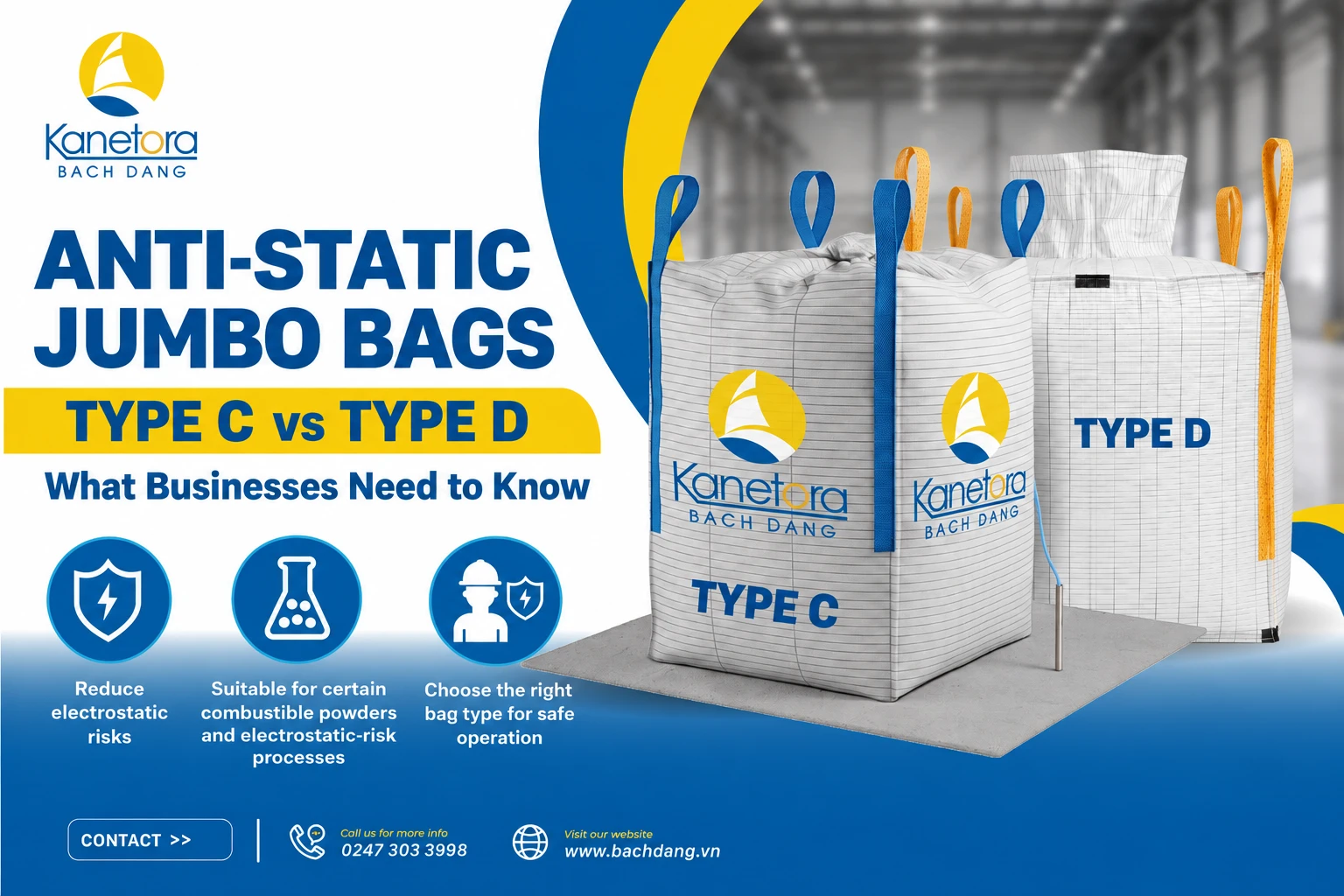
FIBCs are therefore classified into several electrostatic categories, commonly referred to as Type A, Type B, Type C and Type D.
In general:
Type C FIBCs use conductive construction and require proper grounding during use.
Type D FIBCs use static-protective materials designed to dissipate charge without being operated in the same way as a grounded Type C bag.
If there is a potential electrostatic hazard, buyers should not select the FIBC type based only on the cargo name.
Instead, information should be provided about:
- material characteristics;
- filling environment;
- discharge environment;
- combustible dust;
- flammable vapors;
- existing grounding systems.
Learn more in our guide to Type C vs Type D FIBC Bags.
8. Assuming Virgin Polypropylene Automatically Means Food Grade
This is another frequent misunderstanding.
Using 100% virgin polypropylene may be important for certain applications, but material selection alone does not define a complete food-grade packaging system.
FIBCs used for food ingredients may also require controls relating to:
- dust;
- loose threads;
- foreign materials;
- metal contamination;
- personnel hygiene;
- production environment;
- packing;
- traceability;
- warehousing.
You can find more information in our guide to Food Grade Jumbo Bags and Contamination Control.
Kanetora Bach Dang operates a combined QC and QA system across its manufacturing process, with in-process inspection and final quality assurance prior to shipment. Kanetora Bach Dang – Company In…
Therefore, when requesting Food Grade FIBCs, buyers should specify:
the product + destination market + contact application + required standards or documentation.
Simply requesting:
Virgin PP Food Grade Bag
may not provide enough information.
9. Assuming Dangerous Goods Only Require a “Stronger Bag”
Dangerous goods packaging requires a different approach.
If the cargo falls under UN dangerous goods packaging requirements, buyers need to determine the appropriate UN-approved FIBC design type.
Compliance cannot be determined simply by:
- fabric GSM;
- SWL;
- Safety Factor;
- or fabric thickness.
Depending on the bag construction, UN woven-plastic FIBCs may use design codes such as:
- 13H1;
- 13H2;
- 13H3;
- 13H4.
The exact design depends on the approved FIBC construction, including coating, liner configuration and tested design type.
If your cargo is classified as dangerous goods, provide the full product classification and packaging requirements to the manufacturer before requesting a quotation.
See more at UN Certified FIBC Bulk Bags.
10. Forgetting About Pallets, Containers and Loading Plans
A bag may perform perfectly during filling but still be inefficient during transportation.
Before finalizing dimensions, buyers should consider:
- whether pallets will be used;
- pallet dimensions;
- 20FT or 40FT container;
- number of bags per layer;
- number of layers;
- maximum loading height;
- lifting method;
- securing method;
- stacking requirements.
For export applications, bag dimensions should therefore be considered as part of the overall container loading plan, rather than as an isolated specification.
This is also one of the reasons Baffle FIBCs are frequently considered where reduced bulging and improved container space utilization are important.
11. Comparing Only the Price Per Bag
FIBC quotations can easily be compared incorrectly if they are based on different specifications.
A lower quotation may involve differences in:
- fabric GSM;
- dimensions;
- SWL;
- Safety Factor;
- coating;
- liner;
- printing;
- lifting loops;
- filling design;
- discharge design;
- sewing;
- packing;
- quality inspection.
A more reliable comparison should be based on:
Same Specification + Same Delivery Terms + Same Quality Requirements.
The lowest unit price does not always result in the lowest total packaging cost if the bag reduces filling efficiency, container utilization, or discharge performance.
12. Asking About MOQ Before Finalizing the Specification
MOQ is an important commercial factor, but it should not be the only question at the beginning of the sourcing process.
MOQ can vary depending on:
- bag construction;
- raw materials;
- fabric color;
- liner design;
- printing;
- accessories;
- customized manufacturing requirements;
- quantity per artwork or specification.
A more effective RFQ sequence is:
Cargo → Application → Specification → Quantity → Delivery Requirement → Quotation
Once the specification is clear, the manufacturer can determine a more realistic production plan and commercial quantity.
13. Failing to Check Artwork and Marking Before Mass Production
For export FIBCs, artwork is more than just a company logo.
Printed information may include:
- product name;
- net weight;
- gross weight;
- handling instructions;
- batch information;
- safety instructions;
- recycling marks;
- customer references;
- destination information;
- warnings;
- UN markings where applicable.
Even a small artwork error can affect the entire production batch.
Before mass production, a clear approval process should therefore be followed:
Artwork Approval → Sample/Specification Approval → Mass Production
For UN FIBCs in particular, markings must correspond to the approved design type. A standard industrial FIBC cannot become UN compliant simply by printing a UN symbol on the bag.
First-Time Jumbo Bag Ordering Checklist
Before sending your RFQ, you can use the following checklist:
PRODUCT INFORMATION
☐ Product name
☐ Powder / granules
☐ Bulk density
☐ Special product characteristics
FIBC SPECIFICATION
☐ Filling weight
☐ SWL
☐ Safety Factor
☐ Dimensions
☐ U-Panel / Circular / 4-Panel / Baffle
☐ Coated / Uncoated
☐ Inner liner
☐ Filling system
☐ Discharge system
☐ Lifting loops
☐ Printing
APPLICATION
☐ Filling method
☐ Discharge method
☐ Forklift / crane handling
☐ Pallet size
☐ Container type
☐ Storage conditions
☐ Outdoor exposure
COMPLIANCE
☐ Standard industrial FIBC
☐ Food Grade
☐ Type C / Type D
☐ UN Certified
☐ Required certificate / test report
COMMERCIAL INFORMATION
☐ Quantity
☐ Ordering frequency
☐ Destination
☐ Required delivery date
Custom Jumbo Bag & FIBC Manufacturer in Vietnam
Kanetora Bach Dang manufactures industrial packaging solutions including FIBC/Jumbo Bags, Block Bottom Valve Bags and multi-layer PE film.
Its reported production capacity for FIBC bags is approximately 300,000 pieces per month. Kanetora Bach Dang – Company In…
The factory operates a standardized FIBC production process covering extrusion, belt weaving, fabric weaving, coating, cutting and printing, sewing, inspection and packing. Kanetora Bach Dang – Company In…
Available FIBC solutions include:
- U-Panel FIBC;
- Circular/Tubular FIBC;
- 4-Panel FIBC;
- Baffle Bags;
- Food Grade FIBC;
- FIBC with inner liner;
- Type A/B/C/D FIBC;
- UN Certified FIBC;
- Sling Big Bags;
- customized filling and discharge configurations.
Explore the full FIBC & Jumbo Bag product range.
FAQ – Common Questions About Ordering Jumbo Bags
What information is needed to quote a Jumbo Bag?
At minimum, buyers should provide the product type, bulk density, filling weight, required SWL, preferred dimensions, filling and discharge configuration, liner or coating requirements, lifting method, quantity and destination market.
Is there a standard size for a 1-ton Jumbo Bag?
No. There is no single standard dimension suitable for every 1,000 kg application.
The correct size depends on the product bulk density, filling level, pallet dimensions, container layout and desired filled-bag shape.
Does a 5:1 Safety Factor mean a 1-ton bag can carry 5 tons?
No.
The Safety Factor relates to the design and testing requirements of the FIBC. The bag should still be used within its specified Safe Working Load.
Does every FIBC need an inner liner?
No.
A liner is selected according to the cargo and required protection against moisture, dust, contamination, electrostatic risks, or other environmental factors.
Are Baffle Bags stronger than standard FIBCs?
Not necessarily.
Baffles are mainly used to control bag shape and reduce bulging. Load-bearing performance depends on the complete FIBC design, not only the presence of internal baffles.
Is virgin polypropylene enough to make an FIBC Food Grade?
No.
Virgin PP may be part of the material requirement, but food-contact applications may also require suitable production hygiene, contamination control, traceability and quality management systems.
Can Jumbo Bags be manufactured in custom dimensions?
Yes.
Dimensions, bag construction, filling system, discharge design, liner, coating, lifting loops and printing can be customized according to the application, subject to technical and manufacturing requirements.
Conclusion
The biggest mistake when ordering Jumbo Bags for the first time is not choosing the wrong dimension or filling spout.
It is treating FIBC as a standardized product that can be selected only by nominal loading capacity.
A proper specification should begin with:
What is the cargo? → What is its bulk density? → How much will be filled? → How will it be filled? → How will it be discharged? → How will the bag be handled and transported? → What protection or compliance requirements apply? → Then determine the appropriate FIBC design.
When these questions are clarified from the beginning, the manufacturer can recommend a more suitable bag structure, reduce unnecessary sample revisions and help improve both packaging cost and operational efficiency.
Kanetora Bach Dang provides custom FIBC/Jumbo Bag solutions for food ingredients, plastic resins, chemicals, minerals, construction materials and other industrial applications for both domestic and export markets.