

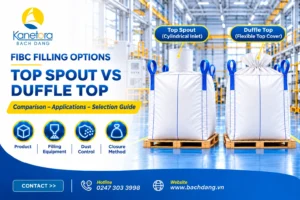
Choosing the right FIBC filling option is essential for efficient bulk material handling, dust control, and compatibility with industrial filling equipment. Among the most common configurations are Top Spout (Filling Spout), Duffle Top (Skirt Top), and customized top closures. Each offers different advantages depending on the material, filling process, and operational requirements.
A Top Spout FIBC is generally well suited to filling systems equipped with dedicated filling heads, particularly for powders and granular materials. A Duffle Top FIBC provides a wider opening and greater flexibility for manual or semi-automatic filling operations. Customized top closures may be considered when specific covering, sealing, or handling requirements apply.
However, there is no single filling configuration suitable for every application. The correct choice depends on material characteristics, bulk density, filling equipment, dust generation, hygiene requirements, and storage conditions.
This guide explains the differences between FIBC filling options, their applications, and the technical factors industrial buyers should evaluate before selecting a bulk bag.
1. What Are FIBC Filling Options, and Why Do They Matter?
A Flexible Intermediate Bulk Container (FIBC), commonly known as a Jumbo Bag or Bulk Bag, is an industrial packaging solution designed for storing, handling, and transporting dry bulk materials.
FIBCs are widely used in industries such as agriculture, food processing, chemicals, plastics, minerals, and construction materials.
While bag construction, lifting loops, and discharge systems are essential considerations, the filling top plays an equally important role in packaging efficiency.
A properly designed FIBC filling system can help manufacturers:
- Improve compatibility with existing filling equipment.
- Reduce material loss during filling operations.
- Limit dust emissions when integrated with suitable dust extraction systems.
- Support hygiene and contamination-control procedures.
- Simplify filling, closing, and handling operations.
- Maintain consistent packaging performance across production batches.
Conversely, an unsuitable filling-top design may cause equipment incompatibility, slow filling rates, excessive dust generation, or difficulties securing the bag after filling.
For this reason, FIBC filling options should be evaluated during the initial packaging design stage rather than selected solely on appearance or cost.
2. Top Spout FIBC: Designed for Controlled Bulk Filling
2.1. What Is a Top Spout FIBC?
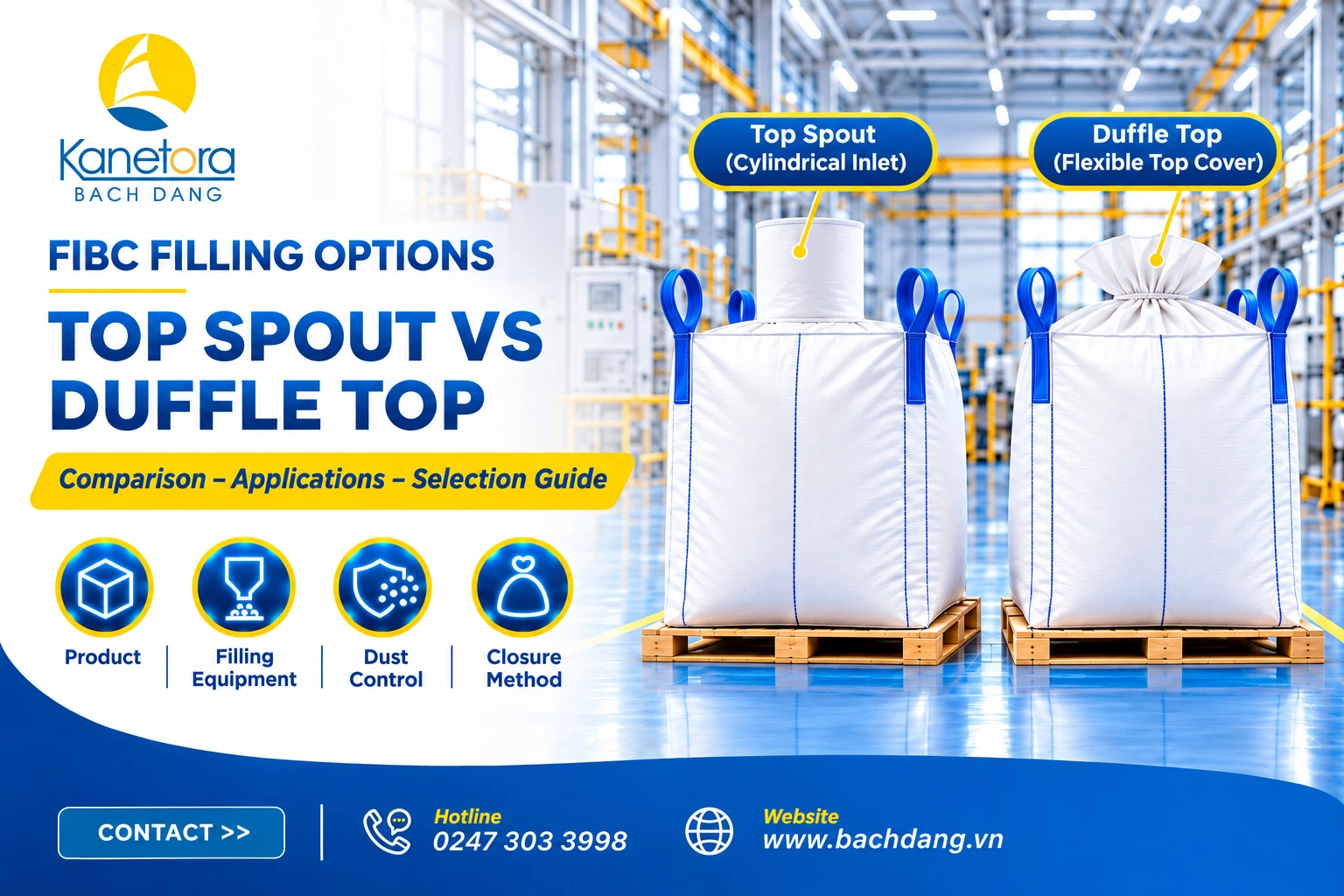
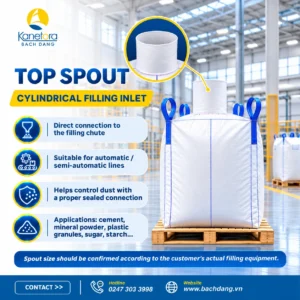
A Top Spout FIBC, also known as a Filling Spout FIBC or Inlet Spout Bulk Bag, features a cylindrical fabric inlet sewn into the top panel of the bag.
The filling spout allows the bag to connect to a filling chute or dedicated filling head, directing material into the container through a controlled opening.
This configuration is commonly used in industrial packaging lines equipped with gravity-feed hoppers, auger feeders, or automated weighing and filling systems.
2.2. Advantages of Top Spout FIBCs
Compatibility with automated filling equipment
Top Spout bags can be manufactured with customized inlet diameters and spout lengths to match specific filling machines.
When properly secured to a suitable clamping mechanism, the spout provides a stable connection during the filling process.
Improved dust-control potential
For fine powders, connecting the filling spout to a properly designed filling head and dust extraction system can help reduce airborne particles compared with unrestricted open-top filling.
However, a Top Spout alone does not guarantee dust-free operation.
Effective dust control depends on the connection between the bag and equipment, ventilation, fabric construction, seam design, and material behavior.
Convenient closing after filling
Once the required filling weight has been reached, the filling spout can be tied or secured using the specified closure method.
Where an inner liner is installed, its closure arrangement should be designed and evaluated separately.
2.3. Technical Considerations for Top Spout FIBCs
Industrial buyers should consider several factors when specifying a filling spout.
Spout diameter: The inlet diameter must accommodate the filling head and required material flow rate.
Spout length: Sufficient length is needed for secure attachment, clamping, and closing.
Fabric construction: Coated or uncoated polypropylene fabric should be selected according to product properties and operational requirements.
Dust extraction: Fine-powder applications may require integrated dust collection and controlled air evacuation.
Inner liner compatibility: Where a liner is used, its filling inlet and attachment method must align with the outer bag design.
Top Spout FIBCs are particularly suitable for applications involving cement, mineral powders, plastic granules, sugar, starch, and other materials filled through dedicated equipment.
For a more detailed discussion of packaging requirements for fine powders and heavy materials, see Jumbo Bags for Cement and Construction Materials.
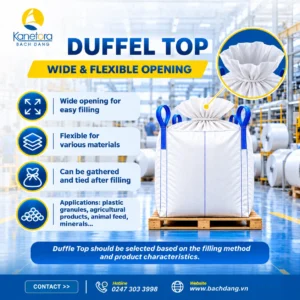
3. Duffle Top FIBC: Flexible Filling for Different Bulk Materials
3.1. What Is a Duffle Top FIBC?
A Duffle Top FIBC, also known as a Skirt Top Bulk Bag, features an extended fabric skirt sewn around the upper opening of the bag.
During filling, the skirt can be opened to provide a relatively large access area.
After filling, the fabric can be gathered and tied to cover the contents.
Duffle Top bags are commonly used for bulk materials requiring flexible filling procedures or wider access to the bag opening.
3.2. Advantages of Duffle Top FIBCs
Wide filling access
The larger opening allows materials to be introduced without necessarily requiring a dedicated cylindrical filling connection.
This can be useful for manual, semi-automatic, or certain gravity-feed filling operations.
Flexibility across different materials
Duffle Top FIBCs can accommodate various dry bulk materials, including plastic pellets, agricultural products, animal feed, minerals, and granular chemicals.
Practical closing arrangement
After filling, the extended fabric skirt can be gathered and secured using the appropriate ties.
This provides a practical covering solution for storage and handling.
The actual degree of dust, moisture, and contamination protection depends on the closing method, fabric construction, coating, and whether an inner liner is used.
3.3. Limitations of Duffle Top FIBCs
Although Duffle Top bags offer operational flexibility, they may be less suitable for tightly connected powder-filling systems.
Compared with a properly fitted Top Spout, creating an enclosed filling connection can be more challenging.
Closing the skirt may also involve additional manual handling.
For moisture-sensitive or contamination-sensitive materials, additional protective measures may be necessary.
Kanetora Bach Dang manufactures Duffle Top FIBC Bulk Bags with customizable dimensions, fabric specifications, lifting configurations, and discharge options.
4. Custom FIBC Top Closures: When Is a Specialized Design Necessary?
In industrial packaging, the terms top cover, top closure, and customized filling top may describe different configurations depending on the manufacturer.
These should not automatically be treated as standardized FIBC categories.
A custom top closure may incorporate a flat covering panel, securing straps, hook-and-loop fasteners, or another engineered closing arrangement.
Such designs are generally considered when customers require a particular opening or closing procedure.
Applications for Customized Top Closures
Customized designs may be appropriate when:
- Standard filling tops do not fit the production equipment.
- Operators require a specialized opening and closing procedure.
- The filling process involves nonstandard equipment geometry.
- Additional product covering is needed during handling.
- The customer has specific packaging or operational requirements.
However, a customized top cover does not automatically provide airtight sealing, complete moisture protection, or food-grade compliance.
These characteristics depend on the complete packaging design, selected materials, sealing methods, and applicable testing requirements.
For food-sensitive applications, additional considerations are discussed in Food-Grade Jumbo Bags: Hygiene Requirements and Contamination Control.
5. Top Spout vs Duffle Top vs Custom Top Closure: Key Differences
Choosing the correct filling top requires understanding how each configuration performs in practice.
| Criteria | Top Spout | Duffle Top | Custom Top Closure |
|---|---|---|---|
| Construction | Cylindrical filling inlet | Extended fabric skirt | Application-specific design |
| Filling opening | Concentrated inlet | Wide opening | Customized |
| Automated filling | Suitable with matching equipment | Equipment-dependent | Design-dependent |
| Dust control | Advantage with an enclosed connection | Additional measures may be needed | Requires evaluation |
| Manual filling | Equipment-dependent | Generally flexible | Depends on design |
| Closing method | Tie or specified closure | Gather and tie skirt | Customized |
| Typical materials | Powders and granules | Granules, agricultural products, bulk solids | Specialized applications |
| Inner liner compatibility | Available | Available | Subject to design |
| Customization | Diameter and length | Skirt dimensions and ties | Application-specific |
Important: This comparison provides general selection guidance rather than guaranteed performance specifications. Actual results depend on filling equipment, material properties, bag construction, and operating conditions.
6. Choosing FIBC Filling Options Based on Material and Production Line
6.1. Cement, Limestone Powder, and Fine Minerals
Fine mineral powders can generate significant dust during filling and handling.
For facilities equipped with tubular filling heads, Top Spout FIBCs are often a practical choice.
A properly designed filling connection can help limit dust escape when used with suitable extraction and ventilation systems.
Additional considerations include:
- Fabric coating and seam construction.
- Dust leakage through stitch holes.
- Inner liner requirements.
- Controlled air evacuation.
- Filling speed and pressure management.
- Moisture protection during storage.
For heavy mineral products, the selected filling configuration must also be compatible with the bag’s Safe Working Load (SWL) and overall structural design.
6.2. PP and PE Plastic Granules
Plastic resin manufacturers and distributors commonly use FIBCs for transporting polypropylene (PP), polyethylene (PE), and other polymer granules.
Both Top Spout and Duffle Top designs may be suitable.
For automated weighing and filling systems, Top Spout bags can provide convenient equipment connections.
For flexible filling operations or facilities without dedicated spout-clamping equipment, Duffle Top bags may offer greater operational adaptability.
Static electricity, material cleanliness, moisture exposure, and discharge performance should also be considered.
6.3. Agricultural Products and Animal Feed
Agricultural bulk materials include rice, grains, seeds, feed ingredients, and other dry products.
Duffle Top bags can be useful where wide filling access is required.
Top Spout bags may be preferable when filling is performed through controlled feeding equipment.
However, packaging requirements vary considerably between agricultural products.
Some materials require moisture barriers, while others need appropriate ventilation to maintain product quality.
The selection should reflect the material’s actual storage and handling conditions.
6.4. Sugar, Starch, and Food Ingredients
Food ingredients may require strict hygiene controls during filling, storage, and transportation.
Top Spout FIBCs can support controlled filling when compatible with dedicated equipment.
However, selecting a filling spout is only one part of food-grade packaging design.
Other relevant considerations include:
- Suitable food-contact materials.
- Manufacturing hygiene.
- Contamination prevention.
- Inner liner compatibility.
- Cleaning and inspection procedures.
- Traceability and documented quality control.
At Kanetora Bach Dang, food-grade packaging solutions are supported by manufacturing quality systems and product-specific testing requirements.
Food-contact suitability must be evaluated against the intended application and relevant documentation rather than assumed from the bag’s top design.
6.5. Chemical Powders and Electrostatic-Sensitive Materials
Filling chemical powders or granules can generate electrostatic charges as materials move through equipment and packaging.
For operations involving potentially flammable dusts, gases, or vapors, electrostatic risk must be assessed before selecting an FIBC.
A Top Spout or Duffle Top does not independently determine whether an FIBC is electrostatically safe.
The selection must consider the FIBC classification, liner properties, electrostatic protection method, filling equipment, and operating environment.
For example, Type C FIBCs require correct grounding as part of their electrostatic protection system, while Type D FIBCs use a different charge-dissipation mechanism and must be used according to their design and certification requirements.
For chemical packaging configurations, explore FIBC Bags for Chemical Products.
For dangerous goods subject to applicable transport regulations, the complete packaging design must comply with the relevant approved UN specification where required.
Learn more about UN Certified FIBC Bulk Bags.
7. Filling Spout Dimensions and Technical Specifications
A suitable FIBC filling top must be engineered around the customer’s filling system.
Filling Spout Diameter
The filling inlet should be compatible with the diameter of the machine’s filling head.
An undersized spout may restrict material flow or create equipment compatibility issues.
An oversized spout may be difficult to secure effectively, potentially increasing the risk of dust leakage around the filling connection.
The correct dimensions should therefore be established using actual equipment measurements.
Filling Spout Length
Spout length affects the ability to attach, clamp, and close the filling inlet.
It should be sufficient for the intended connection and closure arrangement while remaining compatible with the available filling height.
Fabric and Seam Construction
The filling spout and its connection to the upper bag panel should be designed to withstand expected handling forces.
Fabric weight, coating, stitching, reinforcement, and manufacturing tolerances should be specified according to the application.
Air Evacuation During Filling
As bulk material enters an FIBC, displaced air must be managed appropriately.
This is particularly important for high-speed filling processes and fine powders.
An inadequately ventilated filling system may lead to pressure buildup, filling instability, or uncontrolled dust release.
Closing and Sealing Method
The specification should clarify how the filling top will be closed after filling.
Where an inner liner is installed, the liner’s closing or sealing method must also be defined.
For export applications, the closure arrangement should be suitable for the expected handling, warehousing, transportation, and product protection requirements.
8. Dust Control During FIBC Filling: More Than Just the Filling Top
A common misconception is that selecting a Top Spout or coated FIBC fabric automatically creates a dust-free filling system.
In practice, dust management depends on the interaction between the bag and the filling equipment.
Filling-head connection
The filling spout must fit the equipment and provide an appropriate connection to minimize uncontrolled gaps.
Dust extraction and ventilation
The system should manage airborne particles and displaced air during filling.
Fabric coating and seam design
Coated fabric can reduce particle movement through the woven structure, but seams and stitch holes may still require special attention.
Inner liner construction
A suitable liner may provide an additional barrier against dust and moisture. Its performance depends on material selection, positioning, attachment, and closure.
Filling speed
The filling rate should be compatible with material flow properties, equipment capacity, and air evacuation requirements.
Therefore, effective dust control should be approached as a coordinated system:
FIBC Construction + Filling Equipment + Dust Extraction + Air Management + Closure Method
The most appropriate solution is not necessarily the most complex bag, but the design that meets the actual operational requirements.
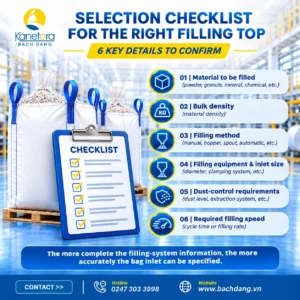
9. FIBC Filling Selection Checklist for Industrial Buyers
Before requesting a quotation, buyers should prepare a clear technical specification.
| Requirement | Information to Confirm |
|---|---|
| Bulk material | Powder, granule, pellet, mineral, food ingredient, chemical |
| Bulk density | Material density under relevant handling conditions |
| Filling weight | Target weight per bag |
| Safe Working Load | Required SWL and applicable safety factor |
| Filling equipment | Manual, hopper, gravity-feed, auger, automated system |
| Filling-head size | Diameter and clamping arrangement |
| Filling capacity | Expected filling rate or cycle time |
| Dust generation | Material dust characteristics and control requirements |
| Filling top | Top Spout, Duffle Top, or custom design |
| Closure method | Ties, liner closure, sealing arrangement |
| Fabric | Coated or uncoated woven polypropylene |
| Inner liner | Required material and construction |
| Discharge system | Flat bottom, discharge spout, or custom outlet |
| Special requirements | Food-contact, electrostatic protection, or UN approval where applicable |
| Destination market | Applicable documentation and product requirements |
For reliable packaging performance, the filling-top design should be considered alongside the complete FIBC construction.
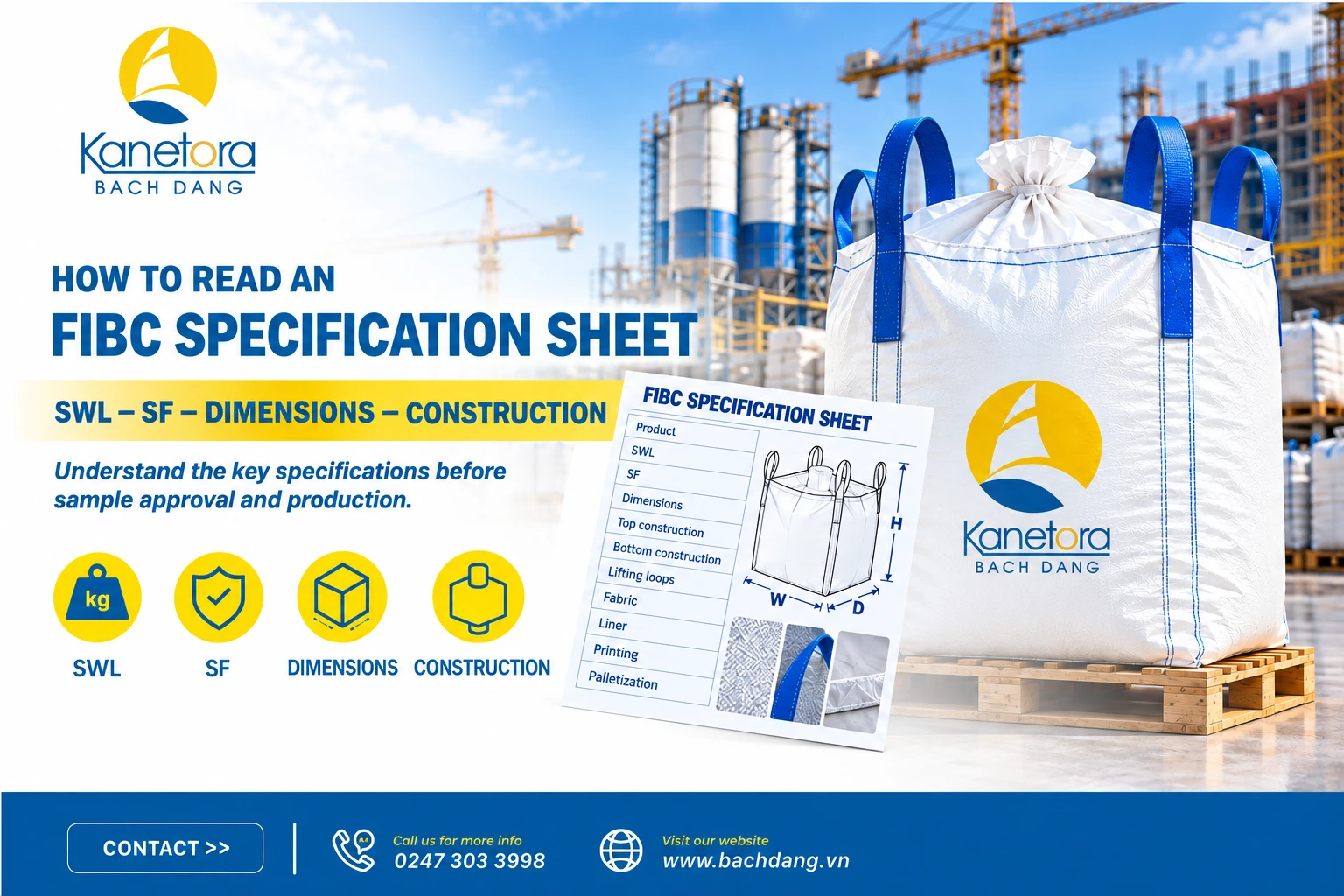
The bag’s SWL is determined by the approved design and load-bearing performance of the complete packaging system, not solely by fabric weight or filling-spout dimensions.
10. Custom FIBC Filling Solutions from Kanetora Bach Dang, Vietnam
Kanetora Bach Dang Joint Stock Company is an industrial packaging manufacturer based in Cau Mai, My Loc Ward, Ninh Binh Province, Vietnam.
As part of the Kanetora Group’s packaging manufacturing operations, the facility produces FIBC/Jumbo Bags and other industrial packaging solutions for domestic and international customers.
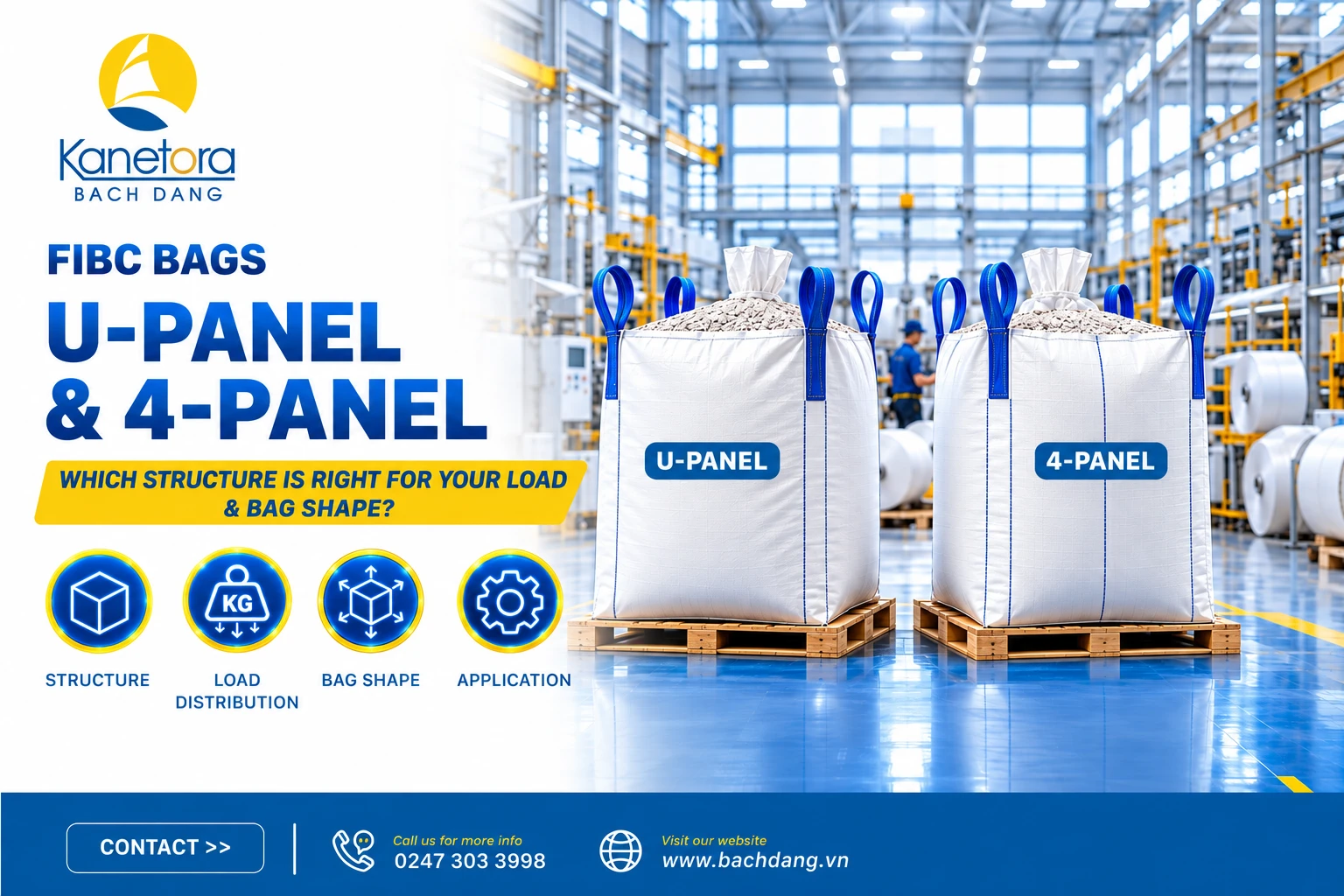
With a stated production capacity of approximately 300,000 FIBC bags per month, Kanetora Bach Dang supports different bag constructions, including U-Panel, 4-Panel, Circular, and Baffle designs.
Customized Filling Tops for Industrial Applications
Depending on customer requirements, available configurations include:
- Top Spout and Duffle Top filling options.
- Customized inlet diameters and spout lengths.
- Different bag dimensions and lifting arrangements.
- Coated and uncoated polypropylene fabrics.
- Optional inner liners.
- Flat-bottom and discharge-spout configurations.
- Application-specific closing and handling solutions.
Each design can be evaluated against the customer’s material characteristics, filling equipment, load requirements, and intended use.
Integrated Manufacturing Capabilities
Kanetora Bach Dang operates an integrated FIBC manufacturing process covering:
- Polypropylene yarn extrusion.
- Webbing production.
- Woven fabric manufacturing.
- Fabric coating.
- Cutting and printing.
- Sewing and assembly.
- Quality inspection.
- Final packing.
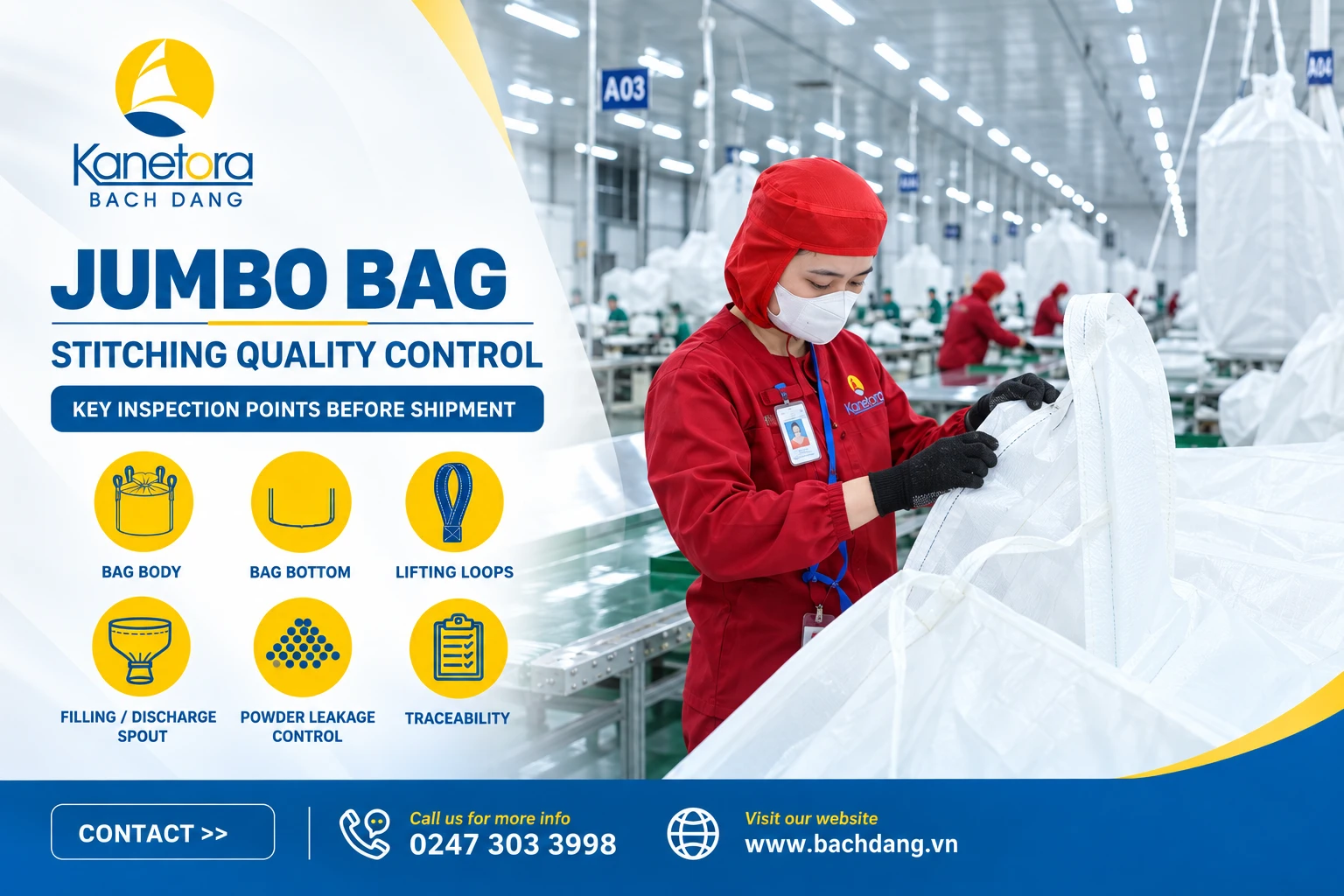
The factory also operates dedicated quality-control and quality-assurance procedures, including in-process inspection and final product verification.
Its documented management systems include ISO 9001:2015 and ISO 14001:2015, supporting consistent manufacturing and environmental management practices.
With direct production capabilities, Kanetora Bach Dang can work with customers to develop technical specifications for filling efficiency, product protection, material handling, and export requirements.
11. Frequently Asked Questions About FIBC Filling Options
What is the difference between Top Spout and Duffle Top FIBC bags?
A Top Spout FIBC has a cylindrical inlet designed to connect with compatible filling equipment. A Duffle Top FIBC uses a wide fabric skirt that can be opened during filling and gathered for closing afterward. Top Spout designs are often preferred for controlled equipment-based filling, while Duffle Top designs provide more flexible access.
Which FIBC filling top is best for fine powders?
A Top Spout is often suitable for fine powders filled through dedicated equipment, especially when dust extraction is required. However, dust-control performance also depends on the equipment connection, air evacuation, fabric, seams, and liner design.
Are Duffle Top FIBC bags dustproof and waterproof?
Not necessarily. A Duffle Top can provide a practical cover after filling, but it does not automatically create a dustproof or waterproof seal. Additional coating, liner, and closure specifications may be required.
Can FIBC bags with inner liners use Top Spout or Duffle Top designs?
Yes. Both configurations can be manufactured with suitable inner liners. The correct arrangement depends on the filling equipment, liner attachment method, closing system, and product protection requirements.
Are Top Spout FIBCs suitable for automated filling systems?
Yes. Top Spout bags are commonly used with automated and semi-automated filling equipment. The spout diameter, length, and attachment mechanism must match the filling system.
Can Kanetora Bach Dang manufacture customized FIBC filling tops?
Yes. Kanetora Bach Dang offers customized FIBC configurations based on technical requirements, including filling-top dimensions, bag construction, safe working load, liners, discharge systems, and other application-specific specifications.
12. Conclusion: Select the Right FIBC Filling Top for Better Packaging Performance
Top Spout, Duffle Top, and customized top closures serve different industrial packaging requirements.
Top Spout FIBCs are generally suited to controlled filling through dedicated equipment. Duffle Top FIBCs provide wide filling access and flexible closing arrangements. Customized top closures address specific operational needs that standard configurations may not accommodate.
The most effective choice depends on more than the filling opening itself.
Bulk material properties, equipment compatibility, filling speed, dust control, hygiene, discharge requirements, and transportation conditions must all be considered.
Selecting the appropriate FIBC filling design at the specification stage can help improve packaging efficiency, reduce avoidable handling problems, and support consistent product protection throughout the supply chain.
As a direct FIBC manufacturer in Vietnam, Kanetora Bach Dang works with industrial customers to develop customized bulk packaging solutions based on real production and handling requirements.
Looking for customized FIBC/Jumbo Bags for your filling line?
Contact Kanetora Bach Dang to discuss your material specifications, filling equipment, bag construction, and packaging requirements.
KANETORA BACH DANG JOINT STOCK COMPANY
- Website: https://bachdang.vn
- Email: info@kanetora.vn
- Hotline: +84 (0) 247 303 3998
- Factory: Cau Mai, My Loc Ward, Ninh Binh Province, Vietnam.
Committed Production – Outstanding Quality.