

When purchasing Flexible Intermediate Bulk Containers (FIBCs), commonly known as Jumbo Bags or Bulk Bags, many buyers initially focus on three factors: load capacity, bag dimensions and price.
However, a comprehensive FIBC specification sheet covers much more than these basic parameters. It defines the bag’s structural design, fabric specifications, lifting system, filling and discharge options, inner liner, dimensional tolerances, stitching requirements and quality control criteria.
Misinterpreting even one technical parameter may result in a bag that meets the stated purchase specifications but is unsuitable for the customer’s filling equipment, forklifts, pallets, storage facilities or container-loading operations.
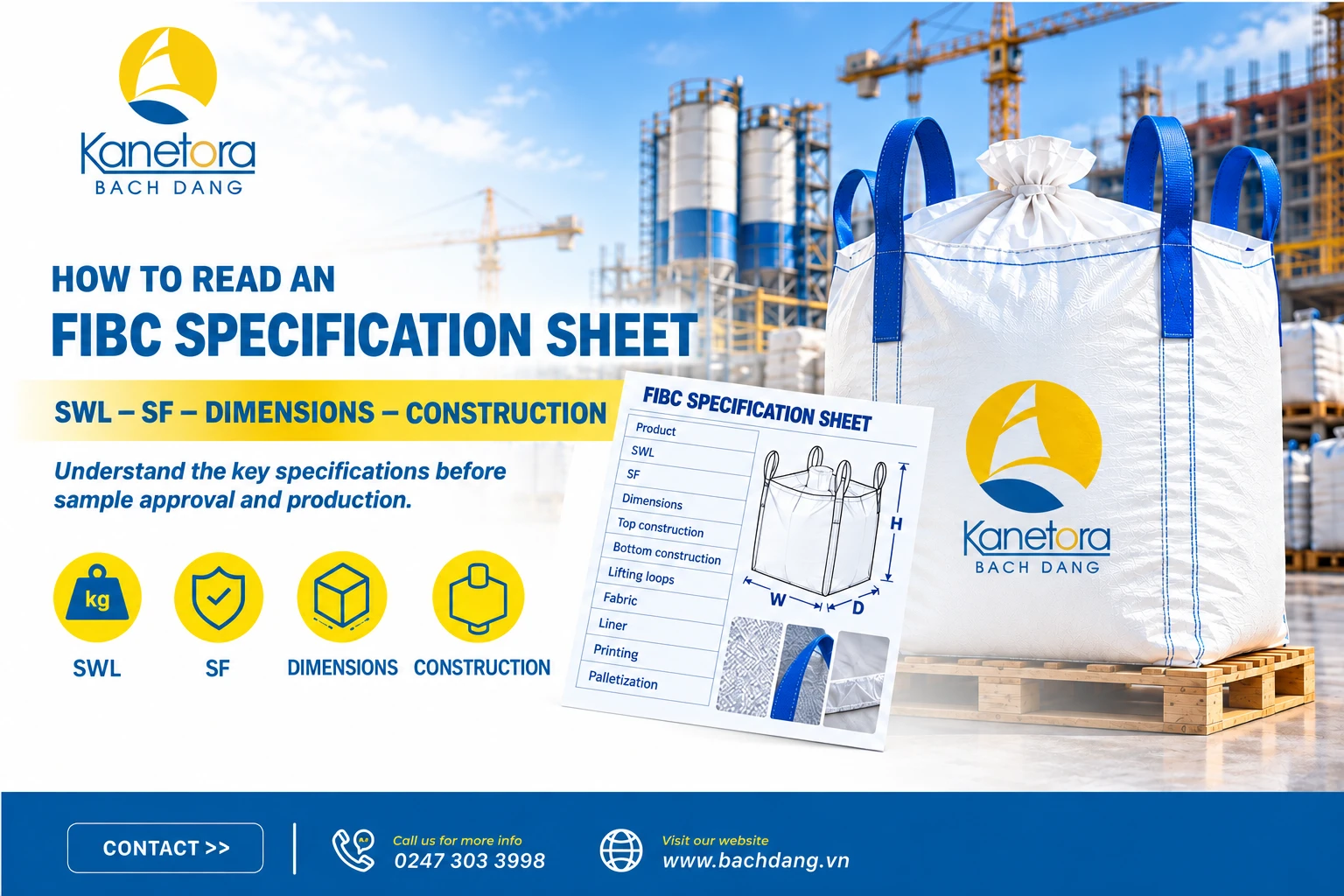
In this guide, Kanetora Bach Dang, a direct FIBC manufacturer in Vietnam, explains how to interpret an FIBC specification sheet, understand essential technical parameters and verify critical requirements before approving production.
1. What Is an FIBC Specification Sheet?
An FIBC specification sheet is a technical document that defines the design, materials, construction, performance requirements and intended application of a specific bulk bag.
It serves as a common reference between the buyer and manufacturer throughout product design, material selection, sample development, quality inspection and final acceptance.
A complete FIBC specification sheet typically includes:
-
Product information and cargo characteristics.
-
Safe Working Load (SWL) and Safety Factor (SF).
-
Bag dimensions and dimensional tolerances.
-
Bag construction and fabric specifications.
-
Filling and discharge configurations.
-
Lifting loop design and webbing specifications.
-
Inner liner requirements.
-
Stitching, printing, labels and accessories.
-
Applicable standards and testing requirements.
Two FIBCs with identical SWL ratings may require entirely different constructions depending on the cargo characteristics and operating conditions.
Essential FIBC Specifications at a Glance
| Parameter | Meaning | What to Verify |
|---|---|---|
| SWL | Safe Working Load | Maximum rated working load |
| SF | Safety Factor | Safety classification of the design |
| Dimensions | Length × Width × Height | Suitability for cargo and equipment |
| Tolerance | Permitted dimensional variation | Acceptable manufacturing limits |
| Construction | Bag body design | U-Panel, Circular, 4-Panel, Baffle |
| Fabric | Material and fabric weight | PP woven fabric, GSM, coating |
| Top | Filling configuration | Open Top, Duffle Top, Filling Spout |
| Bottom | Discharge configuration | Flat Bottom, Discharge Spout |
| Lifting Loops | Lifting system | Loop type, width and height |
| Inner Liner | Internal protective layer | Material, thickness and fixing method |
2. What Does SWL Mean on an FIBC Specification Sheet?
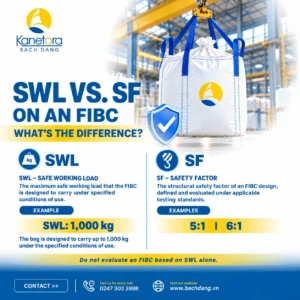
SWL (Safe Working Load) is the maximum working load assigned to an FIBC design under its specified conditions of use.
For example:
SWL: 1,000 kg
This indicates that the FIBC is designed and rated to carry a maximum working load of 1,000 kg when used according to the approved specification and handling instructions.
It does not mean the bag can safely carry 1,200 kg or 1,500 kg simply because no visible tearing or deformation occurs during an informal trial.
An FIBC’s load-bearing performance depends on multiple interconnected components:
-
Tensile strength of the PP woven fabric.
-
Body and bottom construction.
-
Lifting loop strength.
-
Loop attachment areas.
-
Stitching strength.
-
Overall structural integrity.
-
Lifting methods and operating conditions.
Therefore, SWL represents the rated working load, not the breaking load of the bag.
For a more detailed explanation, read our article on FIBC Load Testing: SWL, Safety Factor and Top Lift Test.
3. What Do FIBC Safety Factors of 5:1 and 6:1 Mean?
SF (Safety Factor) represents the safety ratio associated with an FIBC’s structural design and applicable testing requirements.
Two commonly specified safety factors are:
SF 5:1: Commonly associated with single-trip FIBC designs under applicable standards and operating conditions.
SF 6:1: Commonly associated with multi-trip FIBC designs that meet additional performance and handling requirements.
However, an FIBC marked with a 6:1 safety factor is not automatically suitable for unrestricted reuse. Reuse depends on the approved design, inspection procedures, bag condition and established operating controls.
Example: Understanding SWL and SF Together
Consider an FIBC specification indicating:
SWL: 1,000 kg
SF: 5:1
This does not authorize the user to fill the bag with 5,000 kg of material.
The safety factor relates to the bag’s structural performance and testing criteria. The maximum rated working load remains 1,000 kg.
During lifting-strength evaluation, the test loads, procedures and acceptance criteria are determined by the applicable standards. Multiplying SWL by the safety factor alone does not describe the complete testing requirements.
Key takeaway: SWL defines the permitted working load, while SF relates to the structural safety performance required for the design. Both values must be considered together.
4. How to Read FIBC Dimensions
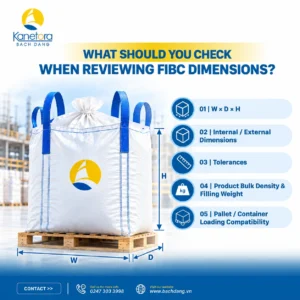
FIBC dimensions are commonly presented as:
Length × Width × Height
For example:
90 × 90 × 120 cm
This indicates:
-
Length: 90 cm.
-
Width: 90 cm.
-
Body height: 120 cm.
If the nominal body is treated as a rectangular box, its theoretical geometric volume is approximately 0.972 m³.
However, this figure is only a reference. Actual filling capacity depends on bag construction, bulging, fill level and the physical properties of the material.
Why Can Two 1,000 kg FIBCs Have Different Dimensions?
One of the main reasons is bulk density.
Bulk density refers to the mass of a bulk material per unit volume, including the spaces between particles.
Consider the following illustrative examples:
| Example Material | Bulk Density | Theoretical Volume for 1,000 kg |
|---|---|---|
| Material A | 500 kg/m³ | 2.00 m³ |
| Material B | 800 kg/m³ | 1.25 m³ |
| Material C | 1,200 kg/m³ | 0.83 m³ |
These are hypothetical values used to explain the calculation, not fixed specifications for particular materials.
The basic calculation is:
Where:
-
V = Required material volume (m³).
-
m = Material mass (kg).
-
ρ = Bulk density (kg/m³).
A lower-density product requires more volume to accommodate the same weight.
In practice, bag dimensions must also account for filling height, pallet dimensions, forklift accessibility, warehouse constraints and container-loading arrangements.
Therefore, there is no universal dimension suitable for every 1,000 kg Jumbo Bag application.
5. What Are FIBC Dimensional Tolerances?
Dimensional tolerance is the permitted variation between the nominal dimensions stated in the specification and the actual measurements of the finished bag.
During FIBC manufacturing, dimensions may vary as a result of fabric weaving, coating, cutting, sewing and the physical characteristics of polypropylene materials.
Example of Dimensional Tolerance
Suppose an FIBC has a nominal body height of:
120 cm
If the buyer and manufacturer agree on a tolerance of:
±2 cm
The accepted body-height range would be:
118–122 cm, provided that the agreed measurement method and acceptance conditions are applied.
This is an illustrative example only. A tolerance of ±2 cm is not a universal requirement for all FIBC designs.
Why Are Dimensional Tolerances Important?
Dimensional tolerances can directly affect compatibility with:
-
Automated filling equipment.
-
Pallet configurations.
-
Container-loading layouts.
-
Warehouse height restrictions.
-
Specialized lifting and discharge systems.
In addition to length, width and height, buyers may need to specify tolerances for filling spout diameter, discharge spout length and lifting loop height.
It is also important to distinguish between empty-bag dimensions and filled-bag dimensions.
Because FIBCs are manufactured from flexible woven materials, their external dimensions and shape may change after filling.
For operations requiring a more consistent square footprint, Baffle FIBC Bags may help reduce bulging and improve space utilization.
6. Understanding Different FIBC Body Constructions
Bag construction determines how the woven fabric panels are assembled and influences the bag’s shape, structural behavior and suitability for different applications.
Four common constructions include U-Panel, Circular, 4-Panel and Baffle FIBCs.
U-Panel FIBC
A U-Panel FIBC uses one large U-shaped fabric panel to form the bottom and two opposite sides, combined with two additional side panels.
This construction provides flexibility for various industrial packaging applications and can be customized with different filling, discharge and lifting options.
Circular or Tubular FIBC
A Circular FIBC is manufactured using continuously woven tubular fabric.
Unlike conventional 4-Panel construction, it does not require longitudinal body seams to join separate side panels.
Circular FIBCs are commonly used for powders, granules and other industrial bulk materials.
4-Panel FIBC
A 4-Panel FIBC consists of four separate side panels joined together and connected to a bottom panel.
This design offers flexibility in adjusting bag dimensions and incorporating various top and bottom configurations.
Baffle FIBC
A Baffle FIBC incorporates internal fabric baffles, generally positioned near the corners, to reduce outward bulging after filling.
This construction is particularly suitable for applications where maintaining a more rectangular shape can improve palletization, warehouse utilization or container loading.
| Construction | Main Feature | Typical Applications |
|---|---|---|
| U-Panel | U-shaped body panel with two side panels | General industrial bulk packaging |
| Circular | Tubular woven body | Powders, pellets and granules |
| 4-Panel | Four side panels with a separate bottom | Customized bulk packaging |
| Baffle | Internal anti-bulging panels | Warehouse and container optimization |
The most suitable construction should be selected according to product properties and handling requirements, rather than assuming one design is universally stronger than another.
7. What Does GSM Mean in FIBC Fabric Specifications?
GSM stands for grams per square meter and indicates the mass of fabric per unit area.
For example, an FIBC specification might state:
-
Body fabric: 160 GSM.
-
Bottom fabric: 180 GSM.
-
Filling spout fabric: 70 GSM.
These values are illustrative. Actual fabric specifications must be determined based on the approved bag design and performance requirements.
GSM is an important material-control parameter that helps manufacturers maintain consistency between production batches.
Does Higher GSM Always Mean Greater Load Capacity?
Not necessarily.
FIBC load-bearing performance is influenced by:
-
PP yarn strength.
-
Fabric construction and weaving density.
-
Fabric tensile properties.
-
Stitching and seam strength.
-
Webbing strength.
-
Lifting loop attachments.
-
Bottom and body construction.
Two FIBCs with the same fabric GSM may demonstrate different lifting performance due to differences in yarn quality, weaving structure, stitching and overall construction.
At Kanetora Bach Dang, mechanical quality evaluation is supported by tensile testing equipment for woven fabric, webbing and seams, as well as equipment for assessing lifting performance.
This approach helps evaluate the complete bag structure rather than relying on fabric weight alone.
8. Coated vs. Uncoated FIBC Fabric
FIBC specification sheets commonly distinguish between coated and uncoated woven polypropylene fabric.
Coated fabric incorporates an additional layer of material on the woven surface.
Depending on the coating configuration, it may help reduce fine-powder leakage through the fabric weave and improve resistance to moisture penetration through the fabric surface.
However, coating does not automatically make an FIBC fully waterproof.
Overall protection also depends on stitching, seams, filling closures, discharge systems and other construction details.
When reviewing coating specifications, buyers should verify:
-
Whether the fabric is coated or uncoated.
-
Whether the coating is applied internally or externally.
-
The coating weight.
-
Dust-control and moisture-resistance requirements.
-
Whether an inner liner is necessary.
For moisture-sensitive products, a combination of coated woven fabric and a suitable inner liner may provide a more appropriate packaging solution.
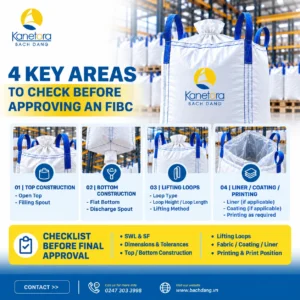
9. How to Read FIBC Top Filling Specifications
The top construction determines how bulk material enters the FIBC during filling.
Selecting the correct configuration can improve filling efficiency, reduce material loss and ensure compatibility with the customer’s equipment.
Open Top
An Open Top FIBC has a fully open upper section.
This design is often used for materials that do not require a closed filling connection, including certain construction materials and minerals.
Duffle Top
A Duffle Top FIBC features an additional fabric skirt that can be tied or closed after filling.
It provides a flexible filling opening and allows the upper section to be covered after loading.
Filling Spout
A Filling Spout FIBC incorporates a cylindrical inlet designed to connect with filling equipment.
Important specification parameters include:
-
Filling spout diameter.
-
Spout length.
-
Fabric material.
-
Closure method.
-
Dimensional tolerances.
-
Compatibility with the filling equipment.
For example, an FIBC may have the correct SWL and body dimensions but still be unsuitable if the filling spout diameter does not match the filling machine.
Therefore, filling-system compatibility should be verified during the design stage.
10. How to Read FIBC Bottom Discharge Specifications
Bottom construction determines how material is discharged after storage or transportation.
Common configurations include:
Flat Bottom
A Flat Bottom FIBC has a closed base without an integrated discharge outlet.
It is suitable for applications where a dedicated bottom discharge system is unnecessary or where a separate unloading method is used.
Discharge Spout
A Discharge Spout FIBC incorporates a cylindrical outlet at the bottom, allowing material to be released in a more controlled manner.
This configuration is commonly used for plastic resins, mineral powders, animal feed and various bulk materials.
Full Open Bottom
Certain specialized FIBC designs feature a bottom-opening system that allows rapid discharge through a large opening.
These configurations must be compatible with the intended handling and unloading equipment.
When reviewing bottom specifications, buyers should verify:
-
Bottom construction.
-
Discharge spout diameter.
-
Discharge spout length.
-
Closure mechanism.
-
Leakage-control requirements.
-
Compatibility with receiving equipment.
For fine powders or materials with poor flow characteristics, the discharge design should also account for material flow behavior and dust control.
11. Understanding FIBC Lifting Loop Specifications
Lifting loops form a critical part of the FIBC load-bearing system.
A specification stating four lifting loops does not provide sufficient technical information on its own.
Additional parameters should include:
-
Number of lifting loops.
-
Loop configuration.
-
Webbing width.
-
Effective lifting-loop height.
-
Webbing material.
-
Loop attachment position and length.
-
Intended lifting equipment.
Two common configurations are:
Cross-Corner Loops: Lifting loops positioned across the bag corners.
Corner-Seam Loops: Lifting loops attached along the corner seam areas.
These configurations differ in loop positioning and may affect forklift access and lifting methods.
Loop height should be considered in relation to forklift tine spacing, lifting clearance and warehouse handling conditions.
An unsuitable lifting-loop arrangement may encourage improper lifting practices or create compatibility problems with existing equipment.
For more information, read 4-Loop Jumbo Bags: Choosing the Right Lifting Loops for Forklifts and Cranes.
12. What Should Be Included in FIBC Inner Liner Specifications?
An FIBC inner liner is an additional protective bag installed inside the outer woven FIBC.
Depending on its material and construction, the liner may provide improved protection against moisture, dust, contamination or other environmental factors.
Common liner configurations include:
-
Standard PE liners.
-
Gusseted liners.
-
Liners with top and bottom fixing tabs.
-
Baffle liners.
-
Conductive liners designed for suitable electrostatic-control systems.
-
Multilayer barrier liners.
Important Inner Liner Parameters
| Parameter | What to Verify |
|---|---|
| Material | PE, PA or multilayer structure |
| Thickness | Film thickness in micrometers (µm) |
| Dimensions | Length, width and height |
| Configuration | Lay-flat or gusseted |
| Fixing Method | Loose or attached liner |
| Top Opening | Filling and closure design |
| Bottom Outlet | Discharge configuration |
| Special Requirements | Static control, moisture or gas barrier |
A general statement such as “FIBC with PE liner” may not be sufficient for production approval.
For example, an inner liner used for food ingredients may require different material documentation and hygiene controls from a liner used for industrial plastic pellets.
For food applications, liner selection must be considered alongside the complete packaging system, including material suitability, production hygiene and contamination control.
Learn more in our article on Food-Grade Jumbo Bags: Hygiene and Contamination Control Requirements.
13. Stitching Specifications and Fine-Powder Leakage Control
For relatively large granular materials, standard FIBC stitching may be suitable.
However, fine powders such as cement, mineral powders and certain chemical ingredients can present additional leakage risks.
Potential leakage areas include:
-
Longitudinal body seams.
-
Bottom-to-body connections.
-
Filling spout attachments.
-
Discharge spout attachments.
-
Panel intersections.
For these applications, buyers may specify sift-proof stitching or other appropriate leakage-control measures.
Sift-proof construction is intended to reduce the escape of fine particles through stitched areas.
However, it does not automatically guarantee a fully sealed packaging system under all operating conditions.
Effective leakage control must be evaluated across the entire bag construction, including filling closures, bottom outlets and inner liners.
14. Printing, Labels and Document Pouches
In export packaging, printing is not limited to brand identification.
Printed information may support product identification, handling instructions and regulatory compliance.
Depending on customer requirements, printing may include:
-
Product name.
-
Safe Working Load.
-
Safety Factor.
-
Handling instructions.
-
Warning symbols.
-
Manufacturer information.
-
Product or batch identification.
-
Applicable compliance markings.
The specification should define the number of printed sides, printing area, artwork dimensions, colors and label locations.
For document pouches, buyers should confirm the dimensions, closure type and attachment position.
For FIBCs intended for dangerous goods, UN markings must correspond to the approved packaging design and applicable regulatory requirements.
Simply printing a UN symbol or code on an ordinary FIBC does not make it suitable for transporting dangerous goods.
15. Example of a 1,000 kg FIBC Specification Sheet
Consider the following illustrative specification for an FIBC intended for exporting polypropylene resin.
| Item | Example Specification |
|---|---|
| Product | PP Resin |
| SWL | 1,000 kg |
| Safety Factor | 5:1 |
| Dimensions | 100 × 100 × 120 cm |
| Construction | U-Panel |
| Fabric | PP Woven Fabric |
| Body Fabric Weight | 180 GSM |
| Coating | Coated |
| Top | Filling Spout |
| Bottom | Discharge Spout |
| Lifting System | Four Lifting Loops |
| Inner Liner | PE Liner |
| Printing | Two Sides |
Note: This table illustrates how an FIBC specification may be presented. It is not a validated design approved for a particular cargo or application.
Although this appears relatively complete, several essential details remain to be confirmed.
Dimensions and Cargo
What is the actual bulk density of the PP resin?
Does the selected bag size provide sufficient filling volume?
What dimensional tolerances are acceptable?
Lifting System
What are the loop width and effective loop height?
Is the lifting configuration compatible with the customer’s forklift or handling equipment?
Filling and Discharge
What are the filling and discharge spout diameters and lengths?
Are the closure systems compatible with the customer’s equipment?
Inner Liner
What is the liner thickness?
How is the liner fixed inside the FIBC?
Are additional moisture-protection requirements necessary?
Quality Control
Which parameters must be inspected during sample approval?
What testing documentation is required before mass production?
A specification becomes a reliable production reference only when all critical requirements have been properly defined and agreed upon.
16. Why Different Products Require Different FIBC Specifications
One common purchasing mistake is selecting FIBCs based primarily on SWL without sufficiently considering cargo characteristics.
FIBC Bags for Plastic Resin
For polypropylene, polyethylene and other plastic pellets, buyers typically focus on efficient filling and discharge, moisture protection and transportation efficiency.
Where the handling environment presents hazardous electrostatic conditions, additional assessment may be necessary to determine the appropriate electrostatic FIBC classification.
FIBC Bags for Food Ingredients
For sugar, flour, starch, grains and food additives, important requirements include:
-
Production hygiene.
-
Food-contact material suitability.
-
Foreign-matter control.
-
Inner liner specifications.
-
Traceability.
-
Packaging and inspection procedures.
Using virgin polypropylene alone does not automatically establish the food-contact compliance of the entire finished FIBC.
Suitability must be assessed according to the complete packaging construction and intended conditions of use.
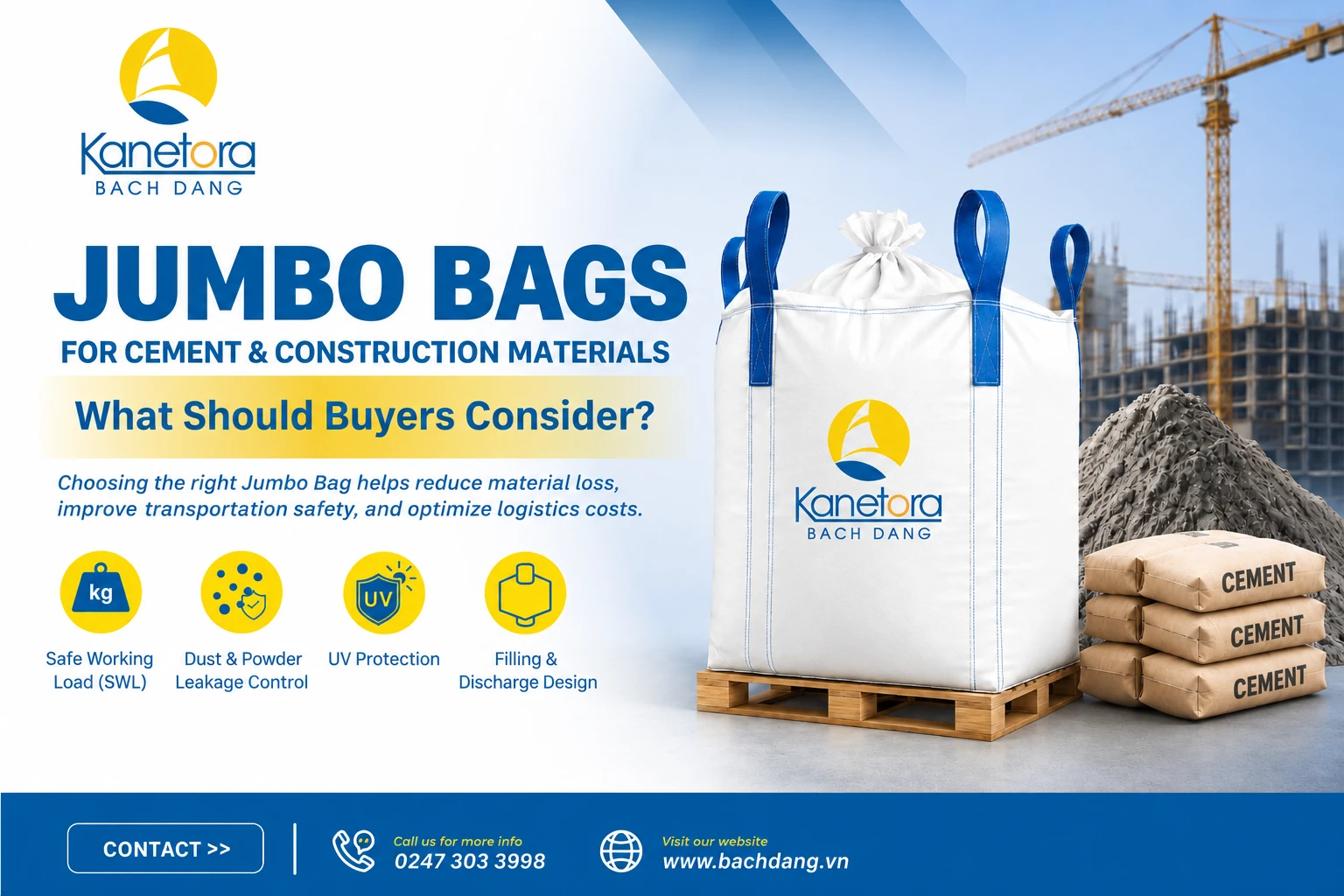
FIBC Bags for Cement and Mineral Powders
Cement, limestone powder and other construction materials may have relatively high bulk density and can generate significant dust during filling or discharge.
The specification should therefore address bag dimensions, load-bearing structure, seam construction, fabric coating, liner requirements and discharge compatibility.
For further guidance, read Jumbo Bags for Cement and Construction Materials.
The essential point: SWL represents only one part of the overall technical requirements. The complete FIBC design must match the specific cargo and its handling conditions.
17. FIBC Specification Checklist Before Production Approval
Before approving samples or placing a mass-production order, buyers should review the following information.
Cargo Information
-
Product name and physical form.
-
Bulk density.
-
Required net filling weight.
-
Special characteristics, including moisture sensitivity, dust generation or electrostatic hazards.
Load and Dimensions
-
Safe Working Load (SWL).
-
Safety Factor (SF).
-
Length, width and height.
-
Dimensional tolerances and measurement methods.
Construction and Materials
-
Bag body construction.
-
Fabric weight and coating specifications.
-
Lifting-loop and webbing details.
-
Stitching and seam requirements.
-
Inner liner specifications.
Filling, Discharge and Transportation
-
Top filling configuration and dimensions.
-
Bottom discharge configuration and dimensions.
-
Lifting equipment.
-
Pallet dimensions and container type.
-
Warehousing and transportation conditions.
Printing and Quality Requirements
-
Artwork and label positions.
-
Document pouch requirements.
-
Food-contact, electrostatic or UN requirements, where applicable.
-
Inspection, testing and sample approval procedures.
This checklist helps purchasing, engineering and quality-control departments establish a consistent basis for approving FIBC designs.
It is particularly useful for first-time buyers who may not yet have a complete technical specification.
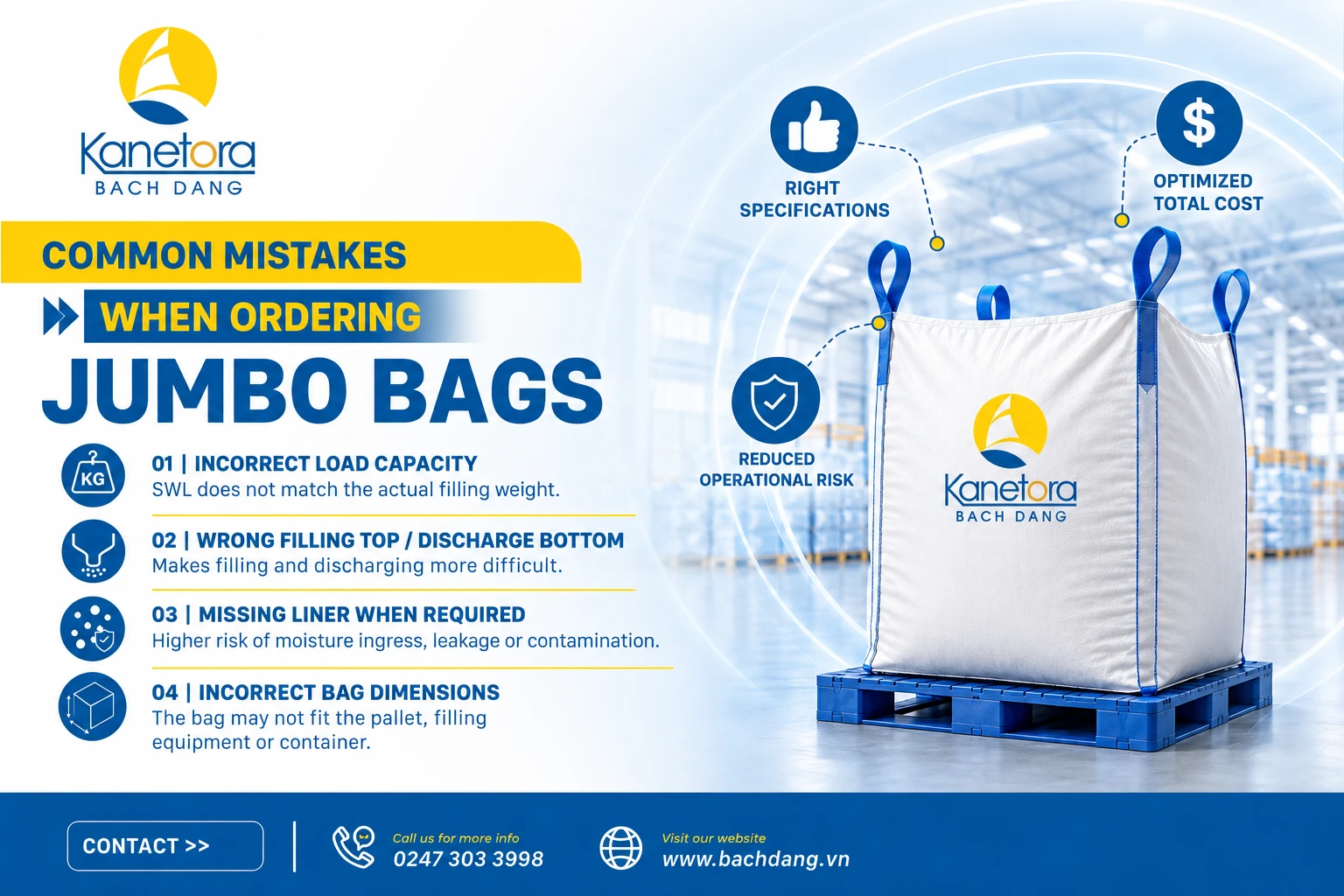
For further guidance, see Common Mistakes When Ordering Jumbo Bags for the First Time.
18. Why Work Directly with an FIBC Manufacturer?
An FIBC specification sheet is more than a quotation document.
It provides a technical reference for the purchasing, engineering, manufacturing and quality-control teams to ensure that the finished packaging meets the intended requirements.
Working directly with an FIBC manufacturer allows buyers to evaluate multiple aspects of the design together, including:
-
Cargo characteristics and required SWL.
-
Filling volume and bag dimensions.
-
Fabric selection and body construction.
-
Lifting-loop configuration.
-
Filling and discharge compatibility.
-
Warehousing and transportation conditions.
-
Quality standards and testing requirements.
FIBC Manufacturing and Quality Control at Kanetora Bach Dang
Kanetora Bach Dang is a direct FIBC and Jumbo Bag manufacturer located in Ninh Binh Province, Vietnam, operating as part of the Kanetora Group and building on the packaging manufacturing experience established by But Son Packaging.
According to the company’s 2026 manufacturing profile, Kanetora Bach Dang has a stated FIBC production capacity of approximately 300,000 bags per month.
Its manufacturing operations cover major processes including yarn extrusion, fabric weaving, webbing production, coating, cutting, printing, sewing, inspection and packing.
The facility also produces various FIBC components in-house, including webbing, inner liners, labels and document pouches, helping maintain consistency and flexibility across customized packaging designs.
Quality assurance is supported by in-process inspections and final product checks, together with laboratory equipment for tensile strength, lifting performance, UV resistance and liner-material evaluation.
For specialized applications, including food-grade packaging, electrostatic-control FIBCs and UN-certified bulk bags, the relevant design requirements and compliance documentation must be confirmed for each intended application.
Explore our FIBC and Jumbo Bag Product Range for additional information about available packaging solutions.
19. Frequently Asked Questions About FIBC Specifications
What does SWL mean on an FIBC bag?
SWL stands for Safe Working Load. It indicates the maximum rated working load assigned to an FIBC design. A bag marked SWL 1,000 kg should not be loaded beyond 1,000 kg under its specified operating conditions.
Does an FIBC with SWL 1,000 kg and SF 5:1 carry 5,000 kg?
No. The 5:1 safety factor relates to structural safety performance and testing requirements. The permitted working load remains 1,000 kg.
Is there a standard dimension for a 1-ton Jumbo Bag?
There is no single universal dimension for every 1,000 kg bulk bag. The appropriate dimensions depend on cargo bulk density, required volume, bag construction and handling conditions.
What is dimensional tolerance in FIBC manufacturing?
Dimensional tolerance is the permitted variation between nominal dimensions and the actual dimensions of the finished bag. Acceptable tolerances should be agreed upon based on the design and measurement method.
Does higher fabric GSM mean higher FIBC load capacity?
Not necessarily. Load-bearing performance depends on the combined properties of the fabric, webbing, stitching, lifting-loop attachments and overall bag construction.
Does every FIBC require an inner liner?
No. Inner liners are selected according to cargo characteristics and the required level of protection against moisture, dust, contamination or other environmental factors.
What is the difference between U-Panel, Circular and Baffle FIBCs?
U-Panel bags use a U-shaped fabric panel combined with side panels. Circular FIBCs use tubular woven fabric. Baffle FIBCs incorporate internal panels to reduce bulging and maintain a more rectangular shape after filling.
What information is required to request an FIBC quotation?
Buyers should provide the cargo type, bulk density, required filling weight, preferred dimensions, filling and discharge methods, lifting equipment, transportation conditions, liner requirements and any special compliance requirements.
Can FIBC dimensions or lifting loops be changed after sample approval?
Design modifications may be possible, but the manufacturer must assess their impact on structural performance and suitability. Changes to load-bearing components or certified constructions may require additional testing and approval.
Conclusion: Read the Entire FIBC Specification, Not Just the Numbers
An FIBC specification sheet contains more than load capacity and bag dimensions. It defines the technical requirements for the bag’s materials, structural design, filling and discharge systems, lifting performance and quality control.
When selecting bulk bags, buyers should review SWL, Safety Factor, dimensions, tolerances, fabric specifications, lifting loops, top and bottom construction, inner liners and transportation conditions as interconnected elements.
Defining these requirements clearly from the beginning can reduce manufacturing errors, improve equipment compatibility and help ensure reliable packaging performance.
Looking for an FIBC manufacturer or need assistance reviewing your bulk bag specifications?
Kanetora Bach Dang provides customized FIBC and Jumbo Bag solutions for food ingredients, plastic resins, chemicals, minerals, agriculture and other industrial applications.
Send us your cargo details, required SWL, bulk density, dimensions and filling/discharge requirements to discuss an appropriate bag configuration.
KANETORA BACH DANG – FIBC & JUMBO BAG MANUFACTURER IN VIETNAM
Website: www.bachdang.vn
Email: info@kanetora.vn
Hotline: +84 (0) 247 303 3998
Factory: Cau Mai, My Loc Ward, Ninh Binh Province, Vietnam.