

In industrial bulk packaging, selecting the right Flexible Intermediate Bulk Container (FIBC) involves more than choosing a Safe Working Load (SWL) of 500 kg, 1,000 kg, or 2,000 kg. Bag construction, seam placement, load distribution, and shape retention can significantly influence filling efficiency, handling safety, warehouse operations, and transportation performance.
Among the most widely used FIBC constructions are U-Panel and 4-Panel (Four-Panel) bulk bags. Although both designs are typically manufactured from woven polypropylene (PP) fabric and can be engineered for similar working loads, they differ in fabric panel arrangement, sewing configuration, load-transfer characteristics, and dimensional behavior when filled.
What are the structural differences between U-Panel and 4-Panel FIBC bags? Which design is more suitable for heavy bulk materials? And which construction offers better shape control during filling and storage?
This article examines both designs from the perspective of industrial FIBC engineering, manufacturing, and quality assurance at Kanetora Bach Dang.
1. What Are U-Panel and 4-Panel FIBC Bags?
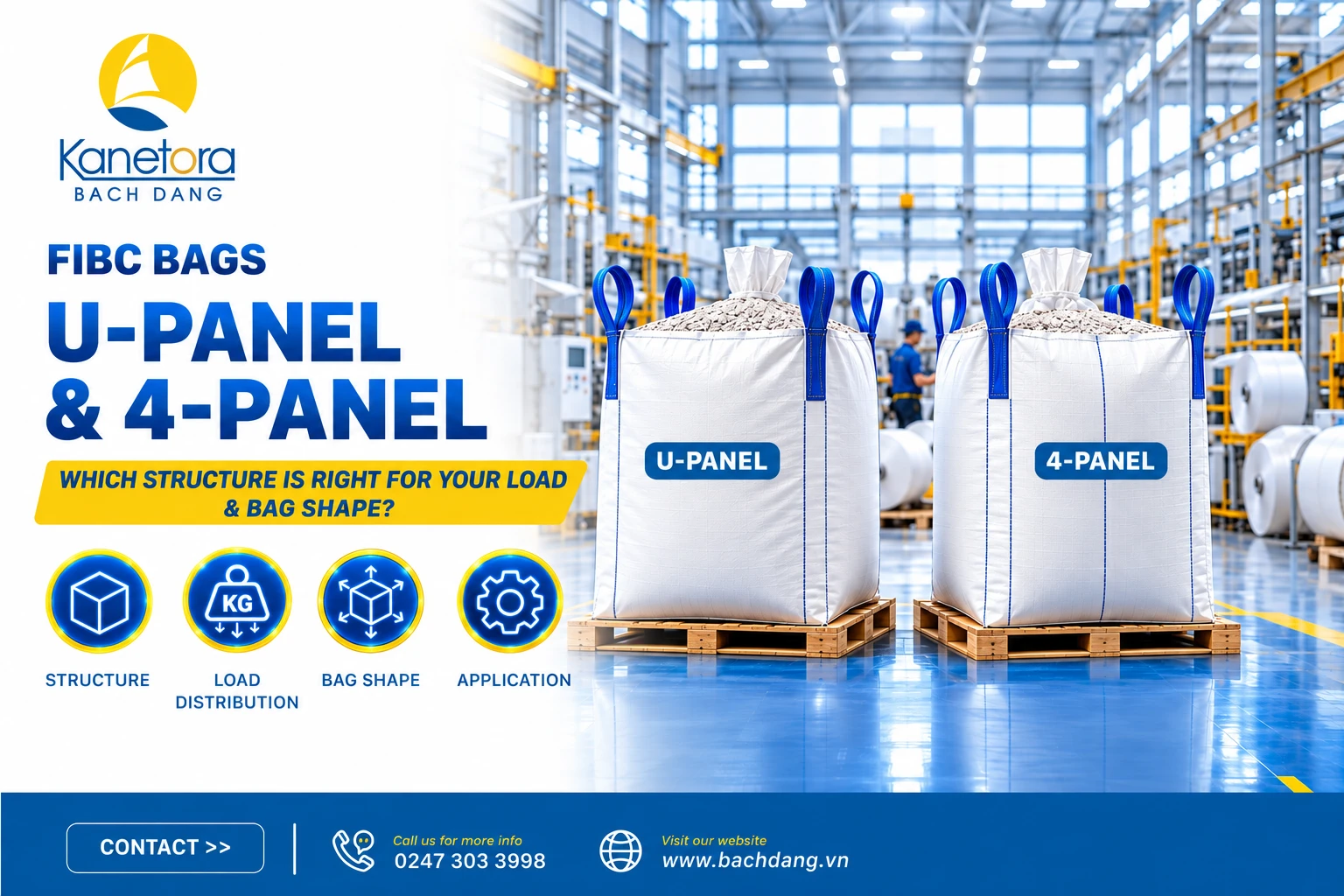
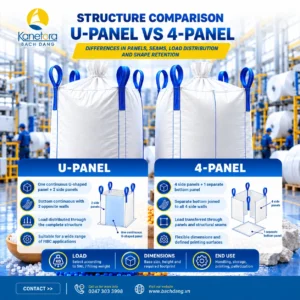
A U-Panel FIBC bag consists of one continuous U-shaped fabric panel forming two opposite side walls and the bottom, combined with two additional side panels sewn into the structure.
A 4-Panel FIBC bag consists of four separate side panels and an individual bottom panel, joined together through reinforced sewing operations to create a complete bulk container.
Both constructions belong to the Flexible Intermediate Bulk Container (FIBC) category and are commonly used to package powders, granules, minerals, chemicals, agricultural commodities, and other industrial bulk materials.
The fundamental difference is not necessarily the number of lifting loops or the nominal load capacity. Instead, it lies in how the fabric panels are arranged and how the seams are incorporated into the bag structure.
At Kanetora Bach Dang, U-Panel and 4-Panel constructions are available as part of our customizable FIBC bulk bag solutions, alongside Circular and Baffle designs.
2. Structural Differences Between U-Panel and 4-Panel FIBC Bags
2.1. U-Panel Construction: Continuous Bottom and Side Walls
A conventional U-Panel FIBC is manufactured using three main fabric panels:
- One continuous U-shaped panel forming the bottom and two opposite side walls.
- Two additional fabric panels forming the remaining side walls.
- Structural seams joining the three panels into a complete container.
A key characteristic of this design is that the bottom is not a separate panel sewn around its entire perimeter.
The continuous U-shaped fabric provides an uninterrupted material path from the bottom into two opposing side walls.
Under load, this construction allows part of the forces acting on the bottom to be transferred through the continuous fabric. However, the remaining side panels, connecting seams, lifting loops, and reinforced attachment points also contribute to the overall load-bearing system.
U-Panel construction offers a relatively straightforward manufacturing configuration and may reduce certain fabric-joining operations compared with designs that use a completely separate bottom panel.
These characteristics make U-Panel FIBCs a practical solution for many standard industrial bulk packaging applications.
For additional technical information, explore our U-Panel FIBC bag specifications and available configurations.
2.2. 4-Panel Construction: Four Side Panels and a Separate Bottom
Unlike U-Panel bags, a conventional 4-Panel FIBC consists of five main fabric components:
- Four separate vertical panels forming the side walls.
- One independent fabric panel forming the bottom.
- Vertical seams connecting the side panels.
- Bottom seams joining the base panel to the surrounding side walls.
This construction enables manufacturers to control individual panel dimensions and customize specific sewing arrangements.
When properly engineered, 4-Panel bags can provide a clearly defined rectangular or square body configuration, which may be advantageous for applications requiring specific base dimensions or pallet compatibility.
However, the separate bottom construction also introduces additional seam locations that must be carefully designed and inspected.
The strength and integrity of the connection between the bottom panel and the side walls are particularly important.
It is essential to recognize that a 4-Panel FIBC is not automatically stronger or weaker than a U-Panel bag simply because it contains more seams.
Actual performance depends on the engineering of the complete bag assembly.
3. U-Panel vs 4-Panel FIBC Bags: Technical Comparison
| Comparison Criteria | U-Panel FIBC | 4-Panel FIBC |
|---|---|---|
| Main construction | One U-shaped panel + two side panels | Four side panels + one bottom panel |
| Bottom configuration | Continuous with two opposite side walls | Separate bottom panel |
| Seam arrangement | Seams connecting the side panels to the U-shaped body | Vertical seams and bottom perimeter seams |
| Load distribution | Continuous fabric path through the bottom and two walls | Load transfer through panels and bottom seams |
| Shape when filled | May bulge depending on material and design | Can form a defined box shape but may still bulge |
| Load capacity | Determined by engineering and testing | Determined by engineering and testing |
| Critical inspection areas | Side seams, corners, and lifting connections | Vertical seams, bottom seams, and lifting connections |
| Production considerations | May simplify selected cutting and sewing operations | Requires separate panel and bottom assembly |
| Typical applications | Granules, powders, minerals, industrial raw materials | Granules, powders, chemicals, and dimension-sensitive applications |
Key takeaway: Neither construction is universally superior. The appropriate design depends on the required working load, material characteristics, shape requirements, lifting conditions, and validated performance of the finished FIBC.
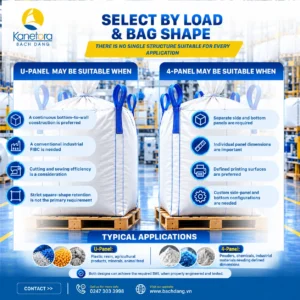
4. How Does Load Distribution Differ Between U-Panel and 4-Panel FIBCs?
An important part of FIBC engineering is understanding how forces are transferred from the bulk material inside the container to the fabric body and lifting system.
4.1. Load Distribution in U-Panel FIBCs
When bulk materials are filled into a U-Panel bag, their weight generates vertical loads on the bottom and lateral pressure against the surrounding walls.
Because the U-shaped fabric extends continuously across the bottom and two opposite walls, the construction provides a fabric load path without transverse bottom seams along those two edges.
Nevertheless, the load is not carried by the continuous fabric alone.
The side panels, connecting seams, bag corners, and lifting system all contribute to the structural behavior of the FIBC.
During forklift or crane lifting, localized stresses may develop around lifting-loop attachment points and nearby seams.
Therefore, having fewer seams does not automatically translate into a higher Safe Working Load.
The complete bag must be designed and tested for its intended lifting conditions.
4.2. Load Distribution in 4-Panel FIBCs
In a 4-Panel FIBC, the bulk material exerts pressure on the separate bottom panel, with forces transferred to the vertical walls through the bottom perimeter seams.
During lifting, the fabric panels, reinforced stitching, and lifting loops work together to support the suspended load.
The connection between the bottom panel and the side walls is one of the important structural areas requiring careful inspection.
Key engineering considerations include:
- Fabric tensile strength and elongation.
- Sewing thread tensile performance.
- Stitch type and stitch density.
- Seam allowance and reinforcement design.
- Lifting-loop attachment configuration.
- Stress concentration around corners and connection points.
Consequently, structural performance should be evaluated using the complete FIBC rather than through a simple comparison of seam quantities.
5. Which FIBC Design Maintains Its Shape Better When Filled?
A common assumption is that 4-Panel FIBC bags always retain a square shape more effectively than U-Panel bags.
In practice, both conventional U-Panel and 4-Panel FIBCs can experience side-wall bulging when filled.
This is because bulk materials generate outward pressure against the woven polypropylene fabric, which undergoes a certain degree of deformation under load.
Factors Affecting FIBC Shape Retention
Bulk material characteristics: Free-flowing granules behave differently from fine powders. Materials with different bulk densities, particle sizes, and flow characteristics can produce different pressure distributions inside the bag.
Bag height-to-width ratio: Excessive height or unsuitable proportions may increase visible side-wall deformation.
Fabric properties: Fabric weight, weaving construction, tensile strength, and elongation characteristics influence dimensional stability.
Filling conditions: Filling speed, vibration, compaction, and material distribution can affect the final shape of the filled container.
For these reasons, a 4-Panel bag does not necessarily maintain a more stable square shape than every U-Panel configuration.
When Should You Consider Baffle FIBC Bags?
When maintaining a near-square or rectangular shape is a primary requirement, a Baffle FIBC design may be more appropriate.
Baffle bulk bags incorporate internal fabric partitions that restrict excessive side-wall expansion while allowing bulk material to move through specially designed openings.
This construction helps improve shape retention and may support more efficient pallet arrangement and container space utilization.
Depending on the engineering requirements, baffle systems can be incorporated into different FIBC body configurations, including U-Panel and 4-Panel designs.
Learn more in our article: Baffle Jumbo Bags: Reducing Bulging and Optimizing Warehouse and Container Loading.
6. Load Capacity: Are U-Panel FIBCs Stronger Than 4-Panel Bags?
Neither U-Panel nor 4-Panel construction can be declared stronger based solely on its structural name.
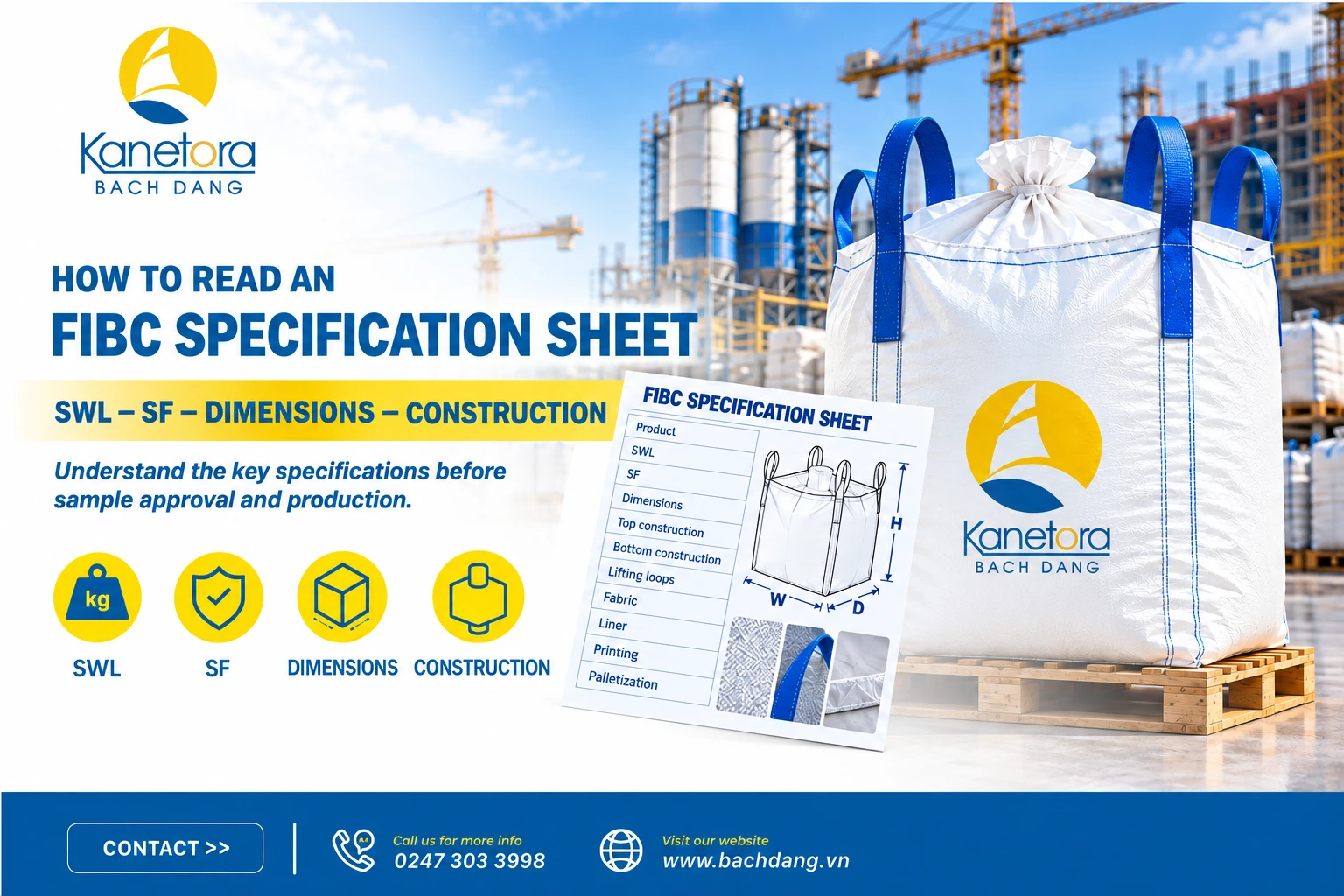
The working load capacity of an FIBC is expressed as its Safe Working Load (SWL), representing the maximum load approved for a specific bag design under defined conditions of use.
Another important parameter is the Safety Factor (SF), which is considered during structural qualification and performance testing.
Both U-Panel and 4-Panel FIBCs can be engineered for common working loads such as:
- 500 kg
- 1,000 kg
- 1,500 kg
- 2,000 kg
The appropriate SWL depends on the design specifications and test results.
Two bags with an SWL of 1,000 kg may have significantly different fabric constructions, seam arrangements, lifting systems, and dimensional performance.
What Determines the Load-Bearing Performance of an FIBC?
The most important factors include fabric strength and construction, polypropylene yarn quality, seam integrity, stitching method, lifting-loop design, bag dimensions, bottom structure, and intended handling conditions.
The number of planned use cycles is also relevant, particularly when distinguishing between single-trip and multi-trip applications.
Depending on the applicable requirements, manufacturers may conduct qualification tests such as the Top Lift Test to evaluate the performance of the finished bag under specified conditions.
For a detailed technical explanation, refer to our guide on FIBC Load Testing: Safe Working Load, Safety Factor, and Top Lift Test.
7. Practical Applications: When to Choose U-Panel or 4-Panel FIBCs
7.1. Plastic Resins and Granular Chemicals
Plastic pellets such as PP and PE generally demonstrate relatively good flow characteristics during filling and discharge.
For these applications, U-Panel bags may offer a suitable combination of practical construction, flexible dimensions, and customizable filling and discharge options.
4-Panel designs may also be selected when customers require specific base dimensions, pallet compatibility, or integration with existing filling equipment.
For electrostatically sensitive materials or potentially hazardous environments, the appropriate FIBC electrostatic classification must be determined separately from the body construction.
7.2. Minerals and Construction Materials
Minerals, sand, cement-related materials, and other dense industrial products can generate substantial loads within a relatively limited volume.
Both U-Panel and 4-Panel constructions can be considered, provided the finished FIBC meets the required load rating and intended operating conditions.
Particular attention should be given to fabric strength, bottom construction, seam quality, and lifting arrangements.
For powder applications, filling spouts, discharge systems, and dust-resistant sewing techniques may also be required to reduce material leakage.
7.3. Agriculture and Food Ingredients
Rice, sugar, starch, animal feed ingredients, and agricultural commodities can be packaged using a range of FIBC constructions.
In these applications, selecting the right body construction is only part of the specification process.
Other important considerations may include:
- Hygienic manufacturing conditions.
- Inner liner compatibility.
- Dust and foreign-material contamination control.
- Traceability requirements.
- Food-contact compliance, where applicable.
Food-grade packaging requirements should be assessed separately from the U-Panel or 4-Panel structural configuration.
Explore our related article: Food-Grade Jumbo Bags: Hygiene Requirements and Contamination Control.
7.4. Export Cargo Requiring Efficient Pallet and Container Loading
For export shipments involving high volumes of bulk materials, the dimensions and filled shape of FIBC bags can affect loading efficiency.
Both U-Panel and 4-Panel constructions can be manufactured to match pallet dimensions.
However, actual side-wall expansion should be considered when determining the effective footprint of a filled bag.
Where dimensional stability is a primary concern, a baffle construction may offer advantages over simply switching between conventional U-Panel and 4-Panel bags.
The final selection should account for actual filled dimensions, stacking arrangements, transportation conditions, and applicable handling safety requirements.
8. Engineering and Approval Process for U-Panel and 4-Panel FIBCs
To minimize structural and operational risks, an FIBC design should be reviewed and approved through a clearly defined technical process before mass production.
Step 1: Identify Bulk Material Characteristics
The manufacturer should receive information about the product type, bulk density, particle size, flow properties, moisture sensitivity, and any relevant handling hazards.
These properties provide the basis for selecting dimensions and structural features.
Step 2: Establish SWL and Operating Conditions
The customer and manufacturer should agree on the required filling weight, applicable safety factor, lifting method, expected use cycles, and handling conditions.
Step 3: Develop the Structural Design and Cutting Layout
The engineering team determines whether U-Panel or 4-Panel construction is appropriate.
The design process includes panel dimensions, seam positioning, fabric specifications, lifting-loop attachments, and filling and discharge arrangements.
Step 4: Produce and Evaluate Samples
Prototype bags should be evaluated for dimensional accuracy, seam quality, lifting configuration, and behavior under representative filling conditions.
Where shape retention is important, sample filling trials can help assess side-wall expansion and dimensional stability.
Step 5: Conduct Applicable Load Tests
Testing should be aligned with the approved SWL, safety factor, intended application, and relevant technical standards or customer specifications.
Appropriate testing of the finished FIBC is necessary to establish whether the proposed construction meets its intended performance requirements.
Step 6: Approve Samples and Technical Specifications
Before mass production, the customer and manufacturer should finalize the technical drawings, specification sheets, reference samples, and quality acceptance criteria.
This approval process is especially important for export orders requiring consistent product performance across production batches.
9. U-Panel and 4-Panel FIBC Manufacturing at Kanetora Bach Dang
Kanetora Bach Dang is an industrial packaging manufacturing facility located in Cau Mai, My Loc Ward, Ninh Binh Province, Vietnam.
The factory supplies customizable FIBC bulk bags for domestic and international markets, including U-Panel, 4-Panel, Circular, Baffle, and specialized configurations.
According to its 2026 company profile, the facility has a monthly production capacity of approximately 300,000 FIBC bags, supported by manufacturing equipment including:
- 43 fabric weaving machines.
- 19 webbing weaving machines.
- 331 industrial sewing machines.
- 7 automatic cutting machines.
This manufacturing infrastructure supports various FIBC constructions, customized specifications, and industrial bulk packaging applications.
Quality Control from Raw Materials to Finished FIBCs
Kanetora Bach Dang implements a standardized manufacturing process covering polypropylene yarn extrusion, webbing weaving, fabric weaving, coating, cutting and printing, sewing, inspection, and packing.
Quality Control (QC) and Quality Assurance (QA) activities are integrated throughout production.
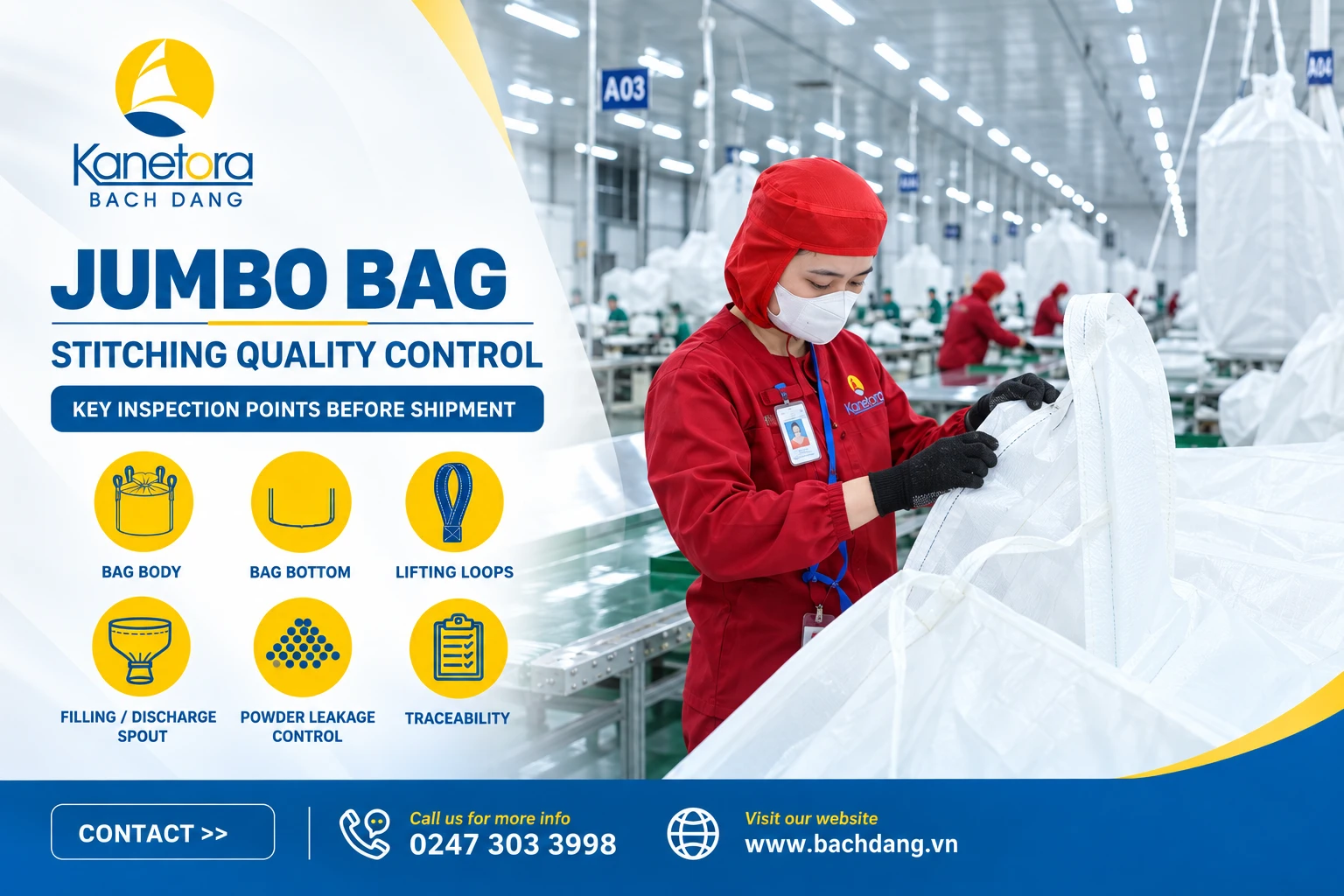
QC personnel perform in-process inspections, while the dedicated QA team conducts final assessments before shipment.
The facility is equipped with testing instruments including tensile strength testers, UV accelerated weathering equipment, and a Top Lift Test machine.
These resources support material evaluation, structural verification, and product quality assessment according to applicable technical requirements.
Custom FIBC Design and Manufacturing
Kanetora Bach Dang works with customers to develop FIBC specifications based on bulk material characteristics, filling conditions, load requirements, pallet dimensions, and export requirements.
Available customization options include coated fabrics, inner liners, filling spouts, discharge spouts, duffle tops, dust-resistant sewing configurations, and various lifting-loop arrangements.
Learn more about our industrial packaging manufacturing facility in Vietnam.
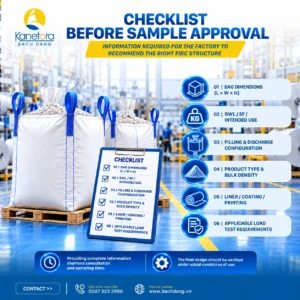
10. Frequently Asked Questions About U-Panel and 4-Panel FIBC Bags
Are U-Panel FIBC bags stronger than 4-Panel bags?
Not necessarily. Load-bearing performance depends on the complete engineering design, including fabric strength, seam construction, lifting-loop attachments, safety factor, and applicable test results.
Do 4-Panel FIBC bags maintain a square shape better than U-Panel bags?
Not in every application. Both constructions may develop side-wall bulging when filled. Where square or rectangular shape retention is critical, a Baffle FIBC may be a more appropriate solution.
Do U-Panel FIBCs have fewer seams than 4-Panel bags?
A conventional U-Panel design features a continuous bottom and two opposite side walls, while a 4-Panel design uses a separate bottom panel. As a result, the seam layouts differ, and U-Panel construction may eliminate certain bottom connection seams.
Can U-Panel and 4-Panel FIBCs both be manufactured with a 1,000 kg SWL?
Yes. Both constructions can be engineered for a 1,000 kg Safe Working Load, provided the complete design satisfies the relevant technical and testing requirements.
Can inner liners be used with both U-Panel and 4-Panel bags?
Yes. Both designs can incorporate polyethylene liners or specialized inner liners, depending on the packaged product, required protection level, and operating conditions.
What information should buyers provide when ordering FIBC bags?
Buyers should specify the bulk material, bulk density, filling weight, required dimensions, filling and discharge methods, lifting equipment, liner requirements, order quantity, and destination market.
11. Conclusion: Should You Choose a U-Panel or 4-Panel FIBC?
Both U-Panel and 4-Panel constructions are widely used in industrial bulk packaging and can be engineered to meet a broad range of handling and transportation requirements.
U-Panel FIBCs feature a continuous bottom-to-side-wall construction and may offer advantages in simplifying selected cutting and sewing operations.
4-Panel FIBCs provide flexibility in individual side-panel and bottom-panel design, making them suitable for applications requiring specific dimensional or structural arrangements.
However, the best FIBC construction should not be selected solely on the basis of panel configuration or the appearance of an empty bag.
A suitable design must account for load capacity, mechanical performance, filled-bag shape, lifting methods, material characteristics, and real operating conditions.
As a direct FIBC manufacturer in Vietnam, Kanetora Bach Dang provides U-Panel, 4-Panel, and customized bulk packaging solutions designed around the technical requirements of individual customers.
Explore our FIBC bulk bag product range or contact our team to discuss a suitable design for your application.
KANETORA BACH DANG – INDUSTRIAL PACKAGING SOLUTIONS
Website: www.bachdang.vn
Factory Address: Cau Mai, My Loc Ward, Ninh Binh Province, Vietnam
Hotline: +84 (0) 247 303 3998
Email: info@kanetora.vn