

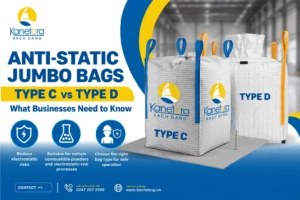
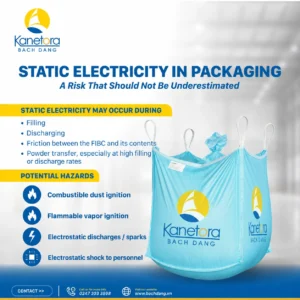
During the filling, discharging and handling of powders or granules in FIBCs, friction and material movement can generate significant electrostatic charge.
For many ordinary bulk products, this may not create a major operational risk. However, in environments containing combustible dust, flammable powders, gases or solvent vapors, an electrostatic discharge can potentially become an ignition source.
This is why industries such as chemicals, polymers, food ingredients, pharmaceuticals and specialty materials may require Type C or Type D anti-static Jumbo Bags instead of conventional FIBCs.
The most important distinction is straightforward:
Type C and Type D FIBCs are both designed to control electrostatic hazards, but they work in fundamentally different ways. Type C bags must be properly grounded, while Type D bags are designed to dissipate charge without grounding the FIBC itself.
IEC 61340-4-4 classifies FIBCs as Type A, B, C and D and establishes requirements for design, testing, labeling and safe use in environments where electrostatic ignition hazards may exist.
For a broader overview of available bag structures and specifications, buyers can also explore the FIBC and Jumbo Bag solutions manufactured by Kanetora Bach Dang.
How Does Static Electricity Build Up in a Jumbo Bag?
Electrostatic charge does not come only from the bag itself.
Charge can be generated when:
- powder or granules flow through pipelines;
- particles collide with each other;
- product rubs against FIBC fabric;
- bulk material moves rapidly during filling;
- product flows against an inner liner;
- discharge takes place at high flow rates;
- conductive equipment is electrically isolated;
- operators or machinery become charged.
The charge can then accumulate across the system:
bulk product → liner → FIBC fabric → equipment → operator
If that charge is not controlled, an electrostatic discharge may occur.
This is why selecting an anti-static FIBC should not begin with a simple question such as:
“Is my product a chemical?”
A proper assessment should consider:
product ignition characteristics + surrounding atmosphere + filling/discharge process + liner + grounding system + operating procedures
What Is the Difference Between Type A, Type B, Type C and Type D FIBCs?
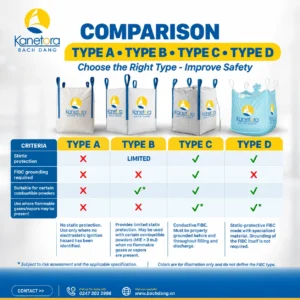
Understanding Type C and Type D is easier when they are viewed within the complete FIBC classification system.
| FIBC Type | Static-Control Function | FIBC Grounding | General Application |
|---|---|---|---|
| Type A | No electrostatic protection | No | Non-hazardous products and environments |
| Type B | Prevents certain high-energy discharges but does not dissipate charge | No | Certain combustible powders where flammable gases or vapors are absent |
| Type C | Conducts charge to earth through an interconnected conductive network | Required | Combustible powders and hazardous environments where grounding can be controlled |
| Type D | Dissipates charge through specialized static-protective fabric | FIBC grounding not required | Combustible powders and specified hazardous environments where a certified Type D design is appropriate |
Type C FIBCs use interconnected conductive elements and must be grounded during filling and discharge.
Type D FIBCs use a specialized static-protective or static-dissipative fabric system and do not require the FIBC itself to be connected to earth.
What Is a Type C Jumbo Bag?
A Type C FIBC, often called a conductive FIBC, incorporates conductive threads, filaments or tapes into the bag fabric.
These conductive elements form an interconnected network.
When the bag is correctly connected to an appropriate earth point, electrostatic charge generated during operation is transferred away from the FIBC.
The principle can be summarized as:
electrostatic charge → conductive network → grounding point → earth
The critical requirement for Type C: grounding
Grounding is not optional.
The Type C FIBC must be properly grounded before and throughout filling and discharge.
If the grounding connection is missing, broken or disconnected, the bag no longer operates according to its intended static-control mechanism.
This is why Type C FIBCs should be used only where the company can reliably control:
- grounding connections;
- grounding clamps;
- grounding points;
- continuity;
- operating procedures;
- operator compliance.
For technical procurement, the buyer should not simply check whether the bag “has a grounding tab.” The complete conductive network and grounding performance must comply with the approved FIBC design and applicable testing requirements.
What Is a Type D Jumbo Bag?
A Type D FIBC is also designed to control hazardous electrostatic discharges, but its operating principle is different from Type C.
Type D uses specialized static-protective or static-dissipative fabric technology that allows charge to dissipate without connecting the FIBC itself to ground.
In practical terms:
the operator does not need to attach a grounding cable to the Type D FIBC before filling or discharge.
This can be valuable in operations where reliable grounding of every individual bag is difficult to manage or where human error is a concern.
However, Type D should never be described as:
“Type C without a grounding cable.”
That would be technically incorrect.
Type C and Type D are different electrostatic-control systems, with different materials, constructions and performance requirements.
Type C vs Type D: Key Differences
For purchasing, production and EHS teams, this comparison is usually the most useful.
| Criteria | Type C | Type D |
|---|---|---|
| Static-control mechanism | Conducts charge to earth | Dissipates charge through specialized fabric |
| FIBC grounding required | Yes | No |
| Grounding point on bag | Required by design | Not required for the FIBC’s static-control mechanism |
| Dependence on operator grounding procedure | High | Lower |
| Risk if grounding is lost | Significant | Does not depend on an FIBC grounding lead |
| Contamination control | Important | Particularly important |
| Liner compatibility | Must be verified | Must be verified |
| Best suited to | Operations with controlled grounding procedures | Operations seeking to reduce dependence on bag grounding |
Neither Type C nor Type D should automatically be considered “better.”
The correct choice depends on the actual process.
When Should a Business Consider Type C?
Type C is often suitable where the facility already has a well-controlled grounding system and established EHS procedures.
Typical conditions may include:
- fixed grounding points at filling stations;
- grounding checks before filling;
- interlocks or grounding monitors;
- trained operators;
- reliable continuity throughout the process;
- combustible powder handling;
- potential presence of flammable gas or vapor where the approved FIBC specification allows use.
The operating principle is simple:
No confirmed grounding → no filling or discharge.
This requirement should be built into the operating procedure rather than left to individual operator judgment.
What Happens If a Type C Bag Is Not Grounded?
This is one of the most important safety points.
A Type C FIBC contains conductive elements designed to transfer charge to earth.
If those conductive elements are isolated from ground, charge may accumulate on the conductive network.
That can create conditions for hazardous spark discharges.
Therefore:
A Type C bag should not be used in a hazardous electrostatic environment unless its grounding connection is properly established and maintained.
A sound operating procedure should answer questions such as:
- Who is responsible for grounding the bag?
- Where is the clamp connected?
- Is continuity verified?
- Is the connection checked before filling?
- What happens if grounding is lost during filling?
- Does the system stop automatically if the grounding connection fails?
The FIBC itself is only one part of the static-control system.
When Should a Business Consider Type D?
Type D may be considered where the operation aims to reduce reliance on the manual grounding of each FIBC.
Examples include facilities where:
- filling takes place at several stations;
- grounding points are difficult to access;
- operator error is a concern;
- bags are changed frequently;
- maintaining a continuous grounding connection is operationally difficult;
- the EHS assessment permits an appropriate Type D system.
Because the FIBC itself does not need to be grounded, Type D can remove one handling step.
However, this does not mean the entire production environment becomes “grounding-free.”
Other conductive components may still require proper bonding and grounding, including:
- filling equipment;
- metal frames;
- pipelines;
- vessels;
- conductive containers;
- operators;
- other isolated conductive objects.
Type D removes the grounding requirement for the FIBC itself — not for every component in the process.
Does Type D Mean Static Electricity Is No Longer a Concern?
No.
Type D reduces the risk of hazardous discharges through its own static-control mechanism, but the operating environment must still be properly managed.
One particularly important issue is surface contamination.
Type D FIBCs should not be used in conditions where conductive contamination may compromise their electrostatic behavior.
Examples can include:
- water;
- grease;
- oil;
- conductive chemicals;
- conductive dust or contamination.
This means storage, cleanliness and bag condition remain important.
Can Type B Replace Type C or Type D?
Not in all applications.
Type B FIBCs are designed to prevent certain high-energy discharges, but they do not dissipate electrostatic charge in the same way as Type C or Type D.
Type B may be suitable for certain combustible powders under defined conditions.
However, it is generally not appropriate where flammable gases or vapors are present.
It may also be unsuitable for highly ignition-sensitive products with very low Minimum Ignition Energy.
Therefore, companies should not simply move from Type A to Type B and assume that all electrostatic hazards have been addressed.
What Is MIE and Why Does It Matter?
MIE stands for Minimum Ignition Energy.
It is the minimum amount of energy capable of igniting a specific dust, gas or vapor mixture under defined test conditions.
The lower the MIE, the more easily the material may be ignited by an electrostatic discharge.
Before selecting Type B, C or D, an EHS or technical team should ideally understand:
- product MIE;
- combustible-dust characteristics;
- presence of flammable gases;
- presence of solvent vapors;
- hazardous-area classification;
- filling rate;
- discharge method;
- conveying conditions.
This information may be available in the product SDS, dust-hazard documentation or specialized test reports.
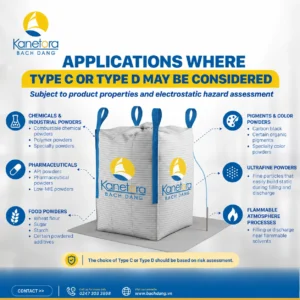
Which Industries Commonly Use Type C or Type D FIBCs?
Chemical Industry
Chemical powders and specialty materials are among the most common applications.
Examples may include:
- powdered chemicals;
- additives;
- pigments;
- polymer powders;
- intermediates;
- specialty compounds.
However, the word “chemical” alone is not enough to determine the correct bag type.
The actual ignition hazard must be evaluated.
Plastics and Polymers
Standard plastic pellets may often be packaged in conventional FIBCs.
However, fine polymer powders or high-speed pneumatic conveying systems can generate substantial static charge.
Where electrostatic hazards are identified, Type C or Type D may be required as part of the overall control strategy.
Food Powders
Certain food ingredients can create combustible dust clouds.
Examples include:
- sugar;
- flour;
- starch;
- corn starch;
- powdered ingredients.
In these applications, electrostatic requirements may need to be combined with hygiene and contamination-control requirements.
Kanetora Bach Dang also manufactures Food Grade FIBC solutions for sensitive powder and granular food ingredients.
Pharmaceutical and Specialty Powders
Fine powders with high purity or very low ignition energy may require stricter electrostatic controls.
For these applications, buyers may need to evaluate several requirements simultaneously:
static control + hygiene + liner compatibility + sift-proof construction + traceability
Does the Inner Liner Affect Anti-Static Performance?
Yes — significantly.
This is one of the most commonly overlooked points in FIBC specification.
A Type C or Type D outer bag does not mean that any standard polyethylene liner can automatically be installed without affecting the electrostatic performance of the complete package.
The liner must be compatible with the approved FIBC electrostatic classification.
This becomes especially important when a liner is required for:
- moisture protection;
- oxygen barrier;
- fine-powder containment;
- contamination protection;
- high-barrier packaging;
- static-control requirements.
The buyer should therefore tell the manufacturer about the liner from the beginning of the design process.
Do not purchase a Type C FIBC and later add an arbitrary liner at the filling facility without technical verification.
Can Type C Be Combined With a Conductive Liner?
Certain engineered FIBC systems can use liners with electrostatic-control properties.
However:
a conductive liner does not automatically convert an ordinary FIBC into a Type C or Type D FIBC.
The electrostatic classification applies to the complete FIBC system.
Relevant components may include:
- body fabric;
- conductive or dissipative elements;
- liner;
- labels;
- document pockets;
- grounding components;
- accessories;
- approved test configuration.
This is why conductive or static-sensitive liner systems should be designed together with the outer FIBC specification.
Are Anti-Static FIBCs the Same as UN-Certified FIBCs?
No.
These are separate technical requirements.
Type C and Type D relate primarily to:
electrostatic-hazard control.
UN-certified FIBCs relate to:
packaging designs tested and approved for specified dangerous-goods transport requirements.
A bag may be:
- Type C but not UN-certified;
- Type D but not UN-certified;
- UN-certified but not Type C/D;
- or engineered to meet both requirements where necessary.
Where dangerous goods are involved, companies should evaluate both transport regulations and electrostatic hazards.
Are SWL and Safety Factor Related to Type C and Type D?
Yes, but they address a different aspect of FIBC performance.
An FIBC may have excellent electrostatic performance and still need to meet all mechanical requirements for:
- Safe Working Load;
- Safety Factor;
- fabric strength;
- lifting loops;
- seams;
- bottom construction;
- bag geometry;
- handling conditions.
In other words:
electrostatic protection does not replace structural performance.
For mechanical design and lifting considerations, buyers can also review Kanetora Bach Dang’s article on 4-Loop Jumbo Bags and lifting-loop selection.
Do Lifting Loops Affect Type C or Type D FIBCs?
Lifting loops are primarily structural components.
However, in an electrostatic-protective FIBC, the complete construction must remain consistent with the approved specification.
Changes should not be made casually to:
- loop material;
- loop attachment;
- liners;
- labels;
- document pouches;
- body fabric;
- accessories.
Any modification may need to be reviewed within the complete FIBC design.
For handling-related design considerations, see 4-Loop Jumbo Bags: Choosing the Right Lifting Option.
Can Baffle FIBCs Also Be Type C or Type D?
Potentially, yes — provided the complete design is engineered and validated for the required application.
Baffles are used primarily to reduce bulging and help the filled FIBC maintain a more rectangular shape.
If the application requires several characteristics at the same time, such as:
- anti-static performance;
- baffle construction;
- liner;
- specific SWL;
- optimized container loading,
the bag should be designed as one integrated system.
You can also refer to Kanetora Bach Dang’s article on Baffle Jumbo Bags for warehouse and container loading.
Type C or Type D? A Buyer Checklist
Before requesting a quotation, companies should ideally provide the following information:
- Product name.
- Powder, granule or pellet form.
- Bulk density.
- MIE, if available.
- Whether combustible dust is present.
- Whether flammable gas or vapor is present.
- Hazardous-area classification, if applicable.
- Filling method.
- Discharge method.
- Expected filling/discharge rate.
- Whether fixed grounding is available.
- Whether grounding continuity is monitored.
- Whether an inner liner is required.
- Required liner or barrier type.
- SWL.
- Safety Factor.
- FIBC dimensions.
- U-Panel, Circular, 4-Panel or Baffle construction.
- Lifting-loop configuration.
- Food Grade or UN requirements, if applicable.
A request such as:
“Please quote a 1,000 kg Type C Jumbo Bag”
is usually not enough to establish a complete technical specification.
Five Operating Considerations for Type C FIBCs
1. Establish grounding before filling
Ground the bag before the product starts flowing.
2. Maintain grounding throughout the process
The grounding connection should remain effective during filling and discharge.
3. Inspect the grounding connection
Do not use the bag if the grounding point, clamp or conductive connection is damaged.
4. Do not change the liner or accessories without approval
The complete configuration must remain compatible with the approved design.
5. Include grounding in the operating SOP
Static-control performance should not depend only on an operator remembering to connect the bag.
Five Operating Considerations for Type D FIBCs
1. The FIBC itself does not require grounding
This is a defining feature of Type D.
2. Other conductive objects still require proper control
Pipelines, equipment, metal structures and operators may still need bonding and grounding according to the site’s EHS requirements.
3. Keep the bag surface clean
Avoid contamination with conductive liquids, oils, grease or other conductive materials.
4. Do not substitute the liner
Only compatible liners should be used.
5. Verify the bag identification before use
A colored fabric, unusual yarn or special-looking bag should never be assumed to be Type D unless its technical classification and performance are properly documented.
Anti-Static Jumbo Bags Manufactured by Kanetora Bach Dang
Kanetora Bach Dang manufactures industrial FIBCs directly in Ninh Binh Province, Vietnam.
The factory has published production capability of approximately:
- 300,000 FIBC bags per month;
- 43 fabric weaving machines;
- 19 belt/webbing weaving machines;
- 331 sewing machines;
- integrated coating, cutting, liner and QC/QA capabilities.
Kanetora Bach Dang’s FIBC portfolio includes Type A, Type B, Type C and Type D configurations, together with options such as:
- U-Panel;
- Circular;
- 4-Panel;
- Baffle;
- coating;
- inner liners;
- filling spouts;
- discharge spouts;
- lifting-loop options;
- Food Grade;
- UN-certified designs.
For chemical powders, polymers, combustible materials and electrostatic-sensitive processes, the factory recommends that buyers provide detailed information about the product, operating environment and handling process, rather than selecting Type C or Type D based only on the industry name.
Frequently Asked Questions About Type C and Type D FIBCs
Does a Type C FIBC have to be grounded?
Yes.
The bag must be properly grounded so that charge can flow through the conductive network to earth.
Does a Type D FIBC need grounding?
The FIBC itself does not require grounding.
However, conductive equipment and other isolated conductive objects in the surrounding system may still need to be properly bonded or grounded.
Is Type D better than Type C?
Not necessarily.
Type D reduces dependence on individual bag grounding, while Type C is highly effective when the facility has a properly controlled grounding system.
The correct choice depends on the application.
Is Type B an anti-static FIBC?
Type B provides protection against certain high-energy discharges, but it does not dissipate electrostatic charge like Type C or Type D.
Therefore, Type B should not be treated as a direct substitute for Type C or Type D in every hazardous environment.
What should operators do if a Type C grounding connection is lost during filling?
The process should be stopped according to the site’s safety procedure.
The bag should not simply continue filling while the grounding connection is being re-established.
Can Type D be used if the surface is wet?
Conductive contamination such as water, oil or grease can affect safe use.
Type D bags should be kept clean and used only under conditions consistent with their approved specification.
Can a standard PE liner be installed inside a Type C or Type D bag?
Not automatically.
The liner must be compatible with the electrostatic classification of the complete FIBC.
Can Type C or Type D be used for chemical products?
Yes, depending on the application.
However, the word “chemical” alone is not sufficient to determine the correct FIBC type.
The material properties, MIE, surrounding atmosphere, liner and process conditions must all be considered.
Conclusion
When selecting an anti-static Jumbo Bag, the key question is not simply:
“Which is better, Type C or Type D?”
The better question is:
“Which electrostatic-control mechanism is appropriate for our product and operating process?”
Type C is an effective solution when the company can maintain a reliable, continuous and well-controlled grounding system.
Type D removes the need to ground the FIBC itself, reducing dependence on that operating step, but still requires proper handling, clean surfaces and control of other conductive objects in the process.
For combustible powders, chemicals, polymers and applications involving potentially flammable atmospheres, the FIBC specification should be considered as a complete system:
MIE + hazardous environment + FIBC type + liner + grounding + SWL + handling + operating SOP
That is the foundation of a technically appropriate and safer bulk-packaging solution.
KANETORA BACH DANG JOINT STOCK COMPANY
Ninh Binh Province, Vietnam
Hotline: +84 (0) 247 303 3998
Website: www.bachdang.vn