

When selecting a packaging manufacturer, buyers often focus first on pricing, production capacity, lead time, and customization capabilities.
However, for companies operating in food, chemicals, minerals, pharmaceuticals, or export-oriented industries, there is another critical question:
How does the factory control quality, hygiene, safety, and manufacturing consistency?
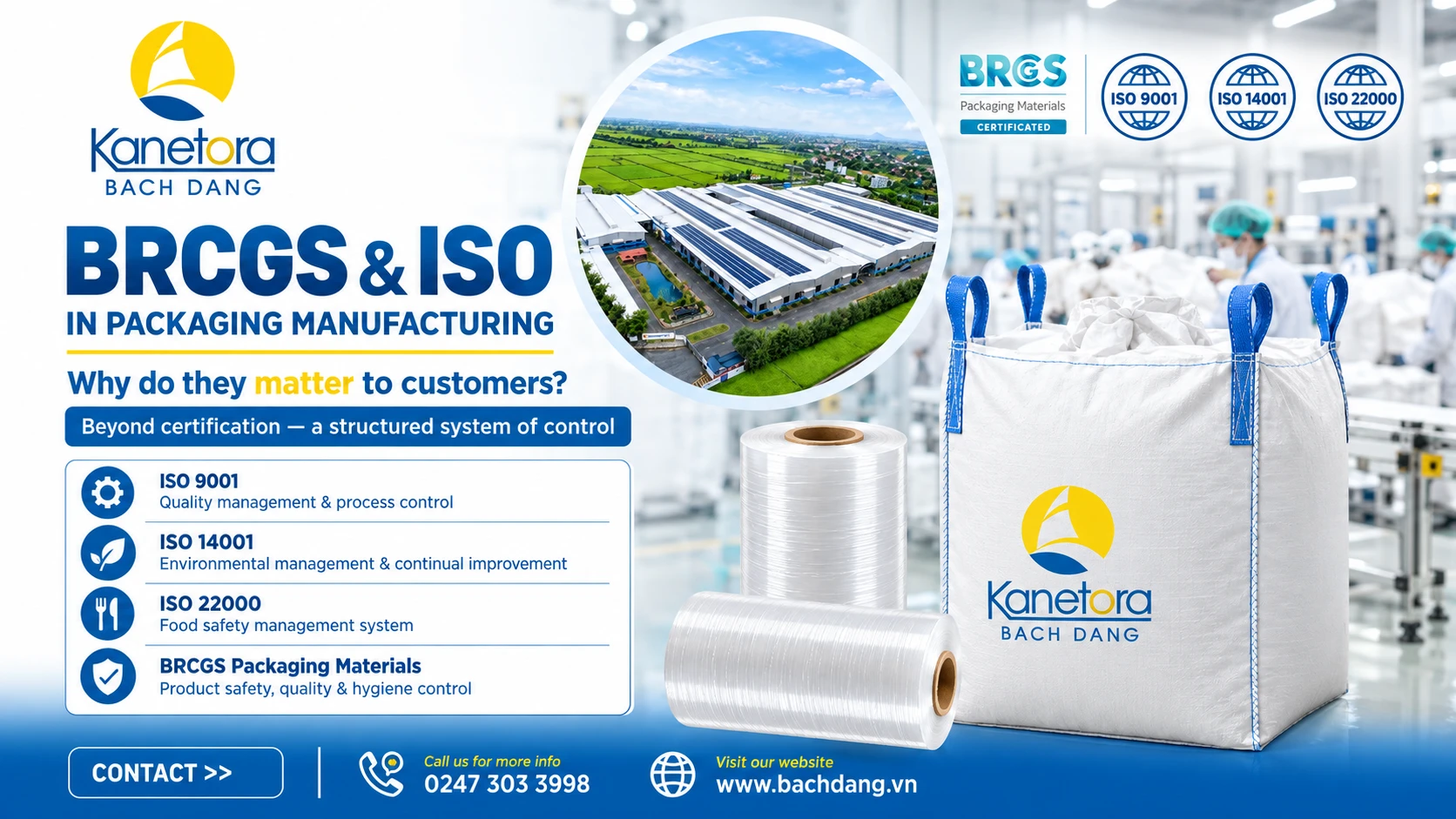
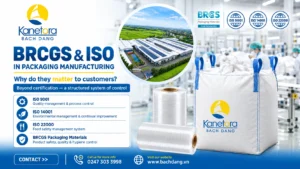
This is where internationally recognized management systems and certifications such as BRC, ISO 9001, ISO 14001, and ISO 22000 become important.
These certifications should not simply be viewed as logos displayed on a company profile. Their real value lies in the management systems, procedures, controls, documentation, and continuous improvement processes implemented throughout the factory.
At Kanetora Bach Dang, the manufacturing facility currently lists BRC Grade A, ISO 9001:2015, ISO 14001:2015, and ISO 22000:2018 among its certifications. The factory also operates an integrated production system supported by QC/QA controls and laboratory testing. KANETORA BACH DANG
What Do BRC and ISO Mean in a Packaging Factory?
BRC in Packaging Manufacturing
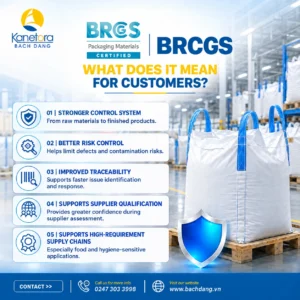
BRC, now widely recognized through the BRCGS standards, provides a structured framework for packaging manufacturers to manage areas such as:
- product safety;
- quality management;
- hygiene;
- manufacturing controls;
- hazard and risk management;
- traceability;
- facility management;
- personnel practices;
- continual improvement.
For packaging manufacturers serving food or other contamination-sensitive industries, these controls are particularly important.
Kanetora Bach Dang currently lists BRC Grade A among the certifications held by its manufacturing facility. Its company information also identifies BRC as part of the factory’s broader quality and hygiene management system. Kanetora Bach Dang – Company In…
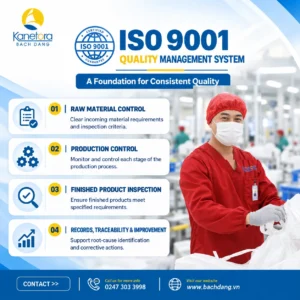
ISO 9001:2015 – Quality Management System
ISO 9001:2015 focuses on establishing a systematic approach to quality management.
For an FIBC manufacturer, product quality is not created only during final inspection. It develops throughout the entire manufacturing process:
Extrusion → Webbing Weaving → Fabric Weaving → Lamination → Cutting & Printing → Sewing → Inspection → Packing
Kanetora Bach Dang operates an eight-stage FIBC manufacturing process designed to maintain product durability, safety, and compliance with defined quality requirements. Kanetora Bach Dang – Company In…
ISO 9001 therefore provides buyers with an important indication that the manufacturer is not relying solely on final-product inspection, but is managing quality through a documented and structured system.
Why does this matter to buyers?
For long-term sourcing, buyers are not simply asking:
“Is this sample acceptable?”
They also need to know:
“Can the supplier consistently reproduce the same quality across future production batches?”
That is where a properly implemented quality management system becomes valuable.
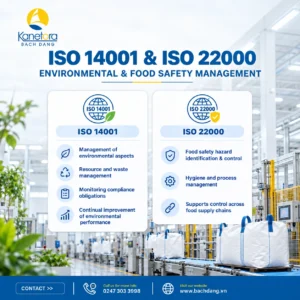
ISO 14001:2015 – Environmental Management
Industrial packaging manufacturing involves polymer materials, energy consumption, machinery, production waste, and several manufacturing processes.
ISO 14001:2015 provides a framework for managing the environmental aspects associated with these activities.
It helps organizations establish systems for:
- identifying environmental impacts;
- managing operational risks;
- improving resource efficiency;
- setting environmental objectives;
- monitoring performance;
- supporting continual improvement.
For buyers increasingly incorporating ESG or supplier sustainability criteria into procurement decisions, ISO 14001 provides an additional reference point when evaluating a packaging manufacturer.
Kanetora Bach Dang’s ISO 14001:2015 certificate covers the manufacture of flexible intermediate bulk containers and, according to the published certificate, remains valid until July 2028 subject to satisfactory surveillance audits. Kanetora Bach Dang – Company In…
ISO 22000:2018 – Why Is It Important for Food Packaging?
For products such as:
- flour;
- starch;
- sugar;
- rice;
- grains;
- whey protein;
- food additives;
- powdered or granular food ingredients,
packaging needs to do more than carry the required load.
It must also support appropriate hygiene and food-safety controls throughout the supply chain.
ISO 22000:2018 specifies requirements for food safety management systems for organizations directly or indirectly involved in the food chain.
For packaging manufacturers serving food-related applications, it supports a systematic approach to identifying and managing relevant food-safety risks.
This is also why a Food Grade Jumbo Bag should not be evaluated only based on whether it is made from virgin polypropylene.
A more complete evaluation should consider:
Raw materials + production environment + personnel hygiene + foreign-matter control + cleaning + inspection + traceability + final packing.
Kanetora Bach Dang’s own guidance on food-grade FIBCs highlights these multiple layers of hygiene and contamination control rather than treating “food grade” as merely a material specification. KANETORA BACH DANG
Why Do BRC and ISO Matter to Packaging Buyers?
1. They Help Reduce Supplier Qualification Risk
When sourcing from a new factory, buyers normally cannot monitor the manufacturer’s operations every day.
Third-party certification provides an additional level of assurance that defined management systems and controls are in place.
This is particularly relevant for:
- international importers;
- multinational companies;
- food manufacturers;
- chemical companies;
- pharmaceutical-related industries;
- companies with supplier audit programs;
- organizations with formal vendor qualification procedures.
However, certifications should never be interpreted as meaning that every product configuration is automatically suitable for every application.
Buyers should always review:
- certificate scope;
- product specification;
- test reports;
- intended application;
- destination-market requirements.
2. They Support Batch-to-Batch Consistency
A successful sample does not necessarily prove long-term manufacturing capability.
For customers purchasing repeatedly, a more important question is:
Will the tenth shipment remain consistent with the first one?
At Kanetora Bach Dang, quality control is implemented at multiple stages of production. QC personnel perform in-process checks, while the QA department conducts final inspections before finished goods are released for shipment. Kanetora Bach Dang – Company In…
This dual-layer approach helps improve production consistency and reduce manufacturing defects.
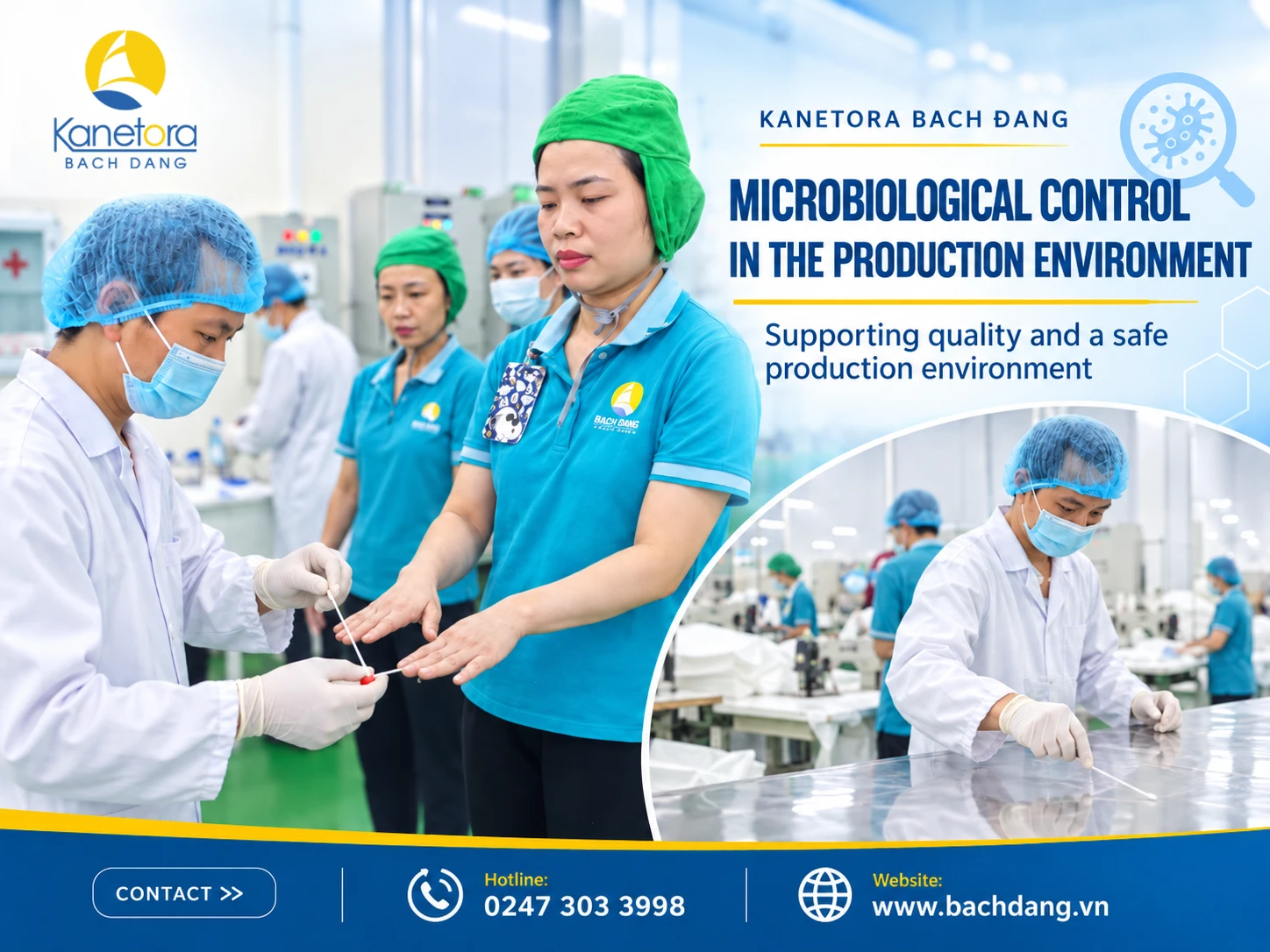
Customers can also learn more about how the factory manages its production environment in Kanetora Bach Dang Strengthens Microbiological Control in the Production Environment. The activity included environmental monitoring and microbiological sampling at the production facility as part of ongoing quality and hygiene management. KANETORA BACH DANG
3. They Support Contamination and Foreign-Matter Control
For food-grade and hygiene-sensitive FIBCs, contamination can originate from many sources:
- dust;
- loose threads;
- PP fibers;
- metal fragments;
- personnel;
- maintenance activities;
- surrounding production areas;
- inappropriate storage;
- final packing.
For this reason, contamination control needs to operate at multiple stages.
Kanetora Bach Dang’s published production information includes facilities and processes for:
- QC inspection;
- protective clothing in controlled areas;
- light-table inspection;
- bag dust removal;
- liner production;
- laboratory testing;
- load testing;
- baling;
- container loading. Kanetora Bach Dang – Company In…
For more detail on this topic, buyers can refer to Food Grade Jumbo Bags: Hygiene and Contamination Control. KANETORA BACH DANG
4. They Make Supplier Assessment Easier for Procurement and QA Teams
Industrial packaging is rarely selected by a single department.
A supplier may need to satisfy requirements from several functions:
| Department | Typical Evaluation Criteria |
|---|---|
| Procurement | Price, capacity, lead time, supply stability |
| QA/QC | Certifications, specifications, inspections, traceability |
| Production | Compatibility with filling and discharge systems |
| EHS | Safety, static control, environmental performance |
| Logistics | Bag dimensions, palletization, container optimization |
| Management | Supplier risk and long-term cooperation capability |
BRC and ISO management systems create a common framework that makes supplier evaluation more structured across these departments.
5. They Become More Important in Export Supply Chains
FIBCs normally operate as one component within a much larger supply chain:
Production plant → filling → warehouse → container → port → international transportation → customer facility
A packaging failure can therefore affect much more than the bag itself.
Examples include:
- inconsistent stitching affecting load performance;
- contamination affecting food ingredients;
- unsuitable liners reducing moisture protection;
- incorrect dimensions reducing container efficiency;
- specification errors affecting filling or discharge operations.
For export customers, packaging sourcing therefore involves evaluating not only the bag price but also the manufacturing system behind the product.
Do BRC and ISO Replace Product Testing?
No.
This distinction is extremely important.
BRC and ISO primarily relate to management systems, certification scopes, and defined manufacturing controls. They do not replace the technical specification or performance testing required for individual FIBC designs.
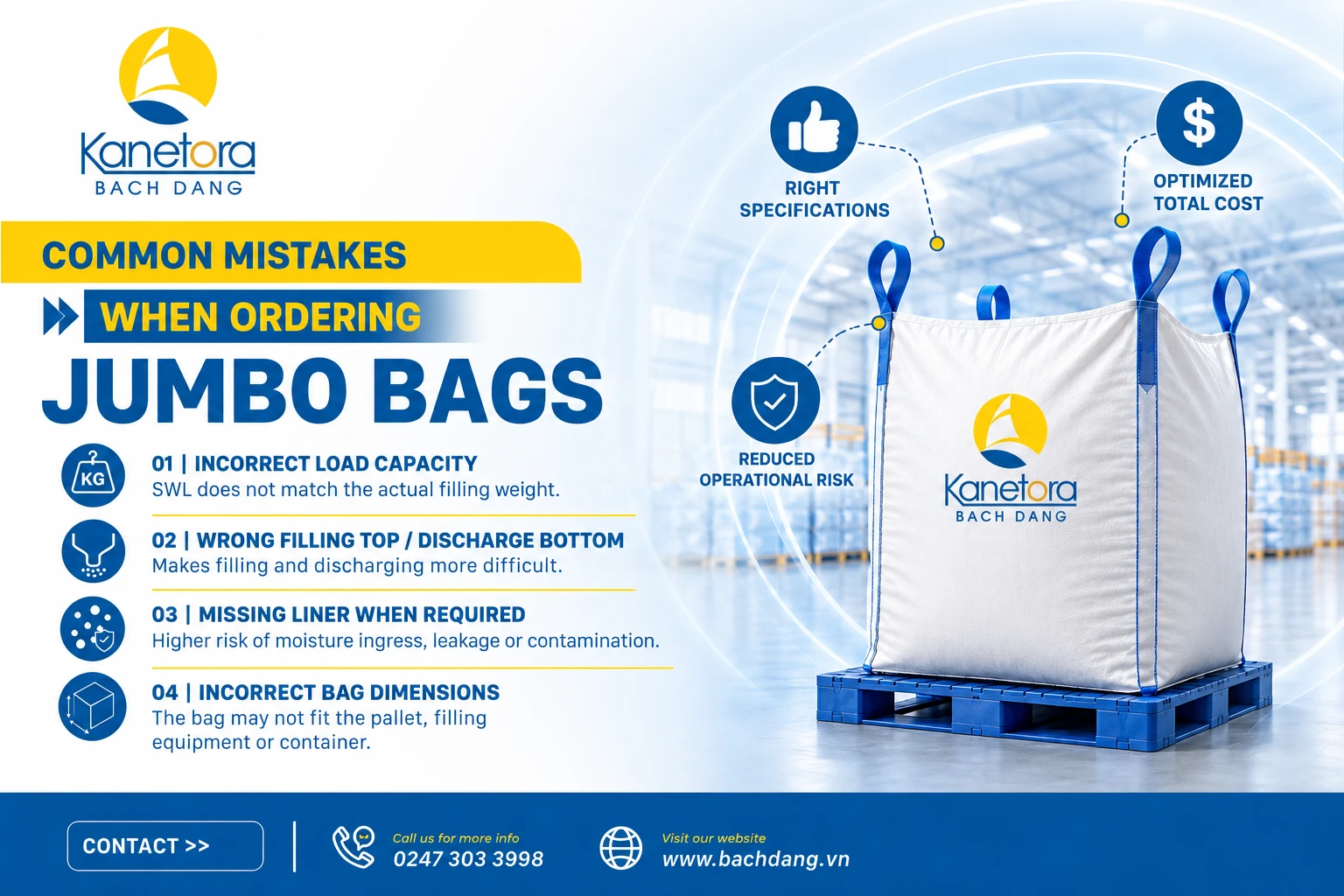
For example, when sourcing a 1,000 kg jumbo bag, buyers should still define and verify factors such as:
- Safe Working Load (SWL);
- Safety Factor (SF);
- bag construction;
- fabric specification;
- lifting loops;
- stitching configuration;
- filling system;
- discharge system;
- coating;
- liner;
- electrostatic properties where applicable;
- lifting and handling conditions.
Kanetora Bach Dang’s factory information shows that its testing equipment includes tensile-strength testing, UV testing, liner testing, and Top Lift Testing for FIBC load performance. Kanetora Bach Dang – Company In…
In other words:
Management-system certification and product testing serve different purposes — and both matter.
From Certification to Real Factory Control
The real value of certification appears when requirements are converted into daily manufacturing practices.
At Kanetora Bach Dang, FIBC production follows an integrated eight-stage process:
Extrusion → Webbing Weaving → Fabric Weaving → Lamination → Cutting & Printing → Sewing → Inspection → Packing
The factory also operates an integrated QC/QA system throughout production.
This creates a broader quality-control chain:
Certification → Management System → Manufacturing Process → Quality Control → Testing → Documentation → Finished Product
This is ultimately what matters to industrial buyers.
A certificate displayed on a wall has limited value unless the requirements behind it are consistently translated into factory operations.
Kanetora Bach Dang – Direct FIBC Manufacturer in Vietnam
Kanetora Bach Dang operates a manufacturing facility in Cau Mai, My Loc Ward, Ninh Binh Province, Vietnam.
According to the company’s current published information, the facility includes approximately:
- 84,000 m² manufacturing area;
- 300,000 FIBC bags/month production capacity;
- 10 million block-bottom valve bags/month;
- 500 tons/month of multilayer PE film;
- 700+ personnel;
- integrated production and laboratory-testing capabilities.
The factory currently lists BRC Grade A, ISO 9001, ISO 14001, and ISO 22000 among its certifications. KANETORA BACH DANG
Kanetora Bach Dang manufactures FIBC solutions for applications including:
- food ingredients;
- minerals;
- construction materials;
- chemicals;
- plastics;
- agricultural products;
- other industrial bulk materials.
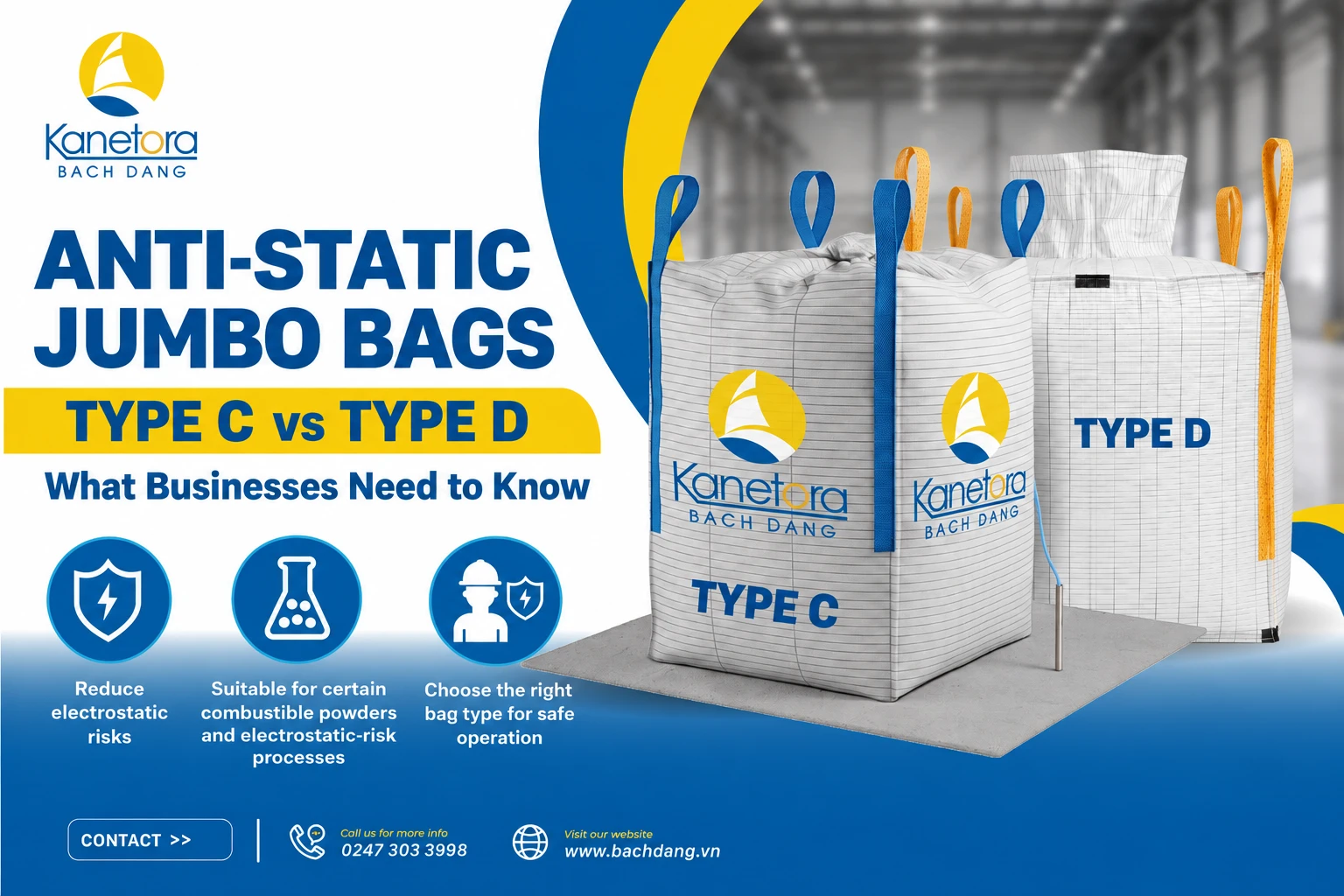
Its FIBC portfolio includes standard bags as well as Food Grade FIBC, Baffle FIBC, Type C FIBC, Type D FIBC, liner-equipped FIBC, and customized filling/discharge configurations.
Buyers looking specifically for hygienic packaging applications can also review the company’s Food Grade FIBC product and related food-grade packaging guidance.
Frequently Asked Questions
Is BRC mandatory for every FIBC manufacturer?
No.
Not every FIBC application requires the same certification system.
BRC/BRCGS becomes particularly relevant where customers require stronger controls around product safety, hygiene, contamination prevention, and supplier assurance.
The exact requirement depends on the industry, customer, target market, and intended application.
Does ISO 9001 mean every jumbo bag automatically meets specification?
No.
ISO 9001 is a quality management system standard. It does not certify each individual bag.
Individual product conformity still depends on:
- agreed specifications;
- production controls;
- testing;
- inspection;
- batch approval.
Is ISO 22000 relevant to Food Grade FIBC?
Yes.
ISO 22000 supports food-safety management across organizations involved directly or indirectly in the food chain.
For packaging manufacturers serving food applications, it is an important part of the broader system used to manage food-safety-related risks.
However, buyers should also review material suitability, hygiene controls, traceability, product specifications, and applicable food-contact documentation.
Why does ISO 14001 matter to packaging buyers?
ISO 14001 demonstrates that a manufacturer has established a structured environmental management system.
This may be increasingly relevant to customers implementing:
- ESG programs;
- sustainable procurement policies;
- supplier environmental assessments;
- international supply-chain requirements.
What documents should Food Grade FIBC buyers request?
Depending on the market and application, relevant documentation may include:
- management-system certificates;
- product specifications;
- test reports;
- inspection reports;
- raw-material information;
- traceability documentation;
- food-contact compliance documentation where applicable.
Kanetora Bach Dang’s published company profile also includes food-contact-related test reports referencing EU Regulation No. 10/2011 and US FDA 21 CFR 177.1520, both recorded as PASS in the documentation. Kanetora Bach Dang – Company In…
Conclusion
For industrial packaging buyers, BRC and ISO should not be viewed simply as certificates displayed in a company profile.
Their real value is the management structure they help create across:
Raw materials → people → production environment → manufacturing → QC/QA → testing → traceability → packing → shipment
A well-managed packaging factory can help customers reduce supplier risk, improve batch-to-batch consistency, and meet increasingly stringent international supply-chain requirements.
Kanetora Bach Dang operates as a direct FIBC manufacturer in Vietnam, supported by integrated manufacturing, QC/QA systems, laboratory testing, and certifications including BRC Grade A, ISO 9001:2015, ISO 14001:2015, and ISO 22000:2018. KANETORA BACH DANG
For companies sourcing FIBC bags for food ingredients, chemicals, minerals, plastics, or other industrial bulk products, Kanetora Bach Dang can develop specifications according to cargo type, loading weight, dimensions, filling and discharge systems, liner requirements, coating, and applicable quality requirements.