

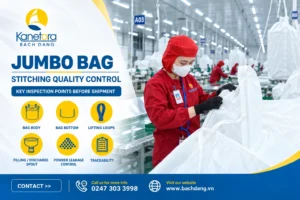
Stitching quality is one of the critical factors affecting the structural integrity, load-bearing performance, and reliability of Jumbo Bags (Flexible Intermediate Bulk Containers – FIBCs). Along with woven fabric strength and bag construction, the quality of sewn seams directly influences lifting-loop stability, product containment, and safe handling during filling, storage, and transportation.
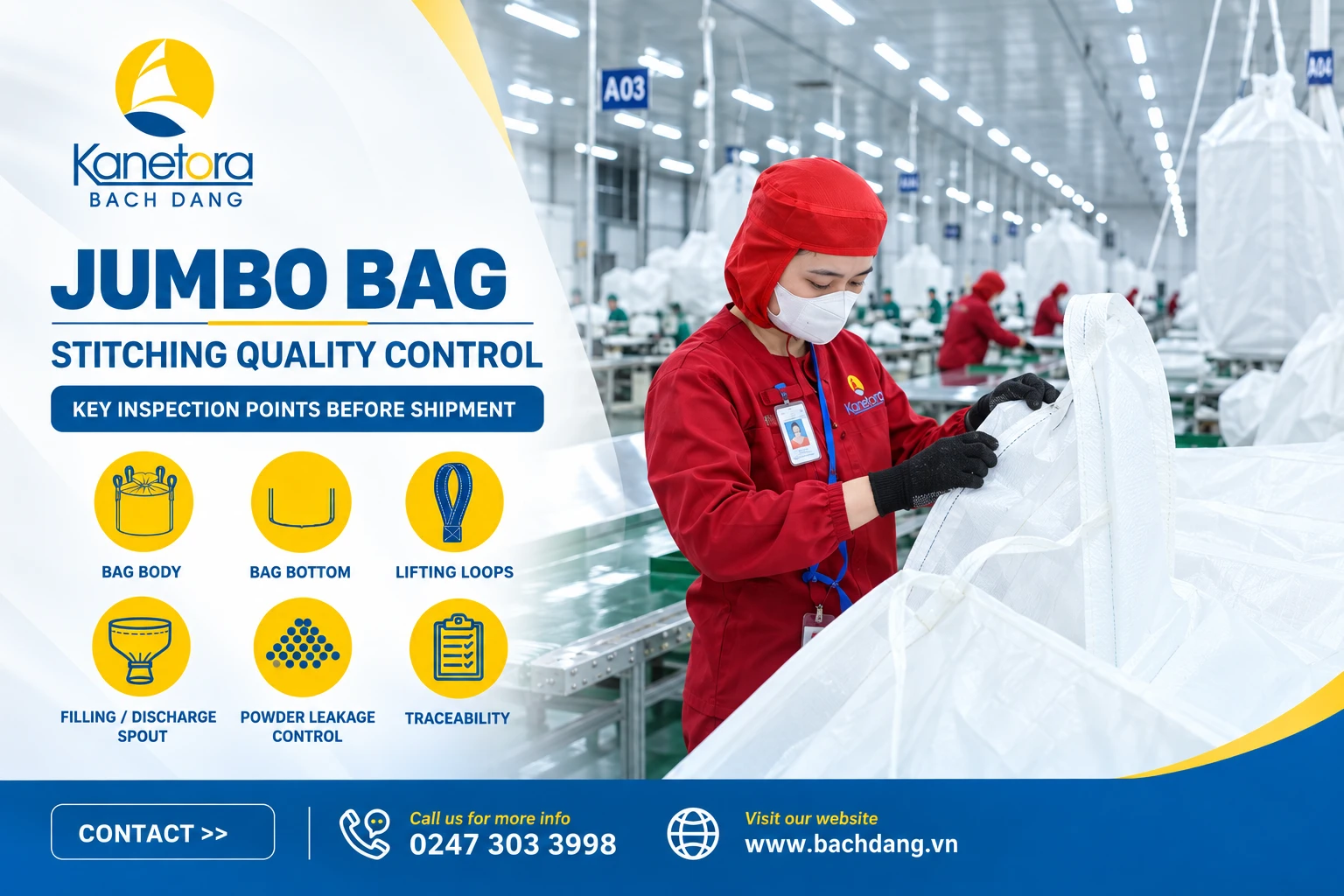
A seam that appears visually acceptable does not necessarily meet all technical requirements. Before shipment, FIBC manufacturers need to inspect body seams, bottom seams, lifting-loop attachments, filling and discharge spouts, loose threads, finished dimensions, labeling, and production traceability.
At Kanetora Bach Dang, stitching quality is managed through an integrated Quality Control (QC) and Quality Assurance (QA) system. Dedicated QC personnel conduct inspections along sewing lines, while the QA department performs final inspections to verify that finished bags meet the agreed specifications before shipment.
1. Why Is Stitching Quality Control Important for Jumbo Bags?
Jumbo Bags are widely used to store and transport bulk materials in industries such as plastics, chemicals, food processing, agriculture, minerals, and construction.
During handling, the weight of the contents generates forces across several structural components, including the bag body, bottom panel, lifting loops, and connecting seams.
If stitching does not meet the required specifications, potential problems may include:
- Seam failure or thread breakage during filling.
- Fine powder leakage through sewn seams.
- Bag deformation under working loads.
- Uneven loading or instability around lifting-loop attachments.
- Incorrectly assembled filling or discharge spouts.
- Loose threads, polypropylene fibers, or other foreign materials inside the bag.
- Inconsistent quality across production batches.
These issues can become particularly significant in food-grade FIBC bags and jumbo bags designed for fine chemical powders, where both structural performance and contamination control are essential.
Therefore, effective stitching quality control should begin during manufacturing rather than being limited to final product inspection.
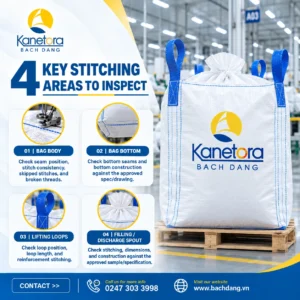
2. FIBC Body Seam Inspection
Body seams connect the woven polypropylene panels to form the main structure of an FIBC.
Depending on the bag design, common constructions include:
- 4-Panel FIBC.
- U-Panel FIBC.
- Circular or Tubular FIBC.
- Baffle FIBC.
Each construction requires a specific seam arrangement and sewing configuration. Inspectors must therefore evaluate stitching against the approved technical drawings and product specifications.
Key inspection points include:
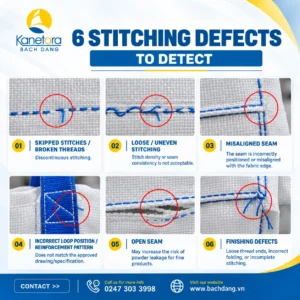
- Correct seam positioning.
- Consistent stitch density.
- No skipped stitches or broken threads.
- No excessive loose stitching.
- Correct fabric alignment.
- Proper joining of overlapping fabric layers.
- No abnormal wrinkling or distortion.
- Correct sewing thread type and color.
- Compliance with the approved sewing configuration.
Consistent body seam quality is particularly important for customized FIBC production, where bags with similar appearances may have different Safe Working Loads (SWL), constructions, and reinforcement requirements.
3. Bottom Seam Inspection
The bottom section of an FIBC supports the contained material during filling, storage, and transportation.
For discharge-spout bags, the bottom assembly also includes additional components such as discharge tubes, closures, and reinforced fabric sections.
During inspection, QC personnel should verify:
- Continuous stitching along the bottom seams.
- Correct alignment between the body and bottom panels.
- Reinforcement at specified seam intersections.
- No missing stitches, thread breakage, or seam separation.
- Correct discharge-spout positioning.
- Discharge-spout diameter and length according to specifications.
- Correct installation of closure ties.
- No distortion around the discharge opening.
For fine powders such as cement, mineral powders, and industrial chemicals, bottom seams must also be evaluated against the required leakage-control performance.
4. Lifting Loop Stitching Inspection
Lifting loops transfer the weight of a filled FIBC to forklifts, cranes, or other lifting equipment.
The connection between the lifting loops and the bag body is therefore among the most critical areas of structural inspection.
Important inspection requirements include:
- Correct webbing material.
- Approved webbing width and construction.
- Consistent lifting-loop length.
- Correct loop attachment positions.
- Proper loop orientation.
- Complete reinforcement stitching.
- No skipped stitches in load-bearing areas.
- No twisting or abnormal folding.
- No visible damage to the webbing.
However, visual inspection of lifting-loop stitching alone cannot establish the load-bearing performance of an FIBC.
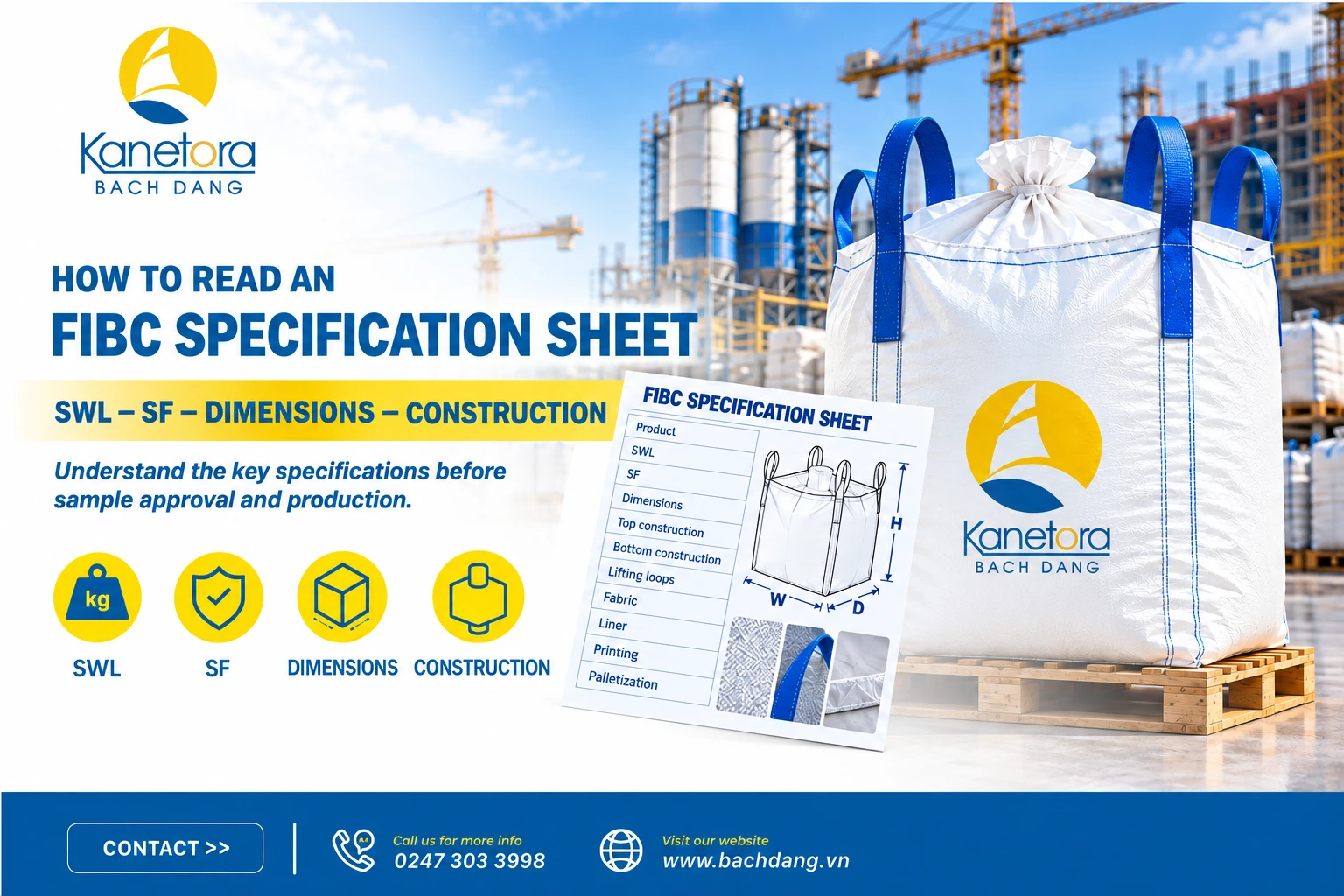
Bag performance must also be evaluated based on its design, Safe Working Load (SWL), Safety Factor (SF), and applicable testing requirements.
At Kanetora Bach Dang, the factory’s testing facilities include a Top Lift Test machine, which evaluates the performance of the complete FIBC structure when lifted through its designed lifting system.
Learn more about different lifting configurations in our guide: 4-Loop Jumbo Bags: Choosing the Right Lifting Option for Forklifts and Cranes.
5. Filling Spout and Top Seam Inspection
The filling system is the interface between an FIBC and the customer’s material-loading equipment.
Depending on the application, Jumbo Bags may feature:
- Open Top.
- Duffle Top.
- Filling Spout.
- Filling Spout with Closure Ties.
- Customized Top Construction.
QC personnel should inspect both the dimensional accuracy and stitching quality of these components.
Inspection points include:
- Filling opening dimensions.
- Filling-spout length and diameter.
- Correct seam position.
- Spout alignment and centering.
- Closure-tie positioning.
- Fabric edge finishing.
- Loose-thread control.
- Correct closure construction.
Incorrectly centered filling spouts or dimensional deviations may create difficulties when connecting the bag to automated filling systems, even when the main bag body meets its structural requirements.
6. Dust Leakage Control at Sewn Seams
Fine powders such as cement, mineral additives, starch, and powdered chemicals can escape through small gaps around sewn seams when the bag construction is unsuitable.
Depending on the material and application, manufacturers may consider:
- Optimized stitch density.
- Dustproof seam construction.
- Additional seam sealing.
- Coated woven polypropylene fabric.
- Polyethylene (PE) inner liners.
- Improved filling and discharge closures.
However, there is no universal dustproof stitching configuration suitable for every bulk material.
The appropriate solution depends on factors such as:
- Particle size.
- Bulk density.
- Flow characteristics.
- Moisture sensitivity.
- Filling and discharge methods.
- Transportation and storage conditions.
For sensitive powders, an FIBC with an appropriately selected inner liner may provide additional protection against dust leakage and environmental exposure.
The final configuration should be determined based on the customer’s product characteristics and packaging requirements.
7. Loose Thread Removal and Post-Sewing Hygiene Inspection
After sewing, loose threads and small polypropylene fibers may remain around body seams, bottom seams, lifting-loop attachments, and spout assemblies.
These materials must be controlled as part of the finishing and inspection process.
For Food Grade FIBC Bags, loose threads and fibers can present foreign-matter contamination risks if they remain inside the finished packaging.
Post-sewing inspection activities may include:
- Trimming loose thread ends.
- Inspecting internal and external surfaces.
- Removing loose polypropylene fibers.
- Cleaning dust and light foreign matter.
- Checking for unwanted materials.
- Metal detection where required.
- Final visual inspection before packing.
Kanetora Bach Dang’s manufacturing system includes cleaning, inspection, and metal-detection capabilities to support hygiene-sensitive FIBC applications.
For a more detailed explanation of contamination prevention, read: Food Grade Jumbo Bags: Hygiene and Contamination Control.
8. Dimensional Inspection After Sewing
Sewing operations can affect the final dimensions of an FIBC because fabric is consumed within the seams.
Without proper dimensional control, finished bags may deviate from the approved technical drawings.
QC inspectors should verify:
- Bag length.
- Bag width.
- Bag height.
- Filling-spout dimensions.
- Discharge-spout dimensions.
- Lifting-loop length.
- Distance between lifting loops.
- Label positioning.
- Document pouch positioning.
- Dimensional tolerances specified by the customer.
Dimensional accuracy is especially important for customers using automated filling equipment, standardized pallet configurations, or container-loading systems.
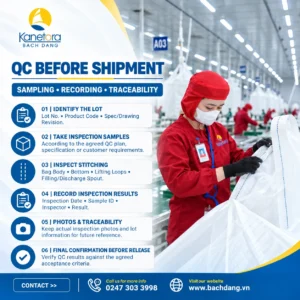
9. Labeling, Product Identification, and Traceability Inspection
A Jumbo Bag may meet its structural requirements but still be unsuitable for shipment if its labeling or product identification is incorrect.
Before final approval, QC and QA personnel should verify:
- Approved printing artwork.
- Correct product code.
- Safe Working Load (SWL).
- Safety Factor (SF).
- Manufacturer identification where required.
- Production batch information.
- Correct label placement.
- Document pouch installation.
- Correct packing specifications.
Proper traceability supports the identification of materials, production stages, inspection records, and batches when quality-related investigations are required.
It also helps reduce the risk of mixing products with different specifications within the same shipment.
10. In-Process Quality Control vs. Final Quality Assurance
An effective FIBC quality management system should not rely solely on inspecting a limited number of finished products at the end of manufacturing.
At Kanetora Bach Dang, quality management involves two complementary functions.
In-Process Quality Control (QC)
QC personnel are assigned to sewing lines to monitor product quality during manufacturing.
Their responsibilities include:
- Inspecting sewing quality and bag construction.
- Checking product dimensions.
- Identifying recurring defects.
- Verifying materials and accessories.
- Comparing production output with approved specifications.
- Detecting deviations that require correction.
Early identification of stitching defects helps reduce repeated production errors and supports timely process adjustments.
Final Quality Assurance (QA)
The QA department conducts final inspections to confirm that finished products satisfy the applicable requirements before shipment.
Depending on the product and customer specifications, quality evaluation may include data from tests such as:
- Tensile strength testing.
- Seam strength testing.
- Top Lift Testing.
- UV resistance testing.
- Puncture resistance testing for liners.
- Heat-seal strength testing.
- Coefficient of friction testing.
- Visual inspection of inner liners using inspection light tables.
These tests support the evaluation of raw materials, semi-finished components, and completed packaging structures.
11. Jumbo Bag Stitching Quality Control Checklist Before Shipment
The following checklist summarizes the main inspection areas for FIBC stitching and finished-bag quality.
| Inspection Area | Key Inspection Requirements |
|---|---|
| Body seams | Correct seam position; no skipped stitches, broken threads, or fabric misalignment |
| Bottom seams | Continuous stitching, correct construction, and specified reinforcement |
| Lifting loops | Correct webbing, loop length, positioning, and reinforcement stitching |
| Filling spout | Correct dimensions, alignment, and seam finishing |
| Discharge spout | Correct dimensions, closure arrangement, and stitching |
| Dust leakage | Appropriate seam structure, coating, and liner configuration where required |
| Loose threads | Proper trimming and removal of loose fibers |
| Finished dimensions | Compliance with approved drawings and tolerances |
| Labeling | Correct product code, SWL, SF, and required identification |
| Traceability | Correct production batch identification and inspection records |
| Visual condition | No visible tears, punctures, contamination, or unacceptable defects |
| Final QA | Product evaluation and approval before shipment |
Important: This is a general technical inspection checklist. Specific acceptance criteria, sampling requirements, and inspection methods must be defined according to the agreed product specifications and applicable standards.
12. Does Stitching Quality Determine the Safe Working Load of a Jumbo Bag?
Stitching quality is a critical factor, but it does not independently determine an FIBC’s Safe Working Load.
The overall load-bearing performance depends on the interaction of multiple components:
Woven fabric strength + body construction + lifting loops + stitching + reinforcement areas + overall bag design.
Therefore, load-bearing performance cannot be established solely through visual inspection or fabric weight.
For example, an FIBC with:
- Safe Working Load: 1,000 kg.
- Safety Factor: 5:1.
does not permit the user to load 5,000 kg into the bag.
The SWL remains 1,000 kg, while the Safety Factor relates to the design’s required testing performance and classification.
Buyers should ensure that the selected FIBC design is suitable for its intended load, handling system, and conditions of use.
13. How Does Kanetora Bach Dang Control FIBC Stitching Quality?
As a direct FIBC and Jumbo Bag manufacturer in Vietnam, Kanetora Bach Dang operates an integrated production and quality-control system covering multiple manufacturing stages.
The factory’s eight-stage production process includes:
- Polypropylene yarn extrusion.
- Webbing weaving.
- Fabric weaving.
- Coating and lamination.
- Cutting and printing.
- Sewing.
- Quality inspection.
- Packing.
The manufacturing facility is equipped with industrial sewing machinery, woven-fabric production lines, cutting systems, and specialized quality-testing equipment.
According to its 2026 company profile, Kanetora Bach Dang operates four sewing workshops with approximately 400 skilled workers, supported by additional temporary operators according to production requirements.
Quality management is organized through two complementary levels:
- In-process QC: Monitoring product quality along manufacturing lines.
- Final QA: Evaluating finished products against the applicable technical requirements before shipment.
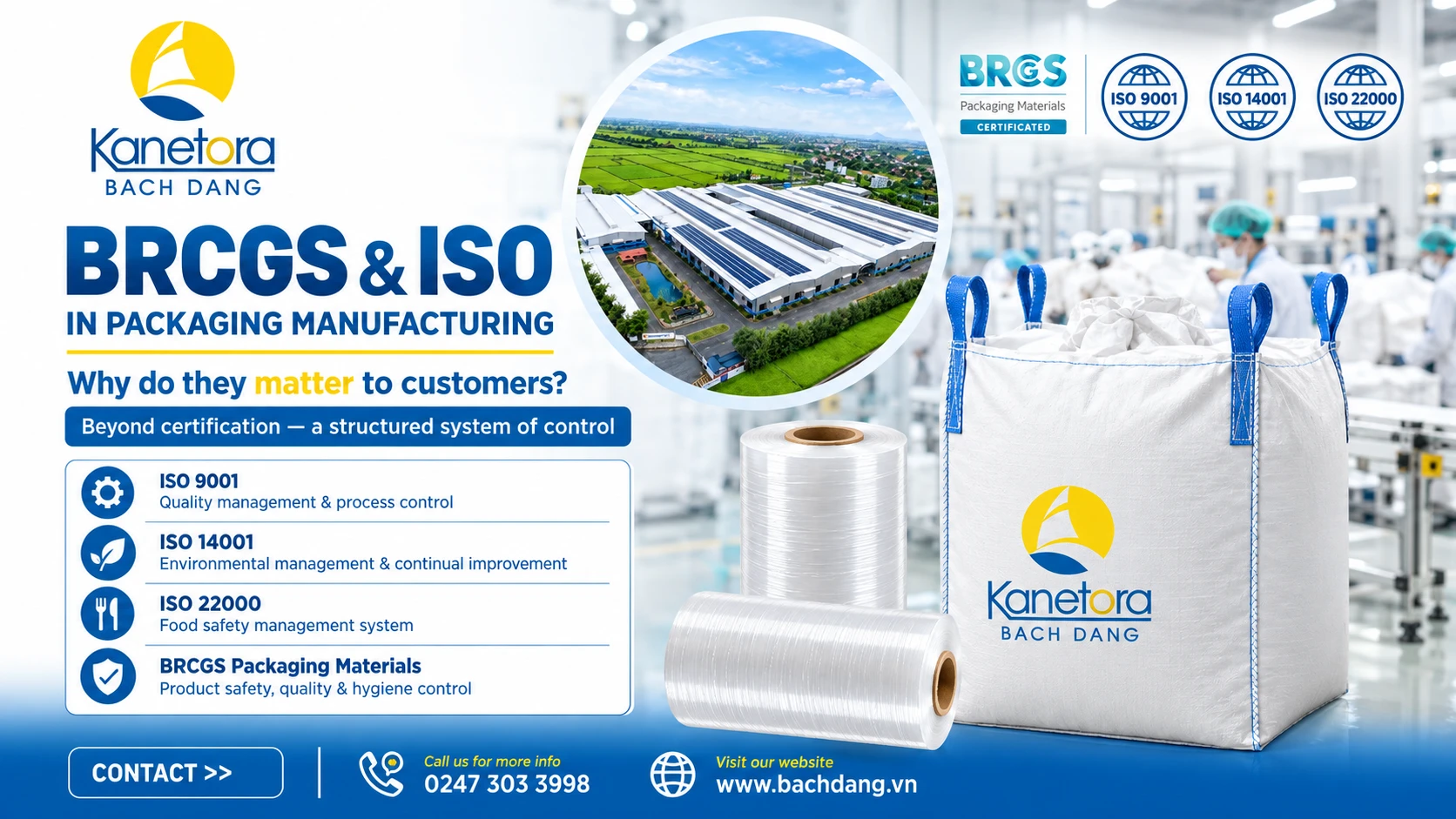
The factory also maintains internationally recognized management systems, including ISO 9001:2015, alongside other relevant quality, environmental, and product safety certifications.
By combining direct manufacturing capabilities with production-stage inspections and technical testing, Kanetora Bach Dang supports customers across various industries, including:
- Food and agricultural products.
- Plastics and polymers.
- Chemical powders and industrial materials.
- Minerals and construction materials.
- Other bulk packaging applications.
For international buyers, working directly with an FIBC manufacturing plant provides greater visibility into production specifications, stitching configurations, quality documentation, sample development, and batch-to-batch consistency.
14. Frequently Asked Questions About Jumbo Bag Stitching Quality
What should be inspected in FIBC stitching quality control?
Key inspection areas include body seams, bottom seams, lifting-loop attachments, filling and discharge spouts, stitch consistency, loose threads, dimensions, and finished-bag appearance. Specific requirements depend on the approved bag design and intended application.
Can defective stitching affect the Safe Working Load of a Jumbo Bag?
Yes. Defects in critical load-bearing seams, especially lifting-loop attachments and reinforced areas, may compromise structural performance. These defects must be evaluated against approved technical requirements.
Can the load capacity of a Jumbo Bag be determined by looking at its stitching?
No. Safe Working Load depends on the complete FIBC design, including woven fabric, lifting loops, seams, reinforcement, and relevant testing results.
Why is in-process stitching inspection important?
In-process inspection helps identify stitching defects early, prevents recurring errors, and allows adjustments before products move to subsequent manufacturing stages.
Do Jumbo Bags for fine powders require different stitching?
They may require different seam configurations or additional dust-control features. Depending on the material, manufacturers may recommend dustproof seams, coated fabric, or an inner liner.
Is visual inspection sufficient to evaluate FIBC seam strength?
No. Visual inspection can identify many manufacturing defects, but seam strength and overall load-bearing performance may require appropriate laboratory or structural testing.
What is the difference between QC and QA in FIBC manufacturing?
QC focuses on checking and controlling products during manufacturing. QA involves broader quality-assurance activities, including confirming that finished products meet the applicable requirements before shipment.
15. Consistent Stitching Quality Supports Reliable FIBC Shipments
Reliable Jumbo Bag quality is not achieved through final inspection alone.
It begins with controlled raw materials, consistent fabric production, accurate cutting, appropriate stitching, and systematic quality verification.
Among these processes, Jumbo Bag stitching quality control plays an essential role in maintaining structural integrity, load-bearing performance, leakage resistance, and consistent finished-bag quality.
At Kanetora Bach Dang, the combination of in-process inspection and final quality assurance supports the early detection of production deviations and helps ensure that finished FIBCs meet the specifications agreed with customers.
Companies sourcing customized FIBC/Jumbo Bags with specific loading capacities, dimensions, lifting-loop configurations, filling systems, discharge arrangements, or dust-control requirements can contact Kanetora Bach Dang for technical consultation and suitable packaging solutions.
KANETORA BACH DANG – COMMITTED PRODUCTION, OUTSTANDING QUALITY
Website: www.bachdang.vn
Hotline: +84 (0) 247 303 3998
Email: info@kanetora.vn
Factory: Cau Mai, My Loc Ward, Ninh Binh Province, Vietnam.