Testing Requirements for UN FIBCs
Depending on the design type and applicable requirements, UN FIBCs may be subject to the following performance tests:
Top Lift Test
Evaluates the strength and integrity of the complete FIBC, including the bag body, lifting loops, seams and other load-bearing components when the bag is lifted according to its intended design.
Drop Test
Evaluates the ability of the FIBC to maintain its integrity when dropped from a specified height.
The test height depends on the Packing Group:
- Packing Group I: 1.8 m
- Packing Group II: 1.2 m
- Packing Group III: 0.8 m
Tear Test
Evaluates the ability of the FIBC material and construction to prevent an initiated tear from propagating further.
Topple Test
Simulates the FIBC being toppled during handling or transportation and evaluates its ability to retain the contents and maintain structural integrity.
Righting Test
Evaluates whether the FIBC can be lifted back into an upright position using its designated lifting devices after being toppled.
Stacking Test
Applicable to design types intended for stacking and evaluates their ability to withstand the specified superimposed load.
Vibration Test is not generally included as a mandatory test for 13H UN FIBCs intended for solid dangerous goods.
How to Identify a UN FIBC
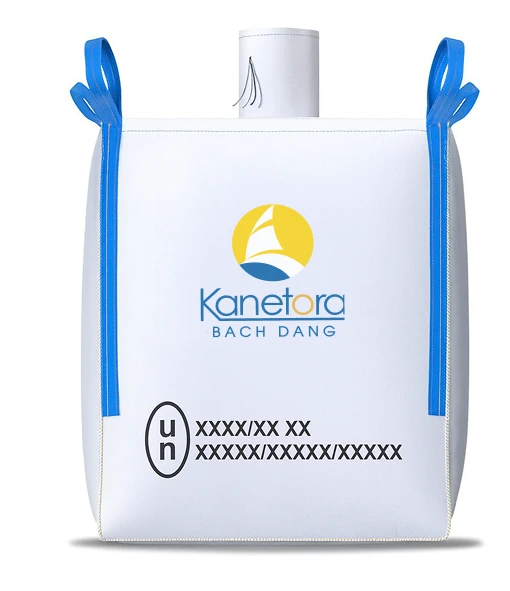
A UN FIBC must carry a UN marking corresponding to its approved design type.
Example:
UN 13H3 / Y / MM YY / Country / Manufacturer ID / …
The marking may include:
- 13H3: Woven plastic FIBC with liner
- X: Performance level applicable to Packing Groups I, II and III for solids
- Y: Performance level applicable to Packing Groups II and III
- Z: Performance level applicable to Packing Group III
- MM/YY: Month and year of manufacture
- Country: Country authorizing the marking
- Manufacturer ID: Manufacturer or approved design-type identification
- Maximum Permissible Gross Mass: Maximum permitted gross mass according to the approved design type
A UN marking is not simply a label attached to the bag. The finished FIBC must be manufactured in accordance with the materials, construction and technical requirements of the corresponding approved design type.
Information Required for Quotation
To select the appropriate UN FIBC configuration, customers should provide:
- UN Number
- Proper Shipping Name
- Dangerous Goods Class
- Packing Group
- Product SDS/MSDS
- Filling weight per bag
- Bulk density
- Required dimensions
- Filling and discharge requirements
- Liner or coating requirements
- Destination country and mode of transportation
Kanetora Bach Dang will evaluate the characteristics of the product and applicable transportation requirements to recommend a suitable FIBC configuration.
Note: A manufacturer’s capability to produce FIBCs or operate load-testing equipment does not mean that every FIBC configuration is UN approved. Customers should verify the UN marking and documentation applicable to the specific design type used for their order.