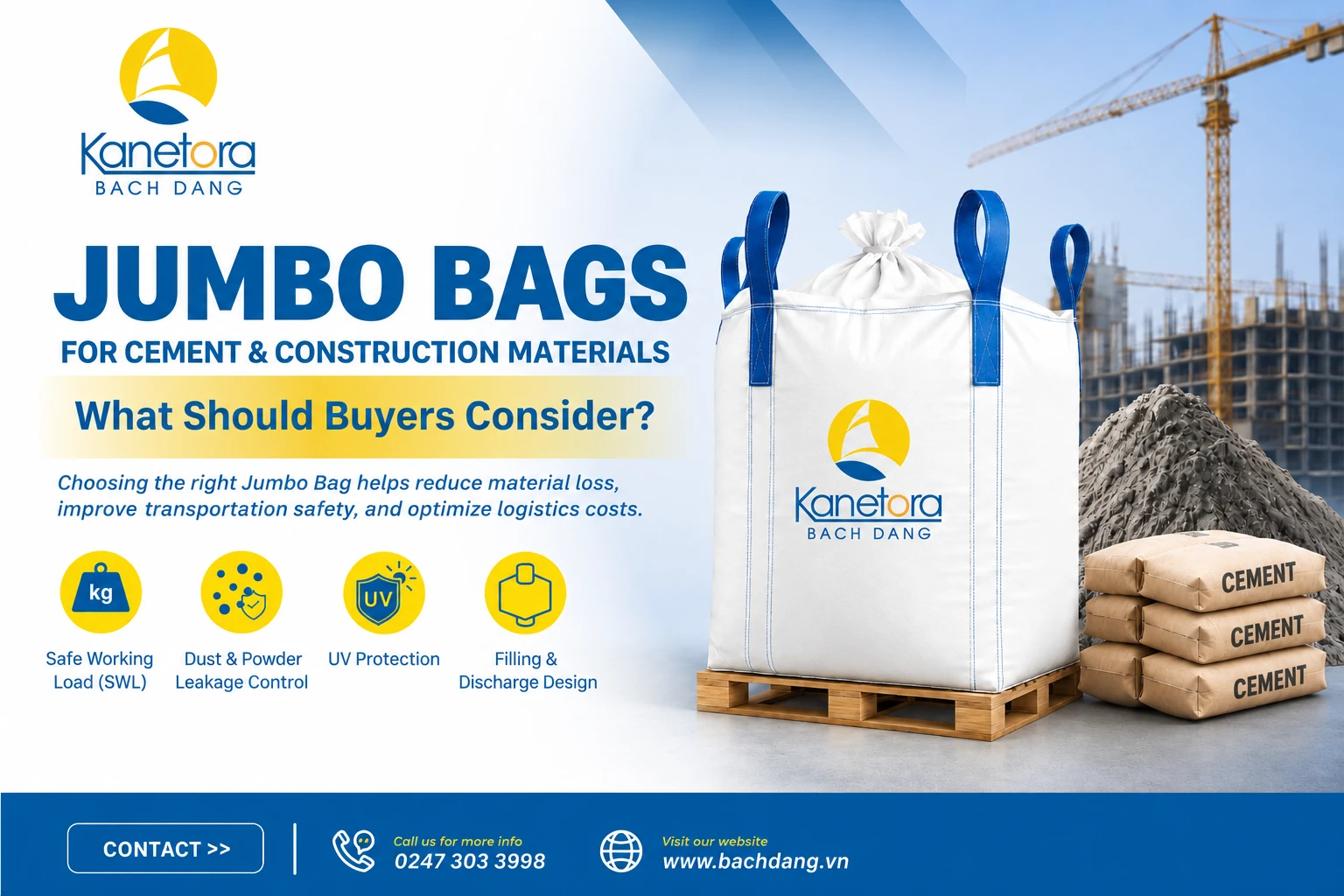


Cement, dry mortar, mineral powders and many other construction materials share several packaging challenges: high bulk weight, fine particles, dust generation and demanding handling conditions.
For this reason, moving from smaller industrial sacks to FIBC Jumbo Bags is not simply a matter of ordering:
“A 1,000 kg Jumbo Bag for cement.”
A suitable FIBC specification should also consider bulk density, dust leakage, Safe Working Load, structural design, coating or liner requirements, filling and discharge systems, lifting equipment, storage conditions and outdoor exposure.
Kanetora Bach Dang manufactures FIBCs in Vietnam with customizable bag construction, coating, liners, filling and discharge options, lifting configurations and functional requirements for different industrial applications.
Are Jumbo Bags Suitable for Cement?
Yes — particularly for bulk industrial quantities, provided the bag is engineered for the actual product and handling process.
FIBCs can be a practical solution when cement or construction materials are supplied in larger quantities to industrial users, batching plants, construction projects or export customers.
However, Jumbo Bags are not automatically the best packaging format for every cement application.
For cement sold in smaller units such as 20 kg, 25 kg, 40 kg or 50 kg, particularly on automatic valve-filling lines, Block Bottom Valve Bags may be a more suitable solution. These bags are specifically designed for powder products such as cement, dry mortar and construction additives, with advantages in filling efficiency, dust control, shape retention and palletizing.
What Is a Block Bottom Valve Bag? Applications for Powders, Chemicals and Construction Materials
Quick Packaging Comparison
| Requirement | Packaging option to consider |
|---|---|
| Cement in 20–50 kg units | Block Bottom Valve Bag |
| Bulk cement or dry mix | FIBC / Jumbo Bag |
| Multiple 25–50 kg bags grouped for lifting | Sling FIBC |
| Better shape for pallet/container loading | Baffle FIBC |
| Higher dust/moisture protection | Coated FIBC or FIBC with liner |
| Controlled discharge into hopper or silo | FIBC with discharge spout |
Which Construction Materials Can Be Packed in FIBCs?
Depending on their physical characteristics and handling requirements, FIBCs may be developed for cement, dry mortar, mineral powders, calcium carbonate, gypsum, construction additives, selected aggregates and other bulk materials.
The key factor, however, is not simply the product name.
Two materials packed at the same nominal weight may require very different bag dimensions if their bulk densities are different.
The design relationship can be summarized as:
target filling weight + bulk density → required volume → bag dimensions → structural design
This is why “1,000 kg FIBC” alone is not a complete technical specification.
1. Bulk Density Should Be Defined First
Bulk density has a direct impact on FIBC size.
A dense construction material may reach its target weight before filling a large bag to its intended volume. A lighter powder may require considerably more internal volume for the same filling weight.
An oversized FIBC can create unnecessary headspace, poor shape retention and inefficient handling.
An undersized FIBC may overfill, distort or interfere with the filling process.
Therefore, before finalizing bag dimensions, the manufacturer should know both the target net weight per bag and the product bulk density.
2. Dust Control Is Critical for Cement and Fine Powders
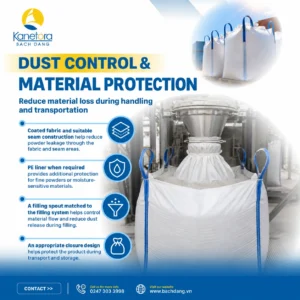
Cement and dry-mix products contain fine particles that may escape through woven fabric gaps, seams or filling/discharge areas when the FIBC is not designed appropriately.
For powder applications, dust performance should be considered across the entire bag:
woven fabric + seams + filling system + discharge system
Simply increasing fabric weight does not necessarily solve powder leakage.
What does coating do?
PP woven fabric can be coated or laminated to reduce the open spaces between woven tapes.
Coating can help:
reduce powder migration through the fabric, improve surface containment, support moisture protection and provide better product protection than basic uncoated fabric.
Kanetora Bach Dang’s manufacturing documentation identifies coating as an option for powders, mineral materials and other products that require improved dust control or moisture protection.
However:
coated fabric should not automatically be described as completely dustproof or waterproof.
The seams, spouts and closures remain part of the complete packaging system.
3. When Should an Inner Liner Be Considered?
Where cement, dry mix or other construction powders need stronger moisture or contamination protection, an inner PE liner or specialized barrier liner may be considered.
A liner provides a separate internal layer and may help improve fine-powder containment and moisture protection.
Coating and liners serve related but different functions.
| Requirement | Coated fabric | Inner liner |
|---|---|---|
| Reduce powder migration through fabric | Good | Good |
| Separate internal protective layer | No | Yes |
| Moisture protection | Supports | Potentially stronger depending on design |
| Simple bag construction | Yes | More complex |
| Requires liner positioning/attachment | No | Often yes |
| Multi-layer barrier options | No | Possible |
Kanetora Bach Dang’s FIBC production process supports various liner configurations alongside coated and uncoated fabric options.
4. Why Do Seams Matter for Fine Construction Powders?
For fine powders, leakage may occur around seams even when the main fabric is coated.
A suitable powder-handling FIBC may therefore require additional consideration of:
seam construction, sift-proof requirements, sewing thread, seam sealing materials where applicable, liner positioning and the connection between the liner and filling/discharge system.
This is why two coated 1,000 kg FIBCs can perform very differently with the same cement or mineral powder.
The complete construction matters more than a single specification such as fabric GSM.
5. Which Filling Top Is Suitable for Cement and Dry Mortar?
For powder filling, a filling spout is often a practical option.
The spout can be designed to interface with the customer’s filling equipment, helping position the bag, control product flow and reduce uncontrolled dust release during filling.
Important parameters include:
spout diameter + spout length + filling-head dimensions + closure method
A spout that is too small may restrict filling speed.
A spout that does not match the customer’s filling head can make bag positioning and dust control more difficult.
The FIBC should therefore be designed around the filling system rather than selecting a generic spout size first.
6. When Is a Discharge Spout Recommended?
Where cement or dry-mix materials are transferred directly into a hopper, silo, mixer or processing line, a discharge spout may provide better control than a flat bottom.
The discharge configuration can help regulate material flow and reduce the need to cut open the bottom of the bag.
However, discharge performance depends on more than the existence of a spout.
Spout diameter, length, closure system, powder flowability, liner design and the receiving equipment should all be considered.
For poor-flowing powders, the customer’s discharge process may also need vibration, massage devices or other flow-assistance systems.
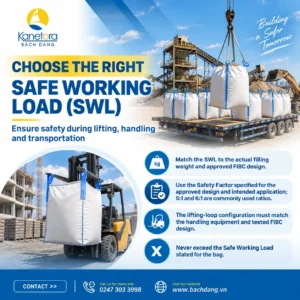
7. SWL Cannot Be Determined From Fabric GSM Alone
Construction materials can be dense and heavy, so load-bearing performance is a critical part of the specification.
SWL – Safe Working Load – applies to the complete FIBC design, not just the woven fabric.
The bag’s load-bearing system includes the body fabric, lifting webbing, loop attachment zones, seams, reinforcement and bottom construction.
Kanetora Bach Dang operates tensile and top-lift testing equipment as part of its FIBC quality-control system.
A bag marked:
SWL: 1,000 kg
SF: 5:1
does not mean that the bag may be filled with 5,000 kg.
The working load remains 1,000 kg. The Safety Factor relates to the design’s test classification and must not be treated as additional usable capacity. Kanetora Bach Dang’s existing SWL guidance makes the same distinction.
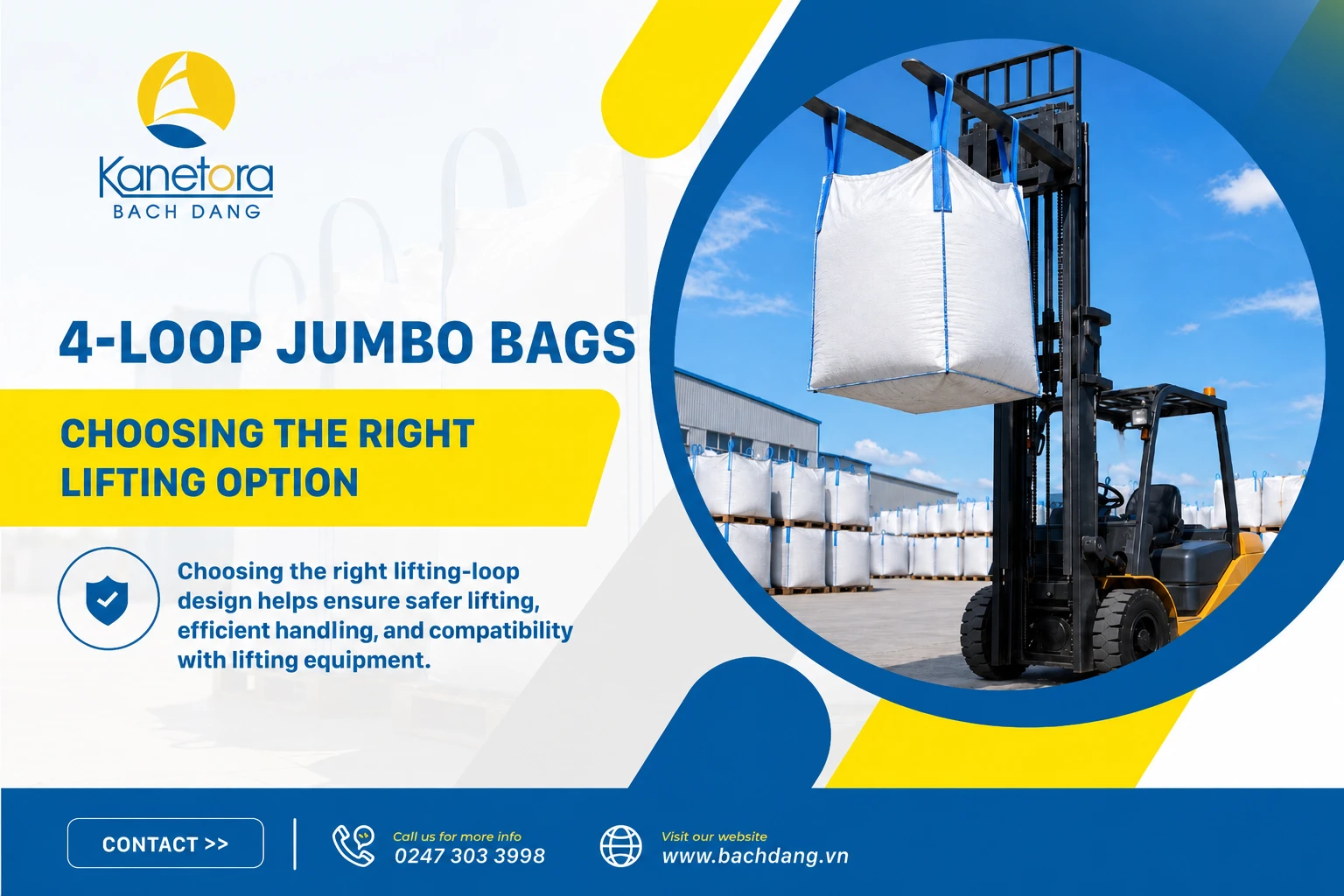
8. Lifting Loops Must Match the Forklift or Crane
Cement and construction-material FIBCs are commonly handled by forklifts, cranes or other lifting systems.
The bag specification should therefore consider the lifting equipment from the beginning.
Fork spacing, bag width, loop height, lifting geometry and the operator’s access to the loops can all influence handling.
Cross-Corner Loops, Corner-Seam Loops and other configurations behave differently during lifting.
Kanetora Bach Dang’s guide to 4-loop FIBCs explains how the lifting-loop design should be matched with actual forklift or crane handling conditions.
4-Loop Jumbo Bags: Choosing the Right Lifting Option for Forklifts and Cranes
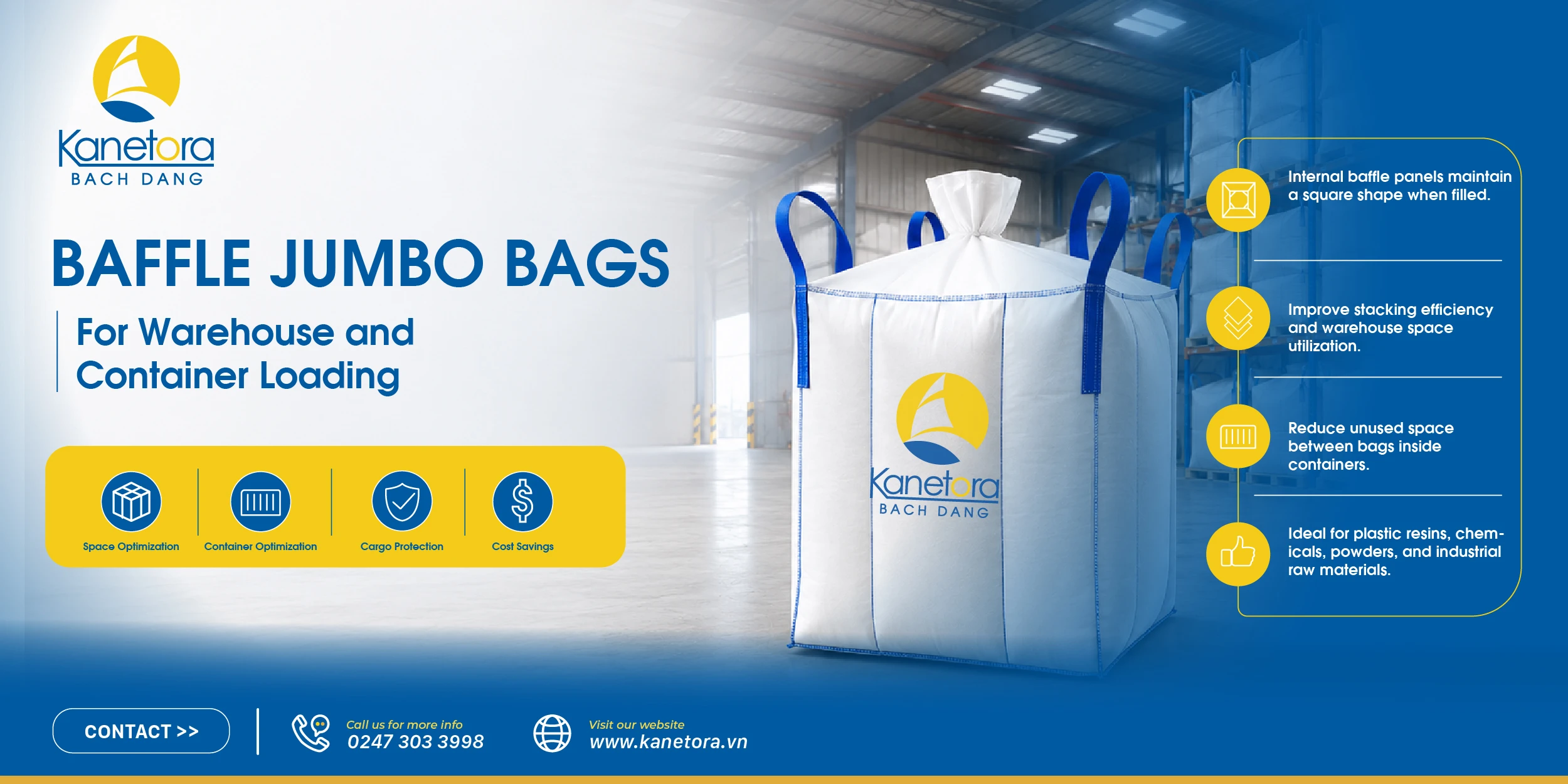
9. Is a Baffle FIBC Necessary for Cement?
Not always.
Internal baffles help reduce side bulging and allow a filled FIBC to maintain a more rectangular profile.
This can be useful when the buyer wants:
better pallet footprint, more consistent dimensions, improved warehouse utilization or more efficient container loading.
However, with dense construction materials, load-bearing performance and product compatibility must come before shape optimization.
A Baffle FIBC should not automatically be assumed to have a higher SWL simply because it maintains a squarer shape.
Bag dimensions, bulk density, filling method, discharge design and container plan should all be evaluated together.
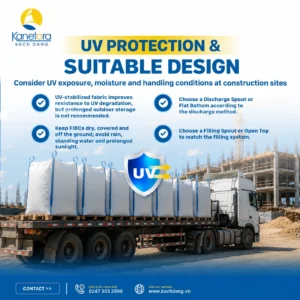
10. Outdoor Storage: UV Protection Is Only Part of the Problem
Construction materials are often stored temporarily at job sites where FIBCs may be exposed to sunlight, heat, dust and moisture.
UV-stabilized PP can improve resistance to sunlight exposure, but UV stabilization should not be interpreted as unlimited outdoor-storage capability.
Actual performance depends on exposure duration, climate, UV intensity and the complete fabric formulation.
For cement and dry mix, water and moisture exposure may be an even more important concern than UV.
The FIBC should therefore be stored in a clean, dry location and protected from rain, standing water and unnecessary outdoor exposure.
Kanetora Bach Dang’s QC laboratory includes UV accelerated-weathering equipment as well as tensile, liner and load-testing systems.
11. Is a Sling Bag the Same as a Jumbo Bag for Bulk Cement?
No.
A Sling FIBC is primarily designed to group and lift multiple smaller bags as one handling unit.
For example, if cement has already been packed in 25–50 kg sacks but the supplier wants to:
reduce individual handling, create one lifting unit, improve port handling or simplify loading and unloading,
a Sling Bag may be more suitable than transferring the cement itself into a bulk FIBC.
Kanetora Bach Dang’s Sling Bag product page specifically describes Sling FIBCs as a solution for grouping multiple small bags such as cement, rice, fertilizers and plastic pellets for unitized lifting.
FIBC Sling Bags for Bulk Material Handling
The distinction is simple:
Bulk cement → FIBC containing the material directly
Cement already packed in 25–50 kg sacks → Sling Bag for unitized handling
Jumbo Bag or Block Bottom Valve Bag for Cement?
Both can be appropriate, but they solve different packaging problems.
| Criteria | FIBC / Jumbo Bag | Block Bottom Valve Bag |
|---|---|---|
| Packaging format | Bulk | Smaller unit bags |
| Typical handling | Forklift / crane | Conveyor / pallet / manual handling |
| Filling system | Bulk filling | Valve packing |
| Number of packaging units | Lower | Higher |
| Retail distribution | Usually less suitable | More suitable |
| Industrial feeding | Highly suitable | More handling required |
| Bulk export | Suitable | Depends on supply model |
| Pallet appearance | Depends on FIBC design | Typically very consistent |
Kanetora Bach Dang manufactures both FIBCs and Block Bottom Valve Bags; the factory currently lists production capacity for both packaging categories.
This makes it possible to select the packaging format based on the customer’s filling weight, production line and logistics model, rather than forcing every construction material into one packaging type.
Example FIBC Configurations for Construction Materials
A typical construction-material FIBC may combine woven PP fabric, coating or liner where required, a filling spout, a discharge system and four lifting loops with a defined SWL.
For fine cement where dust control is important, coated fabric and a suitable seam/filling design may be prioritized.
For moisture-sensitive dry mix, a liner or stronger moisture-barrier structure may be considered.
For feeding into silos or mixers, a controlled discharge spout is usually worth evaluating.
For export shipments where shape and container utilization matter, Baffle construction may be considered.
For very dense powders, structural strength, dimensions and SWL should take priority over cosmetic shape.
And where multiple 25–50 kg cement sacks need to be handled together, a Sling FIBC may be the more appropriate solution.
What Information Should Buyers Provide Before Requesting a Quote?
For a useful technical quotation, the buyer should ideally provide the product name, product form, bulk density, target filling weight, required SWL and Safety Factor, desired bag dimensions if already known, filling method, filling-head dimensions, discharge method, coating or liner requirement, moisture sensitivity, dust-control requirement, forklift or crane configuration, pallet dimensions, container type, indoor/outdoor storage conditions, expected storage duration, destination market and estimated order quantity.
The more clearly the customer defines the product + process + logistics conditions, the easier it is to optimize the FIBC instead of simply increasing fabric weight or bag dimensions.
Jumbo Bags for Cement and Construction Materials from Kanetora Bach Dang
Kanetora Bach Dang manufactures FIBCs directly in Ninh Binh Province, Vietnam.
The factory operates integrated extrusion, weaving, webbing production, coating, cutting, printing, sewing, liner and quality-control capabilities. The company’s website currently lists FIBC output at approximately 300,000 bags per month, alongside Block Bottom Valve Bag and multilayer-film production.
Its production process covers the main FIBC manufacturing stages from PP yarn extrusion through weaving, coating, cutting, sewing, inspection and final packing.
For construction-material applications, this manufacturing setup allows the specification to be developed as a complete system:
dimensions → SWL → fabric → coating → liner → seams → filling/discharge → lifting system
rather than adapting a generic bulk bag after production.
Inside the Export-Standard FIBC Jumbo Bag Manufacturing Process
FAQ – Jumbo Bags for Cement and Construction Materials
Can a Jumbo Bag hold 1,000 kg of cement?
Yes, provided the FIBC is specifically designed and validated for the required SWL and operating conditions. Bag capacity should not be judged only from fabric thickness or physical dimensions.
Does a cement Jumbo Bag always need an inner liner?
No. The requirement depends on moisture sensitivity, powder fineness, transport conditions and the required level of containment. A liner may be valuable where stronger moisture or fine-powder protection is needed.
Are coating and liner the same thing?
No. Coating is applied to the woven fabric, while a liner is a separate internal film layer. They can be used individually or together depending on the specification.
Is a coated Jumbo Bag completely waterproof?
It should not automatically be described as waterproof. Water protection depends on the complete bag construction, including seams, filling top, discharge bottom and closure system.
Can cement FIBCs be stored outdoors?
Outdoor exposure should be minimized. If outdoor storage is unavoidable, UV exposure, rainfall, humidity, ground conditions and storage duration should be included in the original packaging specification.
Should cement Jumbo Bags use a flat bottom or discharge spout?
If the material needs to be discharged into a silo, hopper or mixer, a discharge spout is often more convenient. For other handling processes, a flat bottom may be sufficient.
Is a Baffle FIBC automatically better for cement?
No. Baffles improve shape retention, but they do not automatically increase SWL. Bulk density, load-bearing requirements and handling conditions remain critical.
If cement is already packed in 50 kg sacks, is a Jumbo Bag still necessary?
Not necessarily as the primary package. If the goal is to group several small sacks for lifting and transportation, a Sling FIBC may be a better solution.
Conclusion
A suitable Jumbo Bag for cement or construction materials cannot be selected using only:
“1,000 kg + bag dimensions.”
A complete specification should consider:
material → bulk density → SWL → dust control → moisture protection → filling top → discharge bottom → lifting loops → forklift/crane → storage → job site → container
For bulk material supply, FIBCs can reduce the number of packaging units and simplify industrial handling.
For cement packed in 20–50 kg units, Block Bottom Valve Bags may be more suitable.
For multiple small bags that need to be grouped for crane or forklift handling, Sling FIBCs solve a different logistics requirement.
Selecting the correct packaging system at the beginning can help avoid common problems such as oversized bags, powder leakage, difficult discharge, poor forklift compatibility and unnecessary logistics costs.
KANETORA BACH DANG JOINT STOCK COMPANY
Cau Mai, My Loc Ward, Ninh Binh Province, Vietnam
Website: www.bachdang.vn