

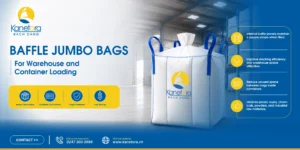
When filled with bulk materials, a conventional jumbo bag can expand outward as the contents exert pressure on the side walls. For companies handling hundreds or thousands of FIBCs per shipment, this bulging can create unused space between bags, complicate pallet layouts and reduce warehouse or container loading efficiency.
Baffle jumbo bags are designed to address this issue.
By incorporating internal baffle panels, these FIBCs help restrict excessive outward expansion and maintain a more square or rectangular profile after filling. They are also commonly known as Baffle FIBCs, Q Bags, baffled bulk bags or form-stable FIBCs.
For businesses that prioritize warehouse utilization, pallet stability and container loading efficiency, a properly designed baffle bag can offer significant operational advantages.
Quick Answer: When Should You Consider a Baffle FIBC?
A baffle jumbo bag may be suitable when your operation requires:
- Reduced sidewall bulging after filling.
- A more stable square or rectangular bag shape.
- More consistent package dimensions.
- Better use of pallet footprint.
- Reduced unused space between bags.
- More efficient warehouse layout.
- Improved container loading configuration.
- Bulk packaging for powders, granules or free-flowing materials requiring better shape control.
However, a Baffle FIBC is not automatically the best solution for every product.
The final design should still consider bulk density, filling weight, bag dimensions, Safe Working Load (SWL), filling and discharge systems, pallet dimensions and the intended container loading plan.
What Is a Baffle Jumbo Bag?
A baffle jumbo bag is a Flexible Intermediate Bulk Container (FIBC) equipped with internal fabric panels that connect different sides or corners of the bag.
These internal panels help restrict excessive outward movement of the PP woven fabric when the bag is filled.
Openings are incorporated into the baffles so that the product can still flow and distribute throughout the bag during filling.
As a result, instead of developing a heavily rounded or bulging profile, the FIBC maintains a more rectangular or square shape.
Kanetora Bach Dang manufactures customizable Baffle FIBC bulk bags for industrial packaging, storage and transportation applications.
Typical Baffle FIBC Configurations
Baffle technology can be incorporated into different FIBC constructions depending on the application, including:
- 4-Panel FIBC.
- U-Panel FIBC.
- Tubular or Circular FIBC.
- Coated FIBC.
- FIBC with inner liner.
- Food-grade FIBC.
- Customized filling and discharge configurations.
The exact construction should be selected according to the physical characteristics of the product and the customer’s handling system.
Why Do Conventional Jumbo Bags Bulge?
When powder, granules or other bulk materials are filled into an FIBC, the contents apply pressure not only to the bottom but also to the side walls.
Because woven polypropylene fabric is flexible, the side panels can move outward under this pressure.
This may result in:
- Curved or rounded side walls.
- A larger actual footprint than the bag’s nominal empty dimensions.
- Gaps between adjacent FIBCs.
- Less predictable pallet dimensions.
- Unused warehouse or container space.
This does not necessarily indicate a manufacturing defect. It is a natural characteristic of flexible bulk packaging under internal load.
A baffle system does not turn an FIBC into a rigid container. Instead, it controls deformation and helps the bag retain its intended geometry more effectively.
How Does a Baffle FIBC Reduce Bulging?
The internal baffle panels act as structural restraints between the walls of the bag.
As the product pushes outward, the baffles restrict the distance that the external panels can expand.
This allows the filled bag to retain flatter sides and a more box-like profile compared with many conventional FIBC constructions.
The result can provide several operational advantages.
1. Better Shape Retention
This is the most visible benefit of a Baffle FIBC.
A conventional FIBC may become increasingly rounded when full, while internal baffles help maintain clearer corners and flatter side walls.
This makes the final package dimensions more predictable.
2. Reduced Gaps Between Bags
Flatter side walls allow neighboring bags to sit closer together.
This can be particularly valuable when:
- Positioning FIBCs on pallets.
- Storing multiple bulk bags in a warehouse.
- Loading bags into shipping containers.
- Arranging cargo on trucks or other transport equipment.
3. More Consistent Unit Loads
A more controlled package profile can make it easier to standardize:
- Pallet dimensions.
- Warehouse locations.
- Container loading patterns.
- Handling procedures.
This is especially useful for companies shipping standardized export loads on a regular basis.
How Can Baffle Jumbo Bags Improve Warehouse Space Utilization?
Warehouse efficiency depends not only on available floor space but also on how much space each individual unit load actually occupies.
For example, an FIBC may be designed with a nominally square footprint. Once filled, however, substantial sidewall bulging can increase its effective footprint.
Across hundreds of bags, these additional centimeters can become significant.
Baffle FIBCs help control this expansion.
Potential Warehouse Benefits
A more stable bag profile can support:
- More predictable storage planning.
- More consistent pallet positioning.
- Better use of warehouse floor space.
- Reduced dead space between packages.
- Easier forklift aisle planning.
- More standardized inventory locations.
For high-volume FIBC users, relatively small dimensional improvements at unit-load level may create meaningful benefits across an entire warehouse operation.
Important Safety Note
The presence of internal baffles does not automatically mean that a bag is suitable for stacking.
Stacking decisions should consider:
- SWL.
- Safety Factor.
- Bag construction.
- Product characteristics.
- Stability of the contents.
- Storage environment.
- Handling procedures.
Baffle construction primarily improves shape retention; it does not replace proper safety evaluation.
How Do Baffle FIBCs Help Optimize Container Loading?
A shipping container has fixed internal dimensions.
For exporters, one of the key packaging questions is therefore:
How can the available container space be utilized efficiently without compromising safe handling?
A heavily bulging FIBC may create unusable gaps:
- Between two adjacent bags.
- Between bags and container walls.
- Between different rows of cargo.
A Baffle FIBC can help reduce these gaps by maintaining a more predictable footprint.
This makes it easier to develop an efficient container loading plan.
However, companies should avoid assuming that every baffle bag produces the same percentage of space savings.
Actual container utilization depends on:
- Internal container dimensions.
- Filled FIBC dimensions.
- Bulk density.
- Filling level.
- SWL.
- Pallet or non-pallet loading.
- Final package height.
- Loading orientation.
- Gross container weight limits.
For this reason, the most effective approach is to design the FIBC around the product and the intended container loading configuration, rather than selecting a standard baffle bag first and adapting the loading plan afterward.
Can Baffle FIBCs Reduce Logistics Costs?
Potentially, yes.
But the correct comparison should focus on total logistics cost, rather than only the purchase price of each bag.
A Baffle FIBC generally requires:
- Additional internal fabric.
- More sewing operations.
- More complex construction.
Therefore, its manufacturing cost can be higher than that of a comparable conventional FIBC.
However, potential operational benefits may include:
- Improved warehouse utilization.
- More consistent pallet configuration.
- Better container space utilization.
- Improved package stability.
- More predictable finished dimensions.
- Reduced unused space between packages.
Instead of asking only:
“How much more does a baffle bag cost?”
buyers should also ask:
“What is the total packaging, warehousing and transportation cost per ton of product?”
That comparison provides a much more useful basis for selecting industrial bulk packaging.
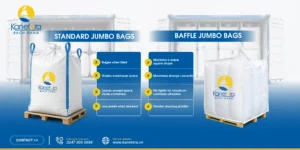
Baffle FIBC vs. Conventional FIBC
| Criteria | Conventional FIBC | Baffle FIBC |
|---|---|---|
| Shape after filling | May develop rounded sides | Better square-shape retention |
| Internal baffles | No | Yes |
| Space between bags | May be larger | Can be reduced |
| Pallet footprint control | Depends on design | Generally more consistent |
| Container utilization | Depends on bulging | Better footprint control |
| Construction | Simpler | More complex |
| Bag cost | Usually lower | Usually higher |
| Customization | High | High |
| Typical priority | General bulk packaging | Shape stability and space optimization |
The table above should be treated as general guidance. Final selection should always be based on the actual application.
Which Industries Can Benefit from Baffle Jumbo Bags?
1. Food and Food Ingredients
Baffle FIBCs can be considered for products such as:
- Flour.
- Starch.
- Sugar.
- Grain products.
- Whey protein.
- Food additives.
- Other powders and granules.
For food applications, however, shape retention is only one consideration.
Packaging must also address:
- Hygiene.
- Foreign-material control.
- Raw material requirements.
- Traceability.
- Liner requirements.
- Cleaning procedures.
- Packing environment.
Learn more in our guide to Food-Grade Jumbo Bags: Hygiene and Contamination Control.
2. Plastic Resin and Polymer Pellets
PP, PE and other polymer pellets are commonly handled in bulk packaging.
Because these materials often have good flowability, the pressure generated during filling can contribute to sidewall expansion.
Where consistent footprints are required for warehouse storage or container exports, a Baffle FIBC may provide a more suitable solution.
Filling spouts, discharge spouts and liners can also be customized according to the customer’s handling system.
3. Chemicals and Powder Products
Certain industrial powders and chemical products may require several packaging functions at the same time:
- Shape stability.
- Dust control.
- Moisture protection.
- Efficient container utilization.
Depending on the application, a baffle construction may be combined with coating or an internal liner.
Where additional moisture protection is required, see our guide to Moisture-Proof Jumbo Bags for Agriculture and Powder Products.
4. Agricultural Products
Certain agricultural powders, ingredients and processed materials may benefit from controlled FIBC dimensions during warehousing and transportation.
Where the contents are sensitive to moisture, a baffle structure can also be combined with a PE liner or multilayer liner solution.
The objective is to address two separate packaging functions:
shape control + product protection.
5. Minerals and Industrial Materials
Baffle FIBCs can also be considered for selected mineral and industrial products where a consistent package footprint is important.
However, higher-density materials require careful engineering.
For these products, load-bearing performance should always take priority over shape optimization.
SWL, fabric specifications, lifting loops, stitching and overall FIBC construction must be evaluated before selecting the final design.
Can a Baffle FIBC Be Combined with an Inner Liner?
Yes.
Baffles and liners perform different functions.
The baffle structure primarily helps manage:
- Bag geometry.
- Sidewall expansion.
- Package footprint.
An inner liner primarily supports:
- Moisture protection.
- Dust containment.
- Product separation.
- Contamination control.
- Barrier performance, depending on liner construction.
Depending on the application, Baffle FIBCs may be combined with:
- Standard PE liners.
- Tabbed liners.
- Form-fit liners.
- Multilayer co-extruded liners.
- Barrier liners.
This combination can be particularly useful where customers require:
shape stability + dust control + moisture protection + product protection.
Information Required When Ordering a Baffle FIBC
To design the correct bag, customers should provide the manufacturer with as much application information as possible.
Key information includes:
- Product name and type.
- Bulk density.
- Required filling weight per bag.
- Target bag dimensions.
- Pallet dimensions, if applicable.
- Container type and planned loading pattern.
- Filling method.
- Discharge method.
- Coating requirements.
- Liner requirements.
- Storage conditions.
- Transportation conditions.
- Food-grade, antistatic or other special requirements.
- Required order quantity.
The more complete this information is, the easier it becomes to engineer the FIBC around the actual application.
Selecting a bag based only on descriptions such as “1-ton bag” or “baffle bag” is rarely enough for an optimized industrial packaging solution.
Baffle Construction Does Not Replace Load Testing
One important point for buyers is:
A bag that maintains an excellent square shape is not automatically a bag with adequate load-bearing performance.
FIBC strength depends on multiple components, including:
- Woven PP fabric.
- Lifting loops.
- Sewing construction.
- Loop-to-body connections.
- Bottom construction.
- Safe Working Load.
- Safety Factor.
- Overall bag design.
Baffle panels therefore do not replace proper quality control or load testing.
At Kanetora Bach Dang, FIBC production is supported by QC and QA controls throughout the manufacturing process, together with testing equipment for fabric, webbing and finished-bag performance.
The factory’s standardized production stages include extrusion, fabric and webbing weaving, coating, cutting and printing, sewing, inspection and final packing.
You can learn more in our guide to the Jumbo Bag Manufacturing Process at Kanetora Bach Dang Factory.
When Is a Baffle FIBC Not Necessary?
Not every bulk packaging application requires baffles.
A conventional FIBC may remain the more economical option when:
- Warehouse space is not a major constraint.
- Container volume is not fully utilized.
- The cargo does not require a precise footprint.
- Transportation distances are limited.
- Pallet dimensions do not need to be highly standardized.
- The additional packaging cost provides little logistics benefit.
In these situations, conventional constructions such as U-Panel, 4-Panel or Circular FIBCs may provide a better balance between performance and cost.
The key is not to specify the most complex bag possible.
The objective should be to specify the simplest FIBC structure that safely and efficiently meets the application’s requirements.
Kanetora Bach Dang – Baffle FIBC Manufacturer in Vietnam
Kanetora Bach Dang manufactures FIBC/Jumbo Bags directly at its production facility in Ninh Binh, Vietnam.
Its FIBC portfolio includes:
- Baffle FIBCs.
- Food-Grade FIBCs.
- Type A and Type B FIBCs.
- Type C FIBCs.
- UN FIBCs.
- FIBCs with inner liners.
- Customized filling and discharge configurations.
- Industrial liner and multilayer PE film solutions.
The facility has a stated FIBC production capacity of approximately 300,000 bags per month and operates integrated manufacturing processes covering extrusion, weaving, webbing production, coating, cutting, sewing, quality inspection, cleaning and packing.
A significant proportion of semi-finished components can also be produced in-house, helping the factory maintain greater control over product consistency and customization.
For companies sourcing industrial bulk packaging from Vietnam, this integrated manufacturing model allows Baffle FIBCs to be developed according to specific product, filling, warehousing and export requirements.
Conclusion: Evaluate Baffle FIBCs from a Logistics Perspective
The key advantage of a Baffle FIBC is not simply that the bag “looks more square.”
Its real value lies in controlling the dimensions of a flexible bulk package after filling.
When properly engineered, Baffle Jumbo Bags can support:
- Reduced sidewall bulging.
- More consistent package dimensions.
- Better pallet utilization.
- More efficient warehouse layouts.
- Improved container loading plans.
- Better unit-load stability.
- Integration with liners, coating and specialized FIBC configurations.
The decision to use a Baffle FIBC should therefore consider the complete system:
Product → Filling → FIBC → Pallet → Warehouse → Container → Transportation.
Rather than selecting a bag only by price or nominal capacity, buyers should evaluate how the packaging affects total handling and logistics performance.
For a customized Baffle FIBC, Q Bag or form-stable jumbo bag, Kanetora Bach Dang can develop specifications based on your product type, bulk density, target filling weight, SWL, pallet dimensions, filling/discharge system and container loading requirements.
Frequently Asked Questions About Baffle FIBCs
What is a Baffle FIBC?
A Baffle FIBC is a flexible intermediate bulk container containing internal fabric panels designed to restrict excessive sidewall expansion and help the filled bag maintain a more square or rectangular shape.
What are other names for Baffle FIBCs?
They are also commonly referred to as:
- Q Bags.
- Baffled bulk bags.
- Form-stable FIBCs.
- Square FIBCs.
- Baffle jumbo bags.
Can Baffle FIBCs increase the number of bags loaded into a container?
They can improve space utilization by reducing excessive sidewall bulging and unused gaps.
However, the actual number of bags per container depends on bag dimensions, bulk density, filling weight, SWL, pallet configuration and the container loading plan.
No single space-saving percentage should be assumed for every application.
Are Baffle FIBCs more expensive than conventional jumbo bags?
Generally, they can be more expensive because the design requires additional internal material and sewing operations.
However, buyers should compare the total cost of packaging, warehousing and transportation rather than bag price alone.
Can a Baffle FIBC use an inner liner?
Yes.
Baffle FIBCs can be combined with PE liners, multilayer liners and specialized barrier liners when additional moisture, dust or contamination protection is required.
Are Baffle FIBCs suitable for food products?
Yes, Baffle FIBCs can be manufactured for food applications.
However, food-grade packaging also requires appropriate raw materials, hygiene controls, foreign-material management, cleaning, traceability and suitable production and packing conditions.
What information is needed for a Baffle FIBC quotation?
Key information normally includes:
- Product type.
- Bulk density.
- Filling weight.
- Bag dimensions.
- SWL.
- Filling and discharge design.
- Liner or coating requirements.
- Pallet dimensions.
- Container loading requirements.
- Certification or special compliance requirements.
- Order quantity.
Providing complete application data allows the manufacturer to recommend a more suitable and cost-effective FIBC configuration.