

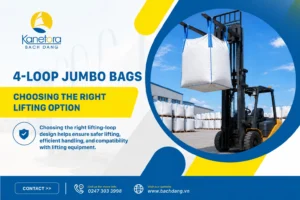
When selecting a Jumbo Bag, buyers often focus first on capacity — 500 kg, 1,000 kg or 1,500 kg — followed by bag dimensions, filling and discharge options, coating or liner requirements.
However, one component directly affects everyday handling and lifting performance but is sometimes treated as a secondary specification: the lifting loops.
A standard 4-loop Jumbo Bag, or 4-loop FIBC, has four lifting points positioned around the upper corners of the bag. These loops allow the FIBC to be handled using forklifts, cranes, hoists or other industrial lifting systems.
But not all four-loop configurations are the same.
Cross-Corner Loops, Corner or Side-Seam Loops and Stevedore Straps create different lifting geometries and different access conditions for material-handling equipment.
For this reason, the lifting-loop design should be selected together with the bag structure, Safe Working Load, filling process and the actual lifting equipment used at the customer’s facility.
For an overview of available FIBC constructions, buyers can also refer to the FIBC/Jumbo Bag solutions manufactured by Kanetora Bach Dang, including various body constructions, inlet/outlet options and lifting configurations.
What Is a 4-Loop Jumbo Bag?
A 4-loop Jumbo Bag is an FIBC equipped with four primary lifting loops positioned at the upper corners of the bag.
This remains one of the most widely used FIBC configurations because it can be integrated with many industrial handling systems, particularly forklifts and four-point lifting arrangements.
However, specifying only:
“1,000 kg Jumbo Bag with four lifting loops”
is usually not enough to complete an FIBC specification.
A technically complete lifting specification may also need to define:
- loop construction;
- loop height;
- loop width;
- loop position;
- sewing configuration;
- forklift fork spacing;
- lifting method;
- SWL;
- Safety Factor;
- filling and discharge equipment;
- available overhead clearance.
The lifting system must be considered as part of the complete load-bearing structure of the FIBC, rather than as a separate accessory.
Kanetora Bach Dang’s FIBC portfolio includes Cross-Corner, Corner Seam and Stevedore lifting options depending on the required bag design and handling method.
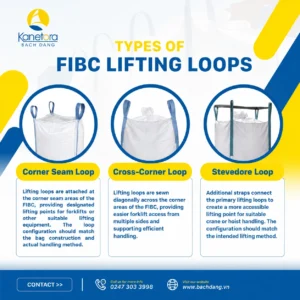
Three Common Lifting Options for 4-Loop FIBCs
| Lifting option | English terminology | Main characteristic | Typical handling consideration |
|---|---|---|---|
| Cross-Corner Loops | Cross-Corner Loops | Loops extend across the corner area of the bag | Forklift handling and applications requiring easier loop access |
| Corner / Side-Seam Loops | Corner Seam / Side-Seam Loops | Loops are integrated into the vertical seam area | Common industrial FIBC configurations including U-Panel and 4-Panel designs |
| Stevedore Straps | Stevedore Loops / Straps | Additional straps connect primary lifting loops | Applications requiring fewer or more accessible lifting points |
A terminology note is important here.
In international FIBC purchasing, terms such as cross-corner, corner seam, side seam and stevedore should preferably be stated clearly in drawings and purchase specifications.
Using only a generic description such as “four loops” may create unnecessary ambiguity between the buyer and manufacturer.
Cross-Corner Loops
Cross-Corner Loops are positioned across the corner area of the FIBC rather than being confined only to a vertical side seam.
This configuration is widely used with different FIBC body constructions, including Circular, U-Panel and 4-Panel bags.
One practical advantage is accessibility during forklift handling.
Depending on the complete design, cross-corner loops may naturally present a wider opening for forklift forks, helping operators engage the loops more efficiently during repetitive material handling.
Cross-Corner Loops may therefore be worth considering when:
- forklifts are the primary handling equipment;
- bags are handled frequently within a warehouse;
- fast fork engagement is important;
- the FIBC is suspended during filling;
- handling efficiency is an important operational requirement.
However, Cross-Corner Loops should not automatically be interpreted as a “stronger” lifting option.
The load-bearing performance of the FIBC also depends on:
- webbing strength;
- loop-leg length;
- attachment area;
- sewing pattern;
- body fabric;
- seam construction;
- bottom construction;
- complete FIBC geometry.
The right loop must therefore be selected as part of the full bag design.
Corner Seam and Side-Seam Loops
With Corner Seam or Side-Seam Loops, the lifting webbing is integrated into the vertical seam area of the FIBC body.
This construction is commonly used with FIBCs manufactured from individual fabric panels, including many U-Panel and 4-Panel Jumbo Bags.
During lifting, the force applied at the loop is transferred through the loop attachment and seam structure into the bag body.
This makes the attachment area particularly important.
The final performance depends not only on the tensile strength of the lifting belt itself, but also on:
- how far the webbing extends down the bag;
- how it is sewn into the body;
- stitch pattern and density;
- seam strength;
- reinforcement design;
- fabric strength.
Another practical consideration is loop presentation.
Depending on bag construction, Side-Seam or Corner-Seam Loops may sit differently when the bag is empty. If fast forklift engagement is a priority, the manufacturer should know how the bag will be approached and handled before the loop configuration is finalized.
For buyers specifying a U-Panel FIBC, the loop construction should therefore be evaluated together with the U-shaped body panel and side-panel configuration rather than as an isolated component.
Stevedore Straps: When Fewer Lifting Access Points Are Needed
A Stevedore Strap is an additional lifting component connecting two or more primary lifting loops.
Its purpose is generally to create a more accessible lifting arrangement when the handling equipment cannot conveniently engage each primary loop individually.
Depending on the design, Stevedore Straps may connect:
- two adjacent loops;
- two opposite lifting points;
- or multiple lifting loops into a designated lifting arrangement.
This can be useful in certain port, crane, hoist or industrial handling environments.
However, there is an important distinction between:
an FIBC intentionally engineered with Stevedore Straps
and
an operator simply gathering standard lifting loops together on a single hook.
These are not technically equivalent.
The lifting method must match the design for which the FIBC was manufactured and tested.
Improperly gathering several lifting loops onto a hook can create undesirable lateral forces and change the load distribution throughout the bag.
For crane-based applications, buyers should therefore provide information about the actual hook, lifting frame or spreader arrangement before the final FIBC specification is approved.
Cross-Corner vs. Side-Seam vs. Stevedore: Which Should You Choose?
There is no single “best” lifting-loop configuration for every Jumbo Bag.
The right design starts with a different question:
How will the bag actually be handled?
| Operating condition | Lifting option to evaluate |
|---|---|
| Forklift is the primary handling equipment | Cross-Corner or conventional four-loop designs matched to fork spacing |
| Bag is suspended at a filling station | Four suspension points and loop height should match the filling equipment |
| Crane or hoist is used | Hook arrangement, spreader configuration and lifting geometry should be defined first |
| Fewer lifting access points are required | Purpose-designed Stevedore Straps may be considered |
| Limited overhead clearance | Total suspended height of the bag and loops must be checked |
| High-density container loading | Loop design, bag dimensions and loading method should be evaluated together |
| High SWL application | Loops, loop attachment, seams and body fabric must be engineered and tested as one system |
This is why specifying only:
“4 loops, SWL 1,000 kg”
still leaves several important engineering questions unanswered.
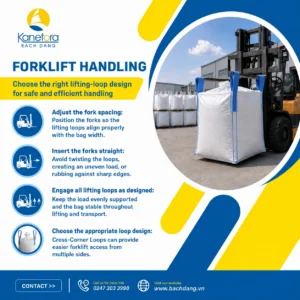
How Should FIBC Lifting Loops Match a Forklift?
One of the most common specification mistakes is designing the bag first and only later checking whether the forklift can handle it conveniently.
A better approach is:
handling equipment first → FIBC lifting configuration second.
The buyer should ideally provide:
- forklift type;
- fork dimensions;
- fork spacing;
- available mast height;
- maximum lifting height;
- operating aisle width;
- pallet use, if applicable;
- bag orientation during pickup.
Fork spacing is particularly important.
During lifting, the loops should remain in an appropriate position without being excessively pulled inward or outward. Poor lifting geometry can generate undesirable lateral loading on the loop system.
Forks and hooks should also have smooth contact surfaces without sharp edges or projections that could cut or damage the lifting webbing.
During transportation, the FIBC should generally be carried in a stable position and should not be dragged across the floor.
The bag should also be handled using all lifting points intended by the design.
Kanetora Bach Dang also conducts internal training related to forklift, overhead crane and lifting-equipment operation, reflecting the practical connection between packaging design and safe material handling.
Why Is the Loop Attachment Area So Important?
When a loaded FIBC is lifted from the ground, the force does not stop at the lifting belt.
The load is transferred through a chain:
lifting equipment → lifting loop → loop attachment/sewing area → body fabric → bottom structure → bulk product
This explains why a high-strength lifting belt alone cannot guarantee a high FIBC Safe Working Load.
The following factors all contribute to structural performance:
- lifting-webbing specification;
- loop-leg length;
- sewing pattern;
- stitch density;
- sewing thread;
- attachment position;
- reinforcement;
- body-fabric tensile strength;
- seam construction;
- base structure.
For this reason, lifting-loop design should always be evaluated as part of the complete FIBC construction.
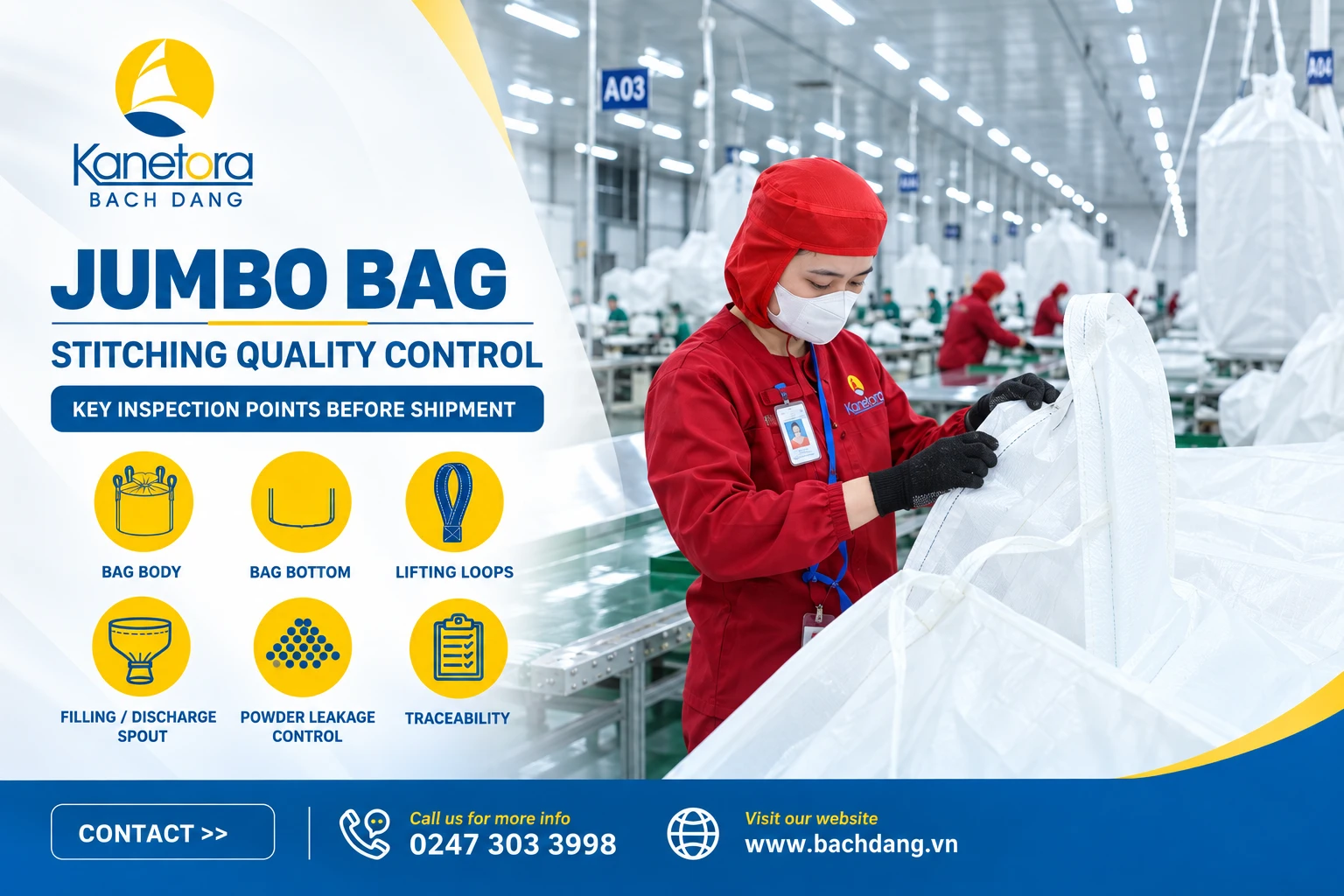
Kanetora Bach Dang’s production process includes webbing weaving, fabric weaving, cutting, sewing, inspection and final packing, allowing the lifting system to be controlled together with the rest of the FIBC structure.
Does a 1,000 kg 4-Loop FIBC Mean Each Loop Only Carries 250 kg?
No. A simple calculation of 1,000 kg ÷ 4 = 250 kg per loop should not be used as the engineering basis for an FIBC.
In actual handling, the load may not be distributed perfectly and equally across all four loops.
Load distribution can be affected by:
- product movement inside the bag;
- uneven filling;
- lifting angle;
- forklift positioning;
- fork spacing;
- bag geometry;
- acceleration and deceleration;
- movement during transportation.
For this reason, the FIBC’s SWL should be established through the performance of the complete bag design, rather than by simply adding together the nominal strength of individual lifting belts.
Kanetora Bach Dang’s 2026 factory profile lists dedicated testing equipment for FIBC production, including tensile testing equipment and a Top Lift Test Machine for evaluating load-bearing performance.
Are Lifting Loops Related to SWL and Safety Factor?
Yes — but the lifting loops are only one part of the structural system.
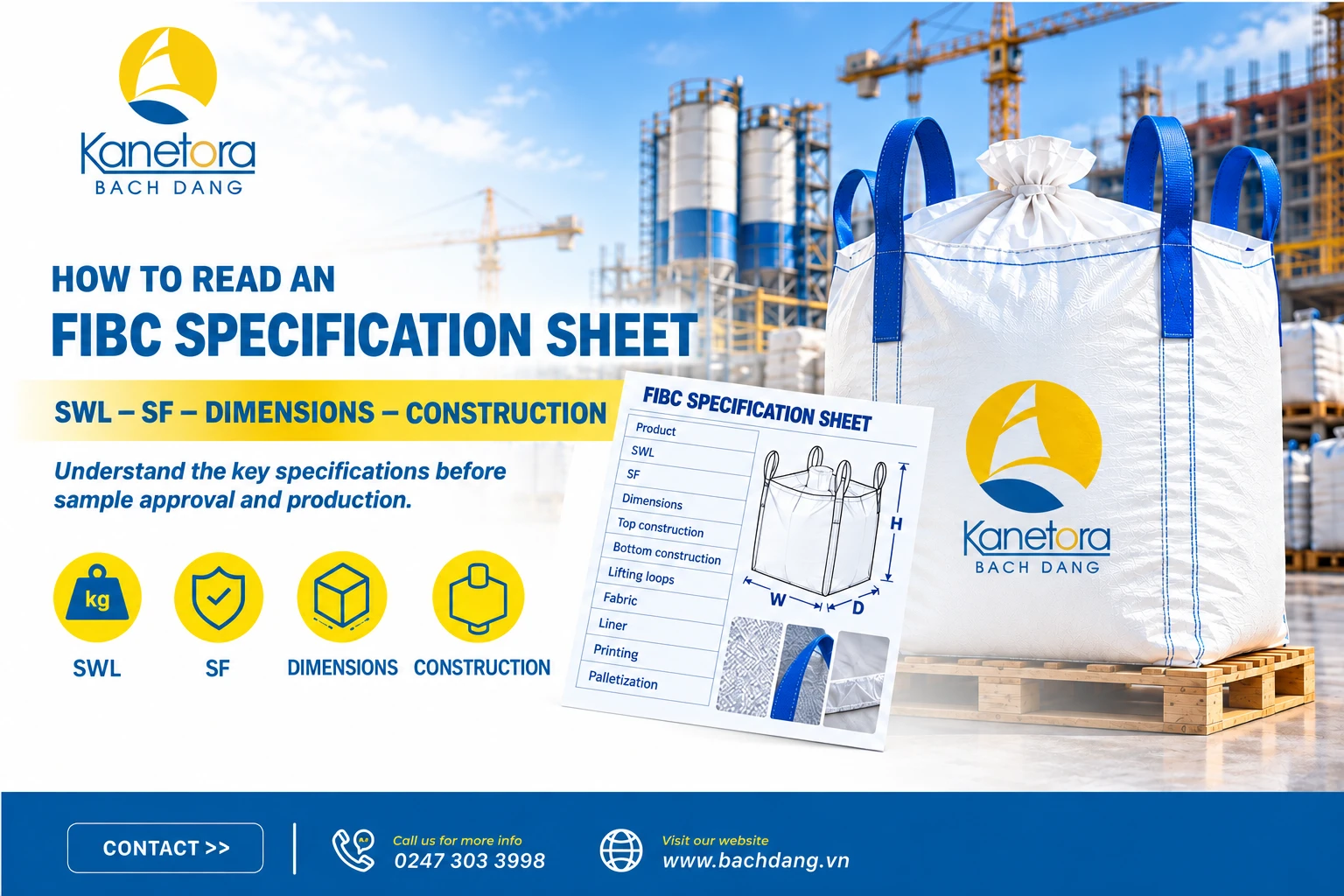
SWL, or Safe Working Load, indicates the maximum load for which a particular FIBC design is intended under defined conditions.
The Safety Factor relates to the test performance required for the specific FIBC design and intended usage.
A Top Lift Test evaluates the bag as a complete load-bearing structure, including the interaction between:
- lifting loops;
- loop attachments;
- seams;
- body fabric;
- bottom structure;
- overall bag geometry.
Therefore, changing an important structural parameter — such as loop design, loop attachment position or body construction — should not automatically be assumed to have no effect on the validated performance of the original design.
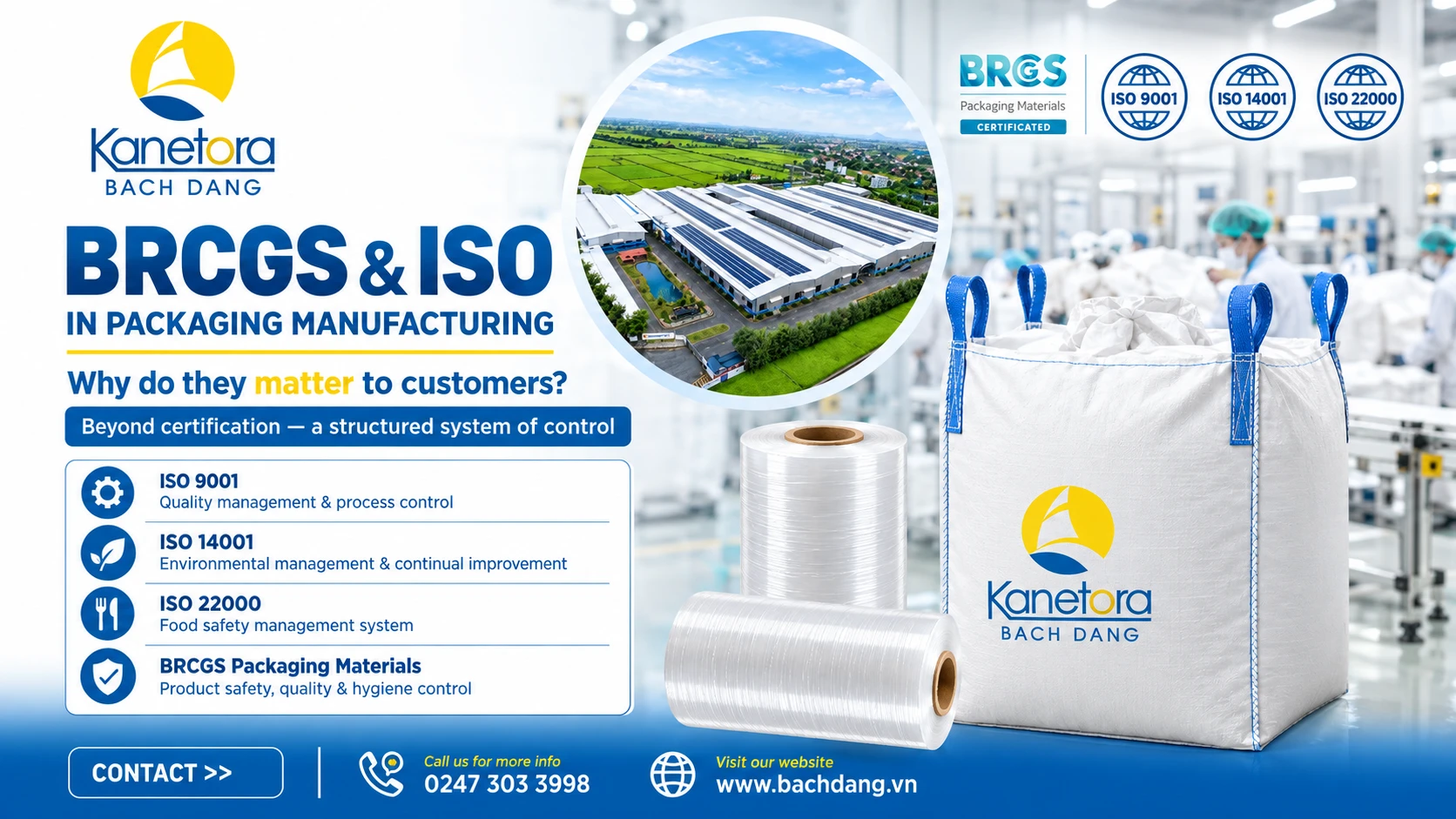
The Kanetora Bach Dang factory applies an integrated QC and QA process throughout production and operates testing equipment for FIBC materials and finished bag performance.
Does the FIBC Body Construction Affect Loop Selection?
Yes.
FIBCs can be manufactured in several common body configurations, including:
- U-Panel;
- Circular or Tubular;
- 4-Panel;
- Baffle.
Each construction creates a different arrangement of fabric panels and seams.
A Circular FIBC, for example, uses a tubular body fabric with fewer vertical body seams, while a 4-Panel FIBC is assembled from separate side panels.
A U-Panel Bag uses one U-shaped section to form the bottom and two opposite sides, combined with additional side panels.
These structural differences influence how load travels through the bag and must therefore be considered when determining the lifting-loop attachment.
For applications where maximizing dimensional stability is the primary objective, buyers may also consider Baffle Jumbo Bags, which use internal baffles to reduce bulging and help maintain a more rectangular filled shape.
However, baffles do not replace the need for properly engineered lifting loops, seams and load-bearing structures.
Can Food-Grade and UN FIBCs Use Customized Lifting Loops?
Yes, provided the final configuration is compatible with the technical requirements of the complete bag design.
For Food-Grade FIBCs, hygiene and contamination-control requirements must be managed together with structural and handling requirements.
The lifting loops may therefore be customized while the production environment, cleaning procedures, contamination controls and packaging process continue to meet the applicable food-packaging requirements.
For UN-certified FIBCs, greater caution is required.
Important structural changes should not be made casually because the certified design relates to a specific construction and tested configuration.
When hazardous materials are involved, the complete FIBC specification should be reviewed against the applicable UN certification and intended application.
Information Buyers Should Provide Before Selecting FIBC Lifting Loops
To reduce specification errors and shorten the technical-development process, buyers should ideally provide the manufacturer with:
- product type;
- bulk density;
- required filling weight;
- required SWL;
- Safety Factor;
- FIBC construction;
- bag dimensions;
- forklift or crane type;
- fork dimensions and spacing;
- crane hook or spreader arrangement;
- required loop height;
- available overhead clearance;
- warehouse handling method;
- filling system;
- discharge system;
- pallet requirements;
- container-loading method;
- coating requirements;
- liner requirements;
- food-grade requirements;
- UN requirements;
- electrostatic-control requirements, where applicable.
This allows the manufacturer to engineer the complete handling solution rather than simply selecting “long” or “short” loops.
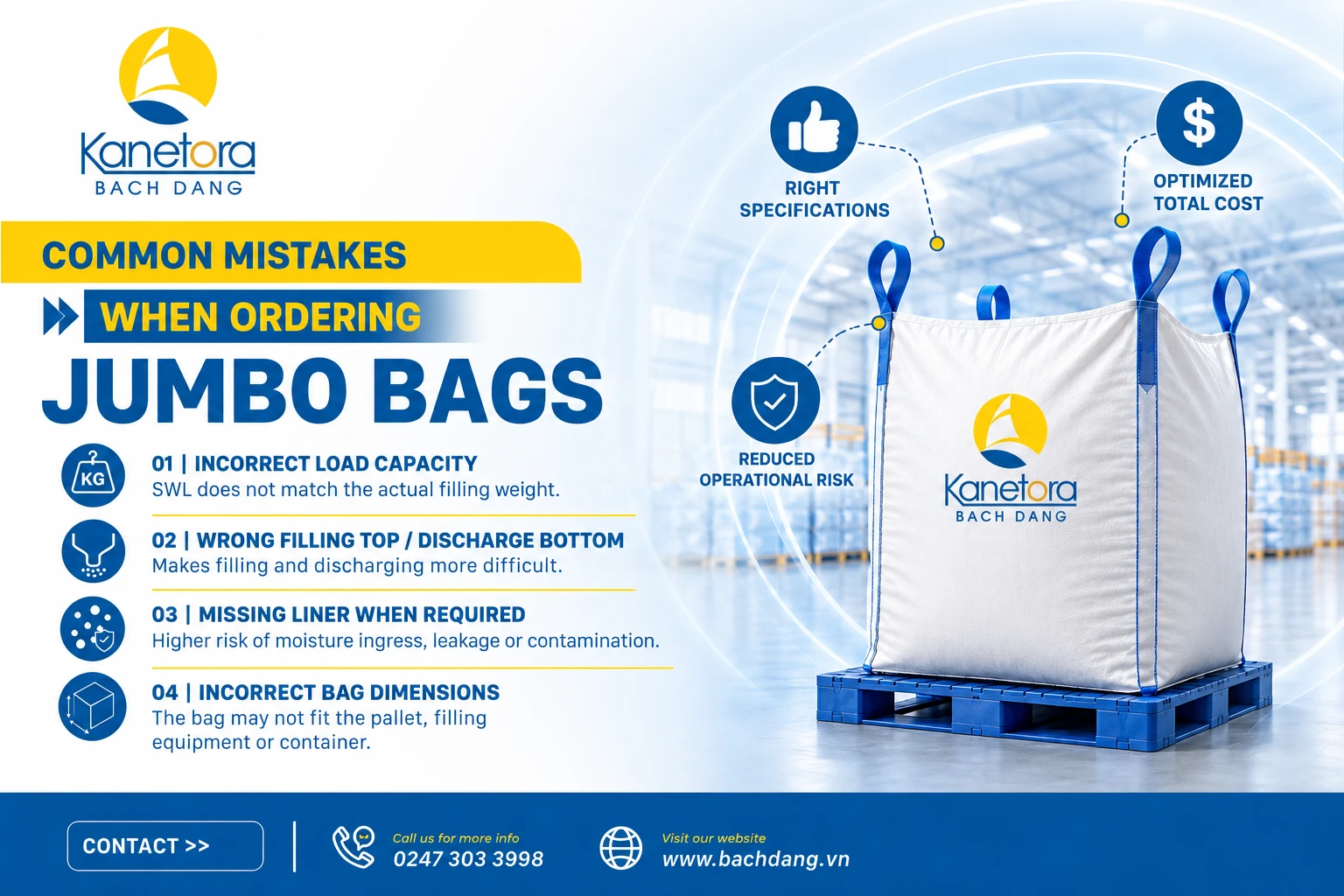
Common Mistakes to Avoid When Handling 4-Loop Jumbo Bags
Lifting loops should never be considered merely as handles attached to the top of the FIBC.
Incorrect handling practices can introduce loads that the original design was not intended to withstand.
Common practices to avoid include:
- lifting the bag with fewer loops than designed;
- improperly gathering four standard loops onto a single hook;
- using forklift forks with sharp or damaged edges;
- lifting with twisted loops;
- dragging the FIBC across the floor;
- applying sudden lifting or stopping forces;
- using lifting equipment that does not match the loop geometry;
- modifying lifting arrangements without checking the original FIBC specification.
Correct handling begins with matching the bag design to the customer’s actual operating conditions.
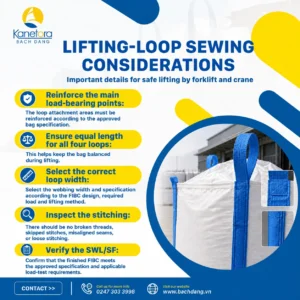
4-Loop Jumbo Bags Manufactured by Kanetora Bach Dang
Kanetora Bach Dang manufactures industrial FIBCs in Ninh Binh, Vietnam, with published production capacity of approximately 300,000 FIBC bags per month.
The factory operates an integrated FIBC production process including:
- PP yarn extrusion;
- fabric weaving;
- lifting-webbing production;
- coating;
- cutting;
- printing;
- sewing;
- inspection;
- testing;
- baling and packing.
The 2026 factory profile lists equipment including 19 belt-weaving machines, 331 sewing machines, tensile testing equipment and a Top Lift Test Machine, supporting in-house control over both semi-finished components and finished FIBC performance.
This production capability allows lifting-loop configurations to be developed together with:
- bag dimensions;
- body construction;
- Safe Working Load;
- filling options;
- discharge options;
- liner requirements;
- coating requirements;
- handling conditions;
- end-use requirements.
Rather than selecting a generic FIBC, buyers can therefore develop a specification based on the way the bag will actually be filled, lifted, stored, transported and discharged.
Frequently Asked Questions About 4-Loop Jumbo Bags
Can a 4-loop Jumbo Bag be used with any forklift?
Not necessarily.
Forklift capacity, fork spacing, fork dimensions, lifting height and operating space should all be compatible with the FIBC and its lifting-loop configuration.
What is the difference between Cross-Corner and Side-Seam Loops?
The main difference is how the loops are positioned and attached to the FIBC body.
Cross-Corner Loops extend across the corner area, while Side-Seam or Corner-Seam Loops are integrated into the vertical seam area of the bag.
This affects both lifting geometry and how easily the equipment can access the loops.
When should Stevedore Straps be used?
Stevedore Straps may be considered when the lifting system requires fewer or more accessible lifting points than the four primary loops provide.
The configuration should be engineered specifically for the intended lifting method.
Can all four lifting loops be placed on one crane hook?
Only when the FIBC and lifting arrangement have been designed for that method.
Standard four-loop bags should not automatically be gathered onto one hook, as this may introduce undesirable lateral loading.
Are longer lifting loops always better?
No.
Longer loops may improve accessibility in some applications, but they also increase the total suspended height of the FIBC and alter the lifting geometry.
Loop height should therefore be matched to the actual handling equipment.
Can changing the lifting-loop design affect SWL?
Yes.
The lifting loop, attachment area and seams are structural components of the FIBC. Changing these parameters can affect how forces are transferred through the complete bag.
What information is most important when ordering a 4-loop FIBC?
At minimum, buyers should provide the product, bulk density, filling weight, SWL, FIBC dimensions, body construction and actual lifting method.
Forklift or crane specifications are highly recommended where the handling arrangement is critical.
Conclusion
Choosing the right lifting configuration for a 4-loop Jumbo Bag is not simply a matter of deciding between Cross-Corner, Side-Seam or Stevedore Loops.
The more important question is:
What equipment will lift the FIBC, under what operating conditions, and at what working load?
Only after these conditions are understood can the manufacturer determine an appropriate combination of:
loop construction + attachment design + bag structure + SWL + handling geometry.
A well-engineered FIBC should create compatibility across the entire operating system:
bulk product → FIBC → lifting loops → forklift/crane → filling system → warehouse → container
For food ingredients, agricultural products, chemicals, plastic resin, minerals and other industrial bulk materials, Kanetora Bach Dang can develop FIBC specifications according to the actual handling and logistics requirements of each application.
KANETORA BACH DANG JOINT STOCK COMPANY
Ninh Binh Province, Vietnam
Hotline: +84 (0) 247 303 3998
Email: info@kanetora.vn