

Moisture is one of the most significant risks affecting agricultural products, food ingredients, animal feed, chemicals, and fine powders during storage and transportation.
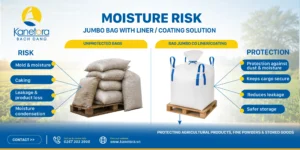
Even a relatively small amount of moisture entering the packaging may cause products to clump, lose flowability, change in quality, or become unsuitable for further processing.
To reduce these risks, businesses often use moisture-proof jumbo bags, also known as moisture-resistant FIBCs. Rather than referring to one specific type of bag, this term covers several FIBC configurations that may include coated woven polypropylene fabric, an internal PE liner, or a multilayer barrier film.
The appropriate bag structure should be selected based on the product’s moisture sensitivity, particle size, storage duration, transportation route, climatic conditions, and hygiene requirements.
Quick Summary
- Coated fabric reduces the open spaces between woven polypropylene tapes, helping control dust and providing a basic level of moisture resistance.
- PE liners create an additional internal barrier and are suitable for fine powders, agricultural products, and moisture-sensitive materials.
- Coated FIBCs combined with liners are commonly considered for export cargo, long-term storage, and transportation through different climatic zones.
- Moisture resistance does not automatically mean complete waterproofing. The filling spout, discharge system, seams, liner closure, and storage conditions must also be carefully controlled.
Businesses unfamiliar with FIBC construction may first refer to our guide on what jumbo bags are, their construction, and their industrial applications.
Why Do Agricultural Products and Fine Powders Need Moisture Protection?
Moisture can reduce the quality of agricultural products
Rice, grains, seeds, beans, animal feed, and other agricultural materials may absorb moisture from the surrounding environment.
When moisture levels exceed acceptable limits, the product may experience:
- Reduced storage stability
- Changes in color or odor
- Clumping or agglomeration
- Difficulty during discharge
- Increased contamination risks
- Reduced commercial value
- Rejection by customers or importers
For export cargo, the risk does not only occur at the producer’s warehouse. Products may also be exposed to changing temperature and humidity during inland transportation, port storage, container loading, and sea freight.
Fine powders are vulnerable to both clumping and leakage
Starch, flour, powdered sugar, food additives, mineral powders, chemicals, and other fine materials usually require protection against two risks at the same time:
- Moisture entering the bag
- Fine particles escaping through the fabric or seams
Standard uncoated woven polypropylene fabric contains small spaces between the warp and weft tapes. These openings may allow very fine particles to escape and may provide limited protection against environmental moisture.
For fine or moisture-sensitive materials, businesses should therefore consider coated fabric, dustproof seams, an internal liner, or a combination of these features.
The jumbo bag manufacturing process at Kanetora Bach Dang Factory includes coating, sewing, inspection, and liner-related processes that can be customized according to the characteristics of each packaged product.
How Are Moisture-Proof Jumbo Bags Constructed?
A moisture-resistant FIBC may include one or more of the following protective components.
1. Uncoated woven polypropylene fabric
Uncoated FIBCs are the most basic configuration. They may be suitable for products that are not highly sensitive to moisture or that require a certain level of airflow.
Typical applications may include:
- Large agricultural grains
- Products requiring ventilation
- Materials stored for relatively short periods
- Products kept in controlled indoor warehouses
- Cargo that does not require strict dust control
However, uncoated woven fabric should not be considered an effective moisture barrier for highly hygroscopic products or cargo transported over long distances.
2. Coated woven polypropylene fabric
Coating is a thin polymer layer applied to the woven polypropylene fabric.
This layer helps:
- Reduce the spaces between woven tapes
- Limit fine powder leakage
- Reduce dust penetration
- Provide a basic to moderate level of moisture resistance
- Improve the consistency of the fabric surface
- Improve printing quality
- Add protection to powder and small-granule products
Depending on the technical requirement, the fabric may be coated on one side or both sides.
However, coating does not automatically make the entire FIBC waterproof. Moisture may still enter through sewing holes, seams, filling openings, discharge spouts, or other areas that have not been properly sealed.
3. Jumbo bags with an inner liner
An FIBC liner is a separate plastic bag installed inside the woven polypropylene outer bag.
The liner creates a direct protective layer between the product and the woven fabric. It may help:
- Reduce moisture ingress
- Prevent fine powder leakage
- Protect product purity
- Reduce contamination risks
- Improve storage stability
- Improve handling during international transportation
Kanetora Bach Dang manufactures FIBC liners and multilayer films using different material combinations, depending on product requirements. The factory is equipped with a multilayer co-extrusion blown film system capable of producing films for FIBC liners, container liners, pallet covers, and other industrial applications.
Learn more about our multilayer PE films and FIBC inner liner solutions.
4. Coated FIBC combined with an inner liner
A coated outer bag combined with an inner liner is often considered when the packaged product:
- Is highly moisture-sensitive
- Has an extremely fine particle size
- Must be stored for an extended period
- Will be transported by sea
- Will pass through different climatic zones
- Requires strict contamination control
- Needs additional protection against product leakage
In this configuration, the coating protects the outer structure and helps control dust, while the liner creates a more effective moisture barrier around the product itself.
Coating vs. Liner: What Is the Difference?
| Criterion | Uncoated FIBC | Coated FIBC | FIBC with Liner | Coated FIBC with Liner |
|---|---|---|---|---|
| Air permeability | High | Reduced | Depends on liner design | Low |
| Dust control | Basic | Good | Very good | Very high |
| Moisture resistance | Low | Basic to moderate | Good | High |
| Suitability for fine powders | Limited | Suitable for some powders | Highly suitable | Highly suitable |
| Customization options | Moderate | High | High | Very high |
| Relative cost | Lower | Moderate | Moderate to higher | Higher |
| Typical application | Large grains and breathable cargo | Minerals, fertilizers, powders | Food ingredients and moisture-sensitive goods | Export cargo and highly sensitive products |
This table should be used as a general reference only. The final bag configuration must be determined based on the actual product, filling system, discharge process, storage conditions, and transportation environment.
Common Liner Types for Agricultural Products and Fine Powders
Lay-flat and gusseted liners
Lay-flat and gusseted liners are widely used in standard FIBC bags. They are relatively simple and can be suitable for:
- Starch
- Flour
- Sugar
- Grain products
- Animal feed
- Fertilizers
- Mineral powders
- Plastic resin
- Industrial additives
Gusseted liners can expand more evenly inside the FIBC body, improving product distribution during filling.
Liners with fixing tabs
Liners may be manufactured with fixing tabs at the top, bottom, or both ends.
These tabs help secure the liner inside the outer FIBC and reduce the risk of:
- Twisting
- Folding
- Liner movement
- Liner collapse during filling
- The liner being pulled back during discharge
This design is particularly useful for automated filling and discharge systems where liner stability is important.
Form-fit liners
A form-fit liner is designed to closely follow the internal shape of the FIBC.
Compared with a basic lay-flat liner, a form-fit liner may provide:
- More even positioning
- Fewer folds and wrinkles
- Improved filling efficiency
- Better compatibility with filling spouts
- More stable discharge performance
Form-fit liners are frequently considered for powders, food ingredients, and automated packaging lines.
Multilayer barrier liners
A single-layer liner may not always provide sufficient protection for highly hygroscopic materials.
Multilayer co-extruded films combine different polymers to improve performance in areas such as:
- Water vapor resistance
- Oxygen barrier
- Mechanical strength
- Puncture resistance
- Heat-sealing performance
- Odor protection
Certain baffled FIBC bag configurations may also be supplied with multilayer barrier liners, depending on the customer’s technical requirements.
The internal baffles help the filled bag maintain a more square shape, reducing bulging and improving palletization and container space utilization.
Aluminum barrier liners
Aluminum barrier liners may be considered for products requiring advanced protection against:
- Moisture
- Oxygen
- Ultraviolet light
- Odor transfer
- Long-term environmental exposure
This is a specialized packaging solution and should be evaluated according to the packaged material rather than applied to all agricultural or powder products.
Selecting Moisture-Proof Jumbo Bags by Product Type
Rice, grains, and seeds
For rice, grains, and seeds, the main objective is to maintain product stability throughout storage and transportation.
Depending on warehouse and export conditions, businesses may consider:
- Uncoated bags for products requiring ventilation
- Coated bags for basic dust and moisture control
- Lined FIBCs for long-term storage or export shipments
- Coated and lined bags for highly humid environments
The moisture content of the product before filling is also critical. A liner can reduce moisture exchange with the outside environment, but it cannot correct a product that already contains excessive moisture when packed.
Starch, flour, and food ingredients
Food powders generally require more than moisture protection. They may also require strict hygiene, contamination control, and dust leakage prevention.
A suitable configuration may include:
- Virgin polypropylene woven fabric
- Coated fabric
- Food-contact-compliant liner
- Dustproof seams
- A closable filling spout
- A controlled discharge spout
- Clean inspection and packing procedures
Businesses can refer to Kanetora Bach Dang’s Food Grade FIBC solutions, which can be manufactured in U-panel, circular, four-panel, or baffled constructions.
The factory operates under quality and food-safety management systems that include ISO 9001, ISO 14001, ISO 22000, and BRC Grade A certification.
Animal feed and agricultural additives
Animal feed may be supplied in powder, pellet, or granular form. The FIBC configuration should therefore be selected according to the particle size, flowability, and moisture sensitivity of the specific formulation.
Possible solutions include:
- Coated FIBCs for feed pellets
- Lined FIBCs for powdered feed
- Dustproof seams for fine additives
- Filling and discharge spouts for controlled handling
For products packed in smaller units, generally from approximately 20 to 50 kilograms, a block-bottom valve bag may sometimes be more appropriate than a large FIBC.
Fertilizers and agricultural chemicals
Some fertilizers are highly hygroscopic and may rapidly clump when exposed to humid air.
For these products, a coated FIBC combined with a sealed liner may offer better protection than standard woven polypropylene bags.
Additional factors should also be assessed:
- Chemical compatibility between the product and liner
- Electrostatic risks
- UV protection requirements
- Indoor or outdoor storage conditions
- Potential product corrosion or reaction
- Required filling and discharge method
Where combustible dusts or flammable environments are involved, the appropriate antistatic FIBC classification must also be evaluated.
Mineral powders and industrial materials
Calcium carbonate, silica, cement fillers, construction additives, and other mineral powders often require strong dust control.
Coating may be sufficient for many standard applications. However, an internal liner may be required when:
- The powder is extremely fine
- Product leakage must be minimized
- Moisture content must remain stable
- The product is transported over long distances
- Cleanliness is a priority
Moisture Resistance Does Not Mean Complete Waterproofing
This is an important distinction when purchasing FIBC bags.
Even a coated or lined jumbo bag may still be exposed to moisture if:
- The liner opening is not properly closed
- The liner is punctured during installation or filling
- The discharge design does not match the liner
- Sewing needles penetrate the intended barrier area
- The bag is exposed directly to rain
- The bag is placed on a wet warehouse floor
- The container has leaks, water ingress, or excessive condensation
- The closure method is unsuitable for the transportation conditions
A supplier should therefore avoid making a general “waterproof” claim solely because a bag includes coating or a liner.
The complete packaging system must be evaluated, including fabric, seams, liner, closures, filling methods, warehouse conditions, and transportation risks.
Information Required When Ordering Moisture-Proof FIBCs
To recommend the correct bag configuration, the manufacturer should receive the following information.
1. Product name and characteristics
Specify whether the product is a powder, pellet, granule, seed, flake, or irregular material.
2. Bulk density
Bulk density is essential for determining the required bag volume and dimensions.
3. Safe Working Load
Common SWL requirements include:
- 500 kg
- 1,000 kg
- 1,250 kg
- 1,500 kg
- 2,000 kg
Custom loads may also be considered based on the bag construction and test requirements.
4. Moisture sensitivity
The customer should clarify whether the product has low, moderate, or high moisture sensitivity.
5. Expected storage duration
Storage for several weeks may require a different packaging solution from storage lasting several months.
6. Transportation method
Possible transportation routes include:
- Domestic trucking
- Rail transport
- Sea freight
- Multimodal transportation
- Long-distance export shipments
7. Filling and discharge design
Typical options include:
- Open top
- Duffle top
- Filling spout
- Flat bottom
- Discharge spout
- Full-open bottom
8. Coating requirement
The customer should specify whether the fabric must be:
- Uncoated
- Coated on one side
- Coated on both sides
9. Liner requirement
Important liner specifications include:
- Film material
- Film thickness
- Single-layer or multilayer structure
- Lay-flat, gusseted, or form-fit design
- Fixing method
- Closure method
- Top and bottom configuration
10. Hygiene and certification requirements
Examples may include:
- Food-grade packaging
- Food-contact compliance
- Antistatic requirements
- UN-certified packaging
- Customer-specific standards
- Cleanroom inspection or packing
11. Pallet and container arrangement
The manufacturer should know whether the bags will be:
- Palletized
- Double-stacked
- Loaded directly into a container
- Stored in racks
- Lifted by forklift or crane
12. Single-trip or reusable application
The required safety factor and FIBC construction may differ depending on whether the bag is designed for a single trip or controlled multiple use.
Providing complete information at the beginning of the project helps reduce sample revisions, shorten development time, and ensure compatibility with the customer’s packaging line.
Storage Recommendations for Agricultural and Powder Products
A suitable FIBC is only one part of an effective moisture-control strategy. Warehouse and transportation conditions must also be properly managed.
Do not place bags directly on the floor
Filled FIBCs should be placed on clean, dry pallets with sufficient load-bearing capacity.
Direct contact with a concrete floor may expose the bag to moisture, water, contamination, or physical damage.
Maintain distance from walls and roofs
Bags should not be stored directly against damp walls, warehouse doors, or areas at risk of roof leakage.
Adequate spacing also allows easier inspection and airflow management.
Inspect containers before loading
Before loading, the container should be:
- Clean
- Dry
- Free from strong odors
- Free from holes or leakage
- Free from standing water
- Structurally suitable for the cargo
Close the liner immediately after filling
Once filling is complete, the liner should be closed according to the approved method.
Possible closure methods include:
- Twisting and tying
- Heat sealing
- Cable ties
- Custom sealing systems
Leaving the liner open for an extended period may reduce its effectiveness as a moisture barrier.
Do not use desiccants as a substitute for proper packaging
Container desiccants may support humidity control, but they cannot replace an appropriately designed liner or barrier packaging system.
The amount and placement of desiccants should be determined based on the route, transit time, product, container size, and environmental conditions.
Common Mistakes When Selecting Moisture-Resistant FIBCs
Requesting a “moisture-proof bag” without technical information
Moisture protection requirements vary significantly between products.
One product may only need basic protection for a few weeks, while another must maintain strict moisture stability during several months of transportation and storage.
Selecting a liner based only on thickness
A thicker liner does not always provide better moisture-barrier performance.
Performance also depends on:
- Polymer type
- Number of layers
- Film structure
- Seal quality
- Puncture resistance
- Closure method
- Manufacturing consistency
Ignoring filling and discharge openings
A high-performance liner may still fail if the filling spout, liner opening, or discharge system is not properly designed.
The liner must remain stable and secure throughout both filling and emptying.
Using the same bag configuration for every product
Rice, starch, fertilizer, animal feed, mineral powder, and chemicals have different physical and storage characteristics.
Using one universal bag configuration may result in unnecessary costs or insufficient product protection.
Skipping production-line testing
For large-volume orders, customers should test samples using their actual:
- Filling equipment
- Weighing system
- Lifting equipment
- Pallet arrangement
- Discharge equipment
Sample testing helps confirm that the bag and liner perform correctly under real operating conditions.
Direct Moisture-Proof Jumbo Bag Manufacturer in Vietnam
Kanetora Bach Dang is a Vietnam-based manufacturer of FIBC jumbo bags, block-bottom valve bags, FIBC liners, and multilayer PE films.
The factory operates an integrated production system covering:
- PP tape extrusion
- Fabric weaving
- Webbing production
- Coating
- Cutting
- Printing
- Sewing
- Liner manufacturing
- Inspection
- Baling and packing
Kanetora Bach Dang currently has an FIBC production capacity of approximately 300,000 bags per month and a multilayer film production capacity of approximately 500 tons per month. The factory also operates quality-control systems and testing equipment for woven fabric, webbing, seams, liners, UV resistance, and lifting performance.
Businesses can explore more information through:
- Kanetora Bach Dang Factory
- Jumbo Bag Manufacturing Process at Kanetora Bach Dang Factory
- What Capabilities Should a Jumbo Bag Factory in Vietnam Have?
- FIBC Bag Product Category
The factory applies a standardized eight-step FIBC production process, including extrusion, webbing and fabric weaving, coating, cutting and printing, sewing, inspection, and packing.
How Kanetora Bach Dang Develops Moisture-Proof FIBC Solutions
Step 1: Product assessment
The technical team evaluates:
- Product type
- Particle size
- Bulk density
- Moisture sensitivity
- Flowability
- Hygiene requirements
- Filling and discharge conditions
Step 2: Bag configuration recommendation
Based on the product data, the factory recommends:
- Fabric type and fabric weight
- Coating configuration
- Liner material and structure
- Filling and discharge design
- Dustproof seams
- U-panel, circular, four-panel, or baffled construction
- Safe Working Load
- Safety factor
Step 3: Sample development and testing
A sample may be produced for the customer to evaluate:
- Dimensions
- Filling performance
- Discharge performance
- Lifting stability
- Liner positioning
- Compatibility with existing equipment
Step 4: Production and quality control
After sample approval, the bags are manufactured according to the agreed technical specifications.
Quality checks are carried out throughout production and before packing and shipment.
Kanetora Bach Dang uses both in-process QC and final QA inspections to support consistent product quality across production lines.
Conclusion
Moisture-proof jumbo bags for agricultural products and fine powders should be considered a complete packaging system, rather than simply a woven polypropylene bag with an added coating.
Depending on the product’s sensitivity and logistics requirements, businesses may choose:
- Uncoated woven fabric for products requiring airflow
- Coated fabric for basic moisture and dust control
- An internal liner for fine powders and moisture-sensitive materials
- A coated FIBC combined with a barrier liner for long-term storage and export shipments
Selecting the correct configuration from the beginning helps:
- Protect product quality
- Reduce leakage and contamination
- Prevent clumping
- Improve filling and discharge efficiency
- Reduce transportation losses
- Minimize customer complaints
- Improve export packaging reliability
Businesses requiring customized moisture-proof jumbo bags, lined FIBCs, coated bulk bags, or packaging for agricultural and powder products can contact Kanetora Bach Dang for technical consultation and sample development.
Frequently Asked Questions
What is a moisture-proof jumbo bag?
A moisture-proof jumbo bag is an FIBC designed to reduce moisture entering the packaged product. It may use coated woven polypropylene fabric, a PE liner, a multilayer barrier liner, or a combination of coating and liner.
Is a coated jumbo bag completely waterproof?
No. Coating reduces the openings in woven fabric and provides basic moisture resistance, but water or moisture may still enter through seams, sewing holes, filling openings, discharge spouts, or improperly closed areas.
When should an FIBC liner be used?
An inner liner should be considered for fine powders, starch, food ingredients, agricultural products, plastic resin, chemicals, hygroscopic materials, and products requiring contamination or leakage control.
What is the difference between coating and an inner liner?
Coating is applied directly to the woven polypropylene fabric. A liner is a separate plastic bag placed inside the FIBC.
A liner generally provides a more complete internal barrier, while coating mainly helps control fabric permeability and dust leakage.
Which FIBC is suitable for starch and flour?
Starch and flour generally require a food-grade FIBC with coated fabric, a suitable food-contact liner, dustproof seams, and closable filling and discharge systems.
Are barrier liners always necessary?
No. Barrier liners are generally used for products requiring stronger protection against moisture, oxygen, odor, or long-term environmental exposure.
A standard PE liner may be sufficient for less demanding applications.
Should customers test a sample before mass production?
Yes. Sample testing helps confirm filling, discharge, lifting, liner stability, palletization, and compatibility with the customer’s actual packaging equipment.