

A jumbo bag is much more than a large woven polypropylene sack. It is an industrial packaging system engineered to safely contain, lift, store and transport hundreds or even thousands of kilograms of bulk materials.
For an FIBC to perform reliably in real operating conditions, every component must be carefully controlled. These components include the PP yarn, woven fabric, lifting loops, coating, liner, seams, filling inlet, discharge outlet and printed identification.
At Kanetora Bach Dang, the jumbo bag manufacturing process is organized into eight major stages, covering everything from polypropylene yarn extrusion and fabric weaving to sewing, quality inspection, packing and warehouse release.
This vertically integrated process allows the factory to maintain better control over product consistency, production schedules and customization for different industries and export markets.
Businesses that are new to this packaging format can first read our guide on what a jumbo bag is, its structure and industrial applications.
Quick Answer: How Are Jumbo Bags Manufactured?
The standard FIBC jumbo bag manufacturing process includes eight key steps:
- Polypropylene yarn extrusion
- Fabric weaving
- Lifting belt weaving
- Lamination or coating
- Cutting and printing
- Sewing and assembly
- Cleaning and quality inspection
- Baling, packing and warehouse release
Depending on the product being packed and the operating environment, manufacturers may adjust the fabric weight, bag construction, lifting-loop design, coating, inner liner, filling and discharge options, dust-proofing features or electrostatic protection.
Technical note: Fabric weaving and lifting-belt weaving are separate semi-finished production streams that can operate simultaneously. Their numerical order in a production diagram may therefore vary without changing the actual manufacturing logic.
Kanetora Bach Dang’s corporate presentation also defines the production flow as an eight-stage system covering extrusion, fabric and belt weaving, coating, cutting, sewing, inspection and packing.
Why Does the Manufacturing Process Matter?
During filling, storage and transportation, an FIBC may be exposed to several types of mechanical and environmental stress:
- Concentrated lifting forces around the lifting loops
- Internal pressure against the bag body and bottom
- Friction during filling, discharge and handling
- Vibration during road or sea transportation
- Stacking pressure inside warehouses and containers
- Moisture, dust, sunlight and temperature changes
- Electrostatic charge generated by certain powders or chemicals
For this reason, FIBC quality cannot be judged by appearance alone.
Two bags with the same dimensions and nominal Safe Working Load may perform very differently if their yarn strength, fabric construction, webbing quality, seam design or manufacturing controls are not equivalent.
A standardized manufacturing process helps identify deviations early, reduce recurring defects and maintain consistency across different production batches. It is also one of the most important factors buyers should examine when evaluating the capabilities of a jumbo bag factory in Vietnam.
The 8-Step FIBC Jumbo Bag Manufacturing Process
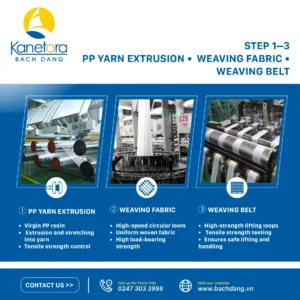
Step 1: Polypropylene Yarn Extrusion
The production process begins with polypropylene resin, commonly known as PP granules.
Depending on the technical requirements of the order, the resin may be blended with color masterbatch, UV stabilizers or other functional additives before entering the extrusion system.
The material is heated and melted before being formed into a thin PP film. This film is then slit into narrow tapes, stretched under controlled conditions and wound onto bobbins.
The stretching process improves molecular orientation and gives the PP tapes the tensile characteristics required for industrial woven fabric.
Important parameters at this stage include:
- Yarn denier
- Tape width
- Tensile strength
- Elongation
- Color consistency
- Additive concentration
- Winding consistency
- Stability during weaving
Yarn quality directly affects the strength of the bag fabric and lifting webbing. Uneven, brittle or poorly stretched yarn may create weak areas and inconsistent load-bearing performance.
For bags intended for outdoor use, UV stabilizers may be added during material preparation. UV resistance can subsequently be evaluated using accelerated weathering equipment.
Step 2: PP Fabric Weaving
The extruded PP tapes are transferred to weaving machines to produce woven polypropylene fabric.
Depending on the required FIBC construction, the factory may manufacture:
- Tubular fabric for circular FIBCs
- Flat fabric for U-panel bags
- Flat panels for four-panel bags
- Baffle fabric for form-stable bags
- Top and bottom panels
- Lightweight fabric for filling and discharge spouts
Different parts of a jumbo bag may require different fabric weights and mechanical properties.
The body must withstand outward pressure from the packed material, while the bottom and lifting-loop attachment areas must support the design load during handling.
Typical inspection criteria include:
- Fabric weight in grams per square metre
- Fabric width
- Warp and weft density
- Tensile strength in both directions
- Surface consistency
- Broken or missing tapes
- Weaving gaps
- Fabric flatness
- Suitability for coating and printing
Bag structure also affects how the fabric is manufactured.
For example, U-Panel FIBC bags use one continuous U-shaped panel to form the bottom and two opposite sides. In contrast, circular FIBC bags use a tubular woven body with fewer vertical seams.
Step 3: Lifting Belt Weaving
The lifting loops or webbings are among the most important load-bearing components of an FIBC.
When a filled jumbo bag is lifted by a forklift or crane, the load is transferred from the contents through the bag body and into the lifting-loop attachment areas.
Lifting options may include:
- Standard corner loops
- Cross-corner loops
- Corner-seam loops
- Stevedore loops
- Double-loop systems
- Single-point lifting arrangements
- Mono-straps for selected sling-bag applications
The webbing specification must define its width, thickness, weight, tensile strength, color and free-loop length.
A lifting loop must not only be strong enough. It must also be compatible with the bag construction, handling equipment and operating method used by the customer.
Proper loop design can improve forklift access, reduce twisting and help distribute lifting forces more evenly.
Kanetora Bach Dang operates dedicated webbing-weaving equipment and also manufactures several semi-finished FIBC components in-house. This improves control over product consistency and production lead time.
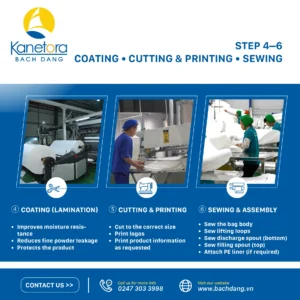
Step 4: Lamination or Coating
Not every jumbo bag requires coating.
Lamination is generally applied when the packed material requires improved:
- Dust containment
- Resistance to powder leakage
- Moisture protection
- Fabric tightness
- Printability
- Storage and transport protection
During this process, a layer of molten polymer is applied to one or both surfaces of the woven fabric.
The production team must control:
- Coating weight
- Coating thickness
- Adhesion
- Surface coverage
- Uniformity across the fabric width
- Pinholes or uncoated areas
- Suitability for cutting and sewing
Coating reduces the gaps between the woven tapes, but it does not always replace an inner liner.
For moisture-sensitive materials, very fine powders, food ingredients or chemicals requiring a higher barrier level, coated fabric may be combined with a PE, PP or multilayer liner.
The decision between coated and uncoated fabric should therefore be based on product characteristics, filling and discharge methods, storage conditions and logistics requirements—not only packaging cost.
Step 5: Fabric Cutting and Printing
After weaving and coating, the fabric is cut into individual components according to the approved technical drawing.
These components may include:
- Main body panels
- Bottom panels
- Top panels
- Filling spouts
- Discharge spouts
- Baffle panels
- Reinforcement pieces
- Duffle tops
- Protective flaps
Automatic cutting systems improve dimensional accuracy and reduce variation between components.
Cutting precision affects the final bag dimensions, seam positions, shape retention and stability after filling.
The required identification is then printed according to the customer-approved artwork.
Printed information may include:
- Customer logo
- Product name
- Safe Working Load
- Safety Factor
- Product code
- Batch number
- Lifting instructions
- Handling warnings
- Traceability details
- Mandatory symbols
- Recycling or disposal information
Before mass production, the artwork should be checked for wording, dimensions, colors, orientation and position on each side of the bag.
For regulated or hazardous products, marking requirements may be considerably more detailed. Buyers in these industries can also review the specifications of UN Certified Bulk Bags.
Step 6: Sewing and Final Assembly
During the sewing stage, the individual semi-finished components are assembled into a completed FIBC.
Depending on the bag design, sewing operations may include:
- Joining the body and bottom
- Attaching lifting loops
- Sewing the filling inlet
- Sewing the discharge outlet
- Installing baffle panels
- Attaching closure ties
- Adding protective flaps
- Installing document pouches
- Attaching labels
- Inserting or fixing an inner liner
Common stitch constructions may include lock stitch, chain stitch, overlock sewing and other application-specific seam designs.
High-stress areas require particular attention, especially:
- Lifting-loop attachment zones
- Bottom seams
- Main body joints
- Spout connections
- Reinforced corners
- Baffle attachment points
Stitch density, thread type, seam allowance and reinforcement patterns must follow the approved manufacturing specification.
For fine powders, additional dust-proof cords or sealing materials may be used along the seams to reduce leakage.
Sewing quality depends on more than machinery. It also relies on operator skill, clear work instructions, approved samples and continuous in-line QC supervision.
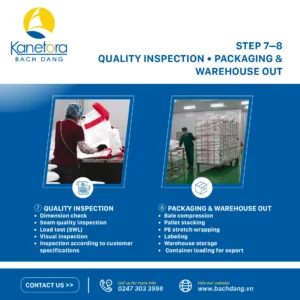
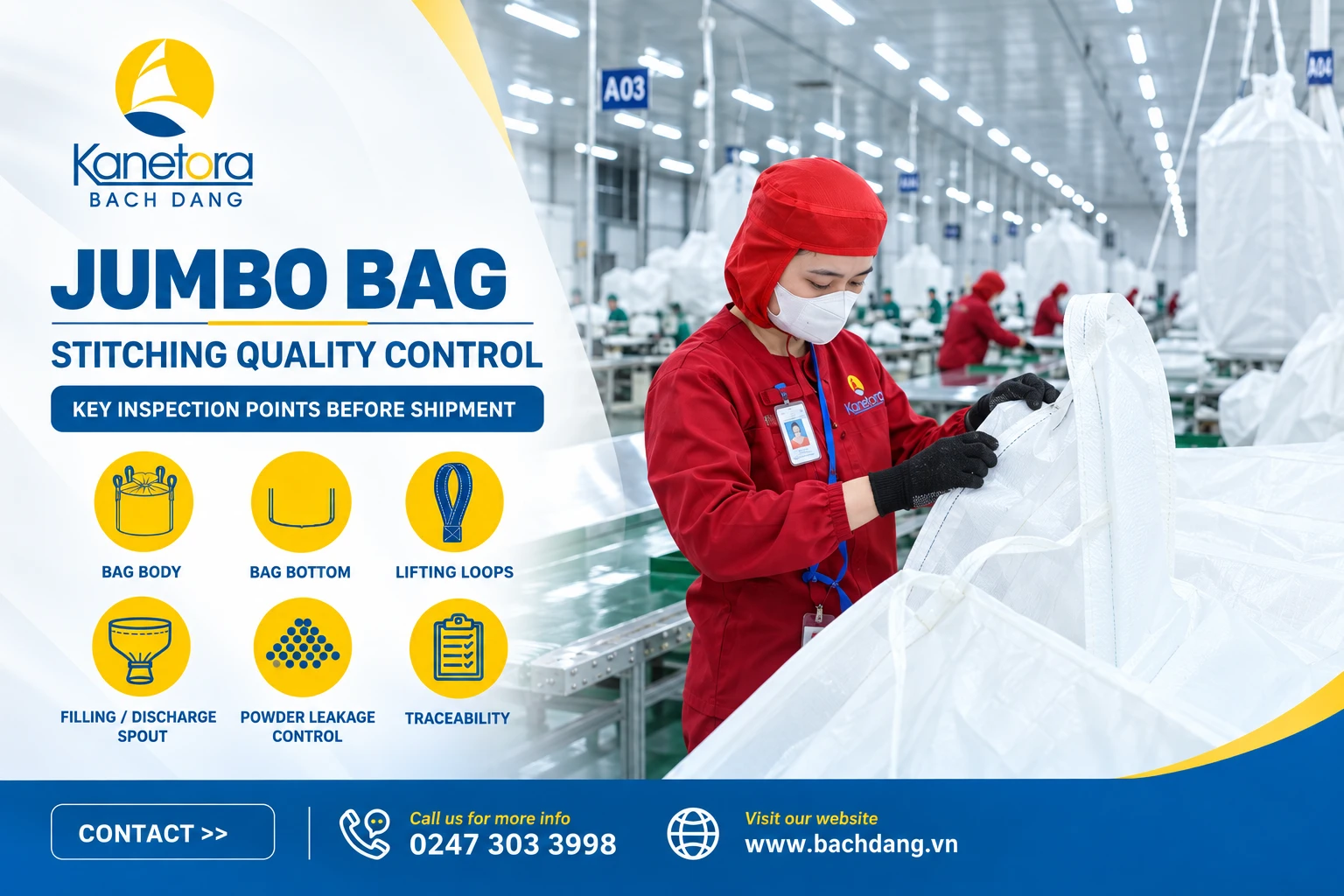
Step 7: Cleaning and Quality Inspection
Quality control should not begin only after the bag has been completed.
In a comprehensive QC and QA system, critical characteristics are monitored throughout raw-material preparation, yarn extrusion, weaving, coating, cutting, printing and sewing.
After assembly, finished bags may undergo:
- Removal of loose threads
- Cauterization of thread ends where applicable
- Air blowing
- Surface cleaning
- Micro-dust removal
- Internal and external visual inspection
- Metal detection when required
- Liner inspection using a light table
- Dimensional inspection
- Seam and loop-position checks
- Printing and label verification
- Comparison against the approved sample
- Packing-quantity verification
Kanetora Bach Dang’s published manufacturing information describes quality control as a dual-layer system: QC personnel perform in-process inspection, while a dedicated QA function conducts final checks before shipment. The factory also lists testing equipment for tensile strength, UV resistance, top-lift performance, liner seal strength, puncture resistance and coefficient of friction.
What Is the Difference Between QC and QA?
Quality Control, or QC, focuses on inspecting products and semi-finished components to identify defects or deviations.
Quality Assurance, or QA, focuses on the management system, documentation, procedures, standards and preventive controls used to reduce the risk of defects.
When QC and QA operate together, problems can be detected and corrected before they affect an entire production batch.
Step 8: Baling, Packing and Warehouse Release
After passing final inspection, the FIBCs are folded, counted and compressed into bales.
Packing arrangements can be customized according to:
- Number of bags per bale
- Bale dimensions
- Bale weight
- Pallet requirements
- External wrapping
- Container-loading plan
- Customer warehouse conditions
- Unloading method at destination
For products requiring a higher level of hygiene control, packing should take place in a suitable controlled area to reduce dust exposure and prevent recontamination after inspection.
Each bale should carry clear identification, such as:
- Product code
- Batch number
- Quantity
- Production date
- Purchase-order reference
- Traceability information
Warehouse controls are also important because several FIBC orders may look similar while having different fabrics, liners, prints, lifting loops or discharge structures.
Clear labeling and location management reduce the risk of mixing products during storage and container loading.
Does the Process Change for Different FIBC Applications?
The basic eight-step process remains similar, but materials, specifications and inspection requirements vary considerably according to the packed product.
FIBCs for Minerals and Construction Materials
These applications normally prioritize:
- High load-bearing performance
- Fabric tensile strength
- Tear resistance
- Strong lifting loops
- Abrasion resistance
- Efficient filling and discharge
- Competitive packaging cost per tonne
The bag structure must also be selected according to material density, particle size and handling conditions.
FIBCs for Plastic Resins and Chemicals
Common requirements include:
- Contamination control
- Moisture protection
- Inner liners
- Controlled discharge
- Dust containment
- Product-code traceability
- Electrostatic protection where necessary
For hazardous chemicals, packaging may also require specific certification and testing. UN Certified Bulk Bags are developed for regulated dangerous-goods applications and must follow the relevant approved design and marking requirements.
Food-Grade FIBCs
Food and agricultural applications typically require tighter controls over:
- Raw materials
- Personnel hygiene
- Production-area cleanliness
- Dust and foreign-object control
- Finished-bag cleaning
- Metal detection where specified
- Liner suitability
- Controlled packing
- Traceability
Food-grade production requirements should be clearly defined according to the product, destination market and customer quality system.
The Bachdang.vn product portfolio includes dedicated food-grade FIBC options alongside standard, baffle, electrostatic and UN-certified designs.
Baffle Bags for Optimized Container Loading
A standard FIBC tends to bulge outward after filling.
A baffled FIBC bag includes internal panels that help the bag maintain a more rectangular shape.
This structure can support:
- More stable stacking
- Better pallet utilization
- Improved container-space efficiency
- More consistent filled dimensions
- A neater appearance after filling
The baffles must be designed and sewn to allow adequate material flow while controlling the final shape of the bag.
Type C and Type D FIBCs for Electrostatic-Risk Environments
Powders flowing into or out of an FIBC can generate electrostatic charge.
In applications involving combustible dust, flammable vapor or sensitive products, the buyer must evaluate:
- Product resistivity
- Minimum ignition energy
- Presence of combustible dust
- Presence of flammable gases or vapors
- Grounding conditions
- Filling and discharge speed
- Required FIBC electrostatic type
Type C FIBC bags use conductive or interconnected elements and require effective grounding during operation.
Type D FIBC bags are made from static-dissipative fabric designed to dissipate charge without a conventional grounding connection, subject to the applicable operating conditions and safety assessment.
Selecting an electrostatic FIBC should always be based on a proper risk assessment rather than on product name alone.
Manufacturing Capabilities of Kanetora Bach Dang
Kanetora Bach Dang is a direct industrial packaging manufacturer located in Ninh Binh Province, Vietnam.
The factory’s published production capacity includes approximately:
- 300,000 FIBC bags per month
- 10 million block-bottom valve bags per month
- 500 tonnes of multilayer plastic film per month
The facility operates equipment for PP yarn extrusion, fabric weaving, webbing weaving, coating, automatic cutting, printing, sewing, liner production, cleaning, inspection, baling and laboratory testing.
Its manufacturing system also covers several internally produced semi-finished components, including webbings, liners, labels and document pouches. This level of integration can help the factory:
- Improve control over incoming components
- Reduce dependence on external suppliers
- Shorten development lead times
- Customize materials and structures
- Maintain more consistent production batches
- Respond more flexibly to special orders
The company’s 2026 introduction lists machinery for yarn extrusion, fabric and webbing weaving, coating, automatic cutting, sewing, liner production, metal detection, tensile testing, UV testing and top-lift testing.
What Information Should Buyers Provide for a Jumbo Bag Quotation?
Accurate input information helps the factory recommend the right bag and prepare a more reliable quotation.
1. Product to Be Packed
Specify whether the material is a powder, granule, pellet, flake, crystal or other form.
Important properties include:
- Bulk density
- Particle size
- Moisture sensitivity
- Dust generation
- Flow characteristics
- Temperature
- Chemical compatibility
- Electrostatic risk
2. Required Filling Weight
Common requirements may include:
- 500 kg
- 1,000 kg
- 1,250 kg
- 1,500 kg
- 2,000 kg
- Custom working loads
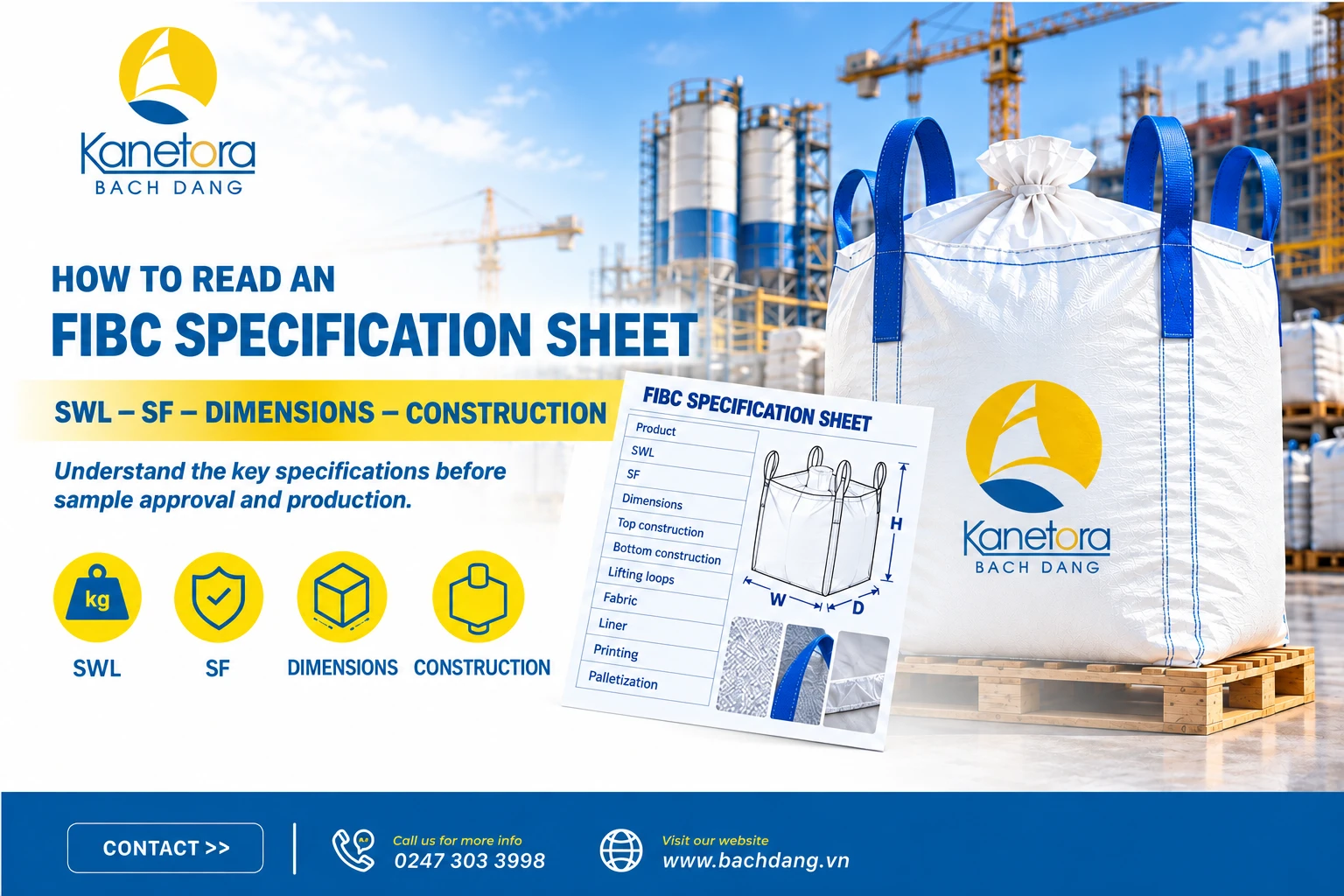
The Safe Working Load must be considered together with the required Safety Factor and operating method.
3. Bag Dimensions
Provide the required length, width and height.
Dimensions should be checked against:
- Filling equipment
- Pallet dimensions
- Warehouse racking
- Truck or container space
- Stacking requirements
- Discharge equipment
4. Bag Construction
Available options may include:
- U-panel
- Four-panel
- Circular
- Baffle
- Sling bag
- Customer-specific structures
5. Filling and Discharge Design
Filling options may include:
- Open top
- Duffle top
- Filling spout
- Flap top
Discharge options may include:
- Flat bottom
- Discharge spout
- Conical outlet
- Full-open bottom
- Iris closure
6. Material and Protection Requirements
Clarify whether the bag requires:
- Coated or uncoated fabric
- Inner liner
- UV stabilization
- Dust-proof seams
- Moisture protection
- Food-grade controls
- Electrostatic protection
- Barrier-film liner
7. Printing and Traceability
Provide requirements for:
- Logo
- Print colors
- Warning text
- Product code
- Batch number
- Labels
- Document pouch
- Barcode or QR code
- Country-specific markings
8. Transport and Storage Conditions
The manufacturer should understand:
- Domestic or export shipment
- Road, rail or sea transport
- Storage duration
- Outdoor exposure
- Destination climate
- Container-loading method
- Customer unloading conditions
The more complete the technical information, the easier it is to reduce sampling revisions and prevent issues during commercial production.
Conclusion
The jumbo bag manufacturing process is an interconnected production system that starts with polypropylene resin and ends with inspected, packed and shipment-ready FIBCs.
Every stage—including yarn extrusion, fabric weaving, lifting-belt production, coating, cutting, printing, sewing, cleaning and quality inspection—directly affects the bag’s strength, cleanliness, safety and suitability for its intended application.
With an integrated production system, in-house semi-finished component manufacturing, dedicated QC and QA controls and flexible customization capabilities, Kanetora Bach Dang develops FIBC solutions for different products, operating environments and international markets.
Businesses seeking a direct FIBC and jumbo bag manufacturer in Vietnam can work with Kanetora Bach Dang to evaluate product characteristics, define the correct specification and develop packaging suitable for commercial production.
Frequently Asked Questions
What Are Jumbo Bags Made From?
Most FIBC jumbo bags are manufactured from woven polypropylene.
Depending on the application, the bag may also include coated fabric, a PE or PP liner, UV additives, anti-static materials, conductive elements, labels, document pouches and other customized accessories.
What Are the Main Steps in the FIBC Manufacturing Process?
The main steps are polypropylene yarn extrusion, fabric weaving, lifting-belt weaving, coating, cutting and printing, sewing, cleaning and quality inspection, followed by final packing.
Why Must FIBC Lifting Loops Be Carefully Controlled?
The lifting loops transfer the load when the bag is handled by a forklift, crane or other lifting equipment.
Insufficient webbing strength, incorrect loop dimensions or poor attachment sewing may affect handling safety.
Do All Jumbo Bags Need Coating?
No.
Uncoated fabric may be suitable for materials that require breathability or do not generate fine dust. Coated fabric is generally used when improved moisture resistance, dust containment or printability is required.
Can Coating Replace an Inner Liner?
Not in every application.
Coating reduces the openings between woven PP tapes, while a liner creates a separate protective layer inside the bag. Fine powders, moisture-sensitive products and high-barrier applications may require both.
Can Jumbo Bags Be Manufactured in Custom Sizes?
Yes.
A manufacturer can customize dimensions, fabric weight, bag construction, lifting loops, filling inlet, discharge outlet, coating, liner, colors, printing and traceability features.
What Is the Difference Between Food-Grade and Standard FIBCs?
Food-grade FIBCs generally require tighter controls over raw materials, production hygiene, foreign-object prevention, cleaning, inspection, packing and traceability.
The exact requirements depend on the food product, customer standard and destination market.
What Is Checked Before FIBC Bags Are Shipped?
Typical final checks include:
- Bag dimensions
- Fabric and component conformity
- Sewing quality
- Lifting-loop position
- Filling and discharge construction
- Liner condition
- Printed information
- Labels and traceability
- Internal cleanliness
- Packing quantity
- Customer-specific requirements