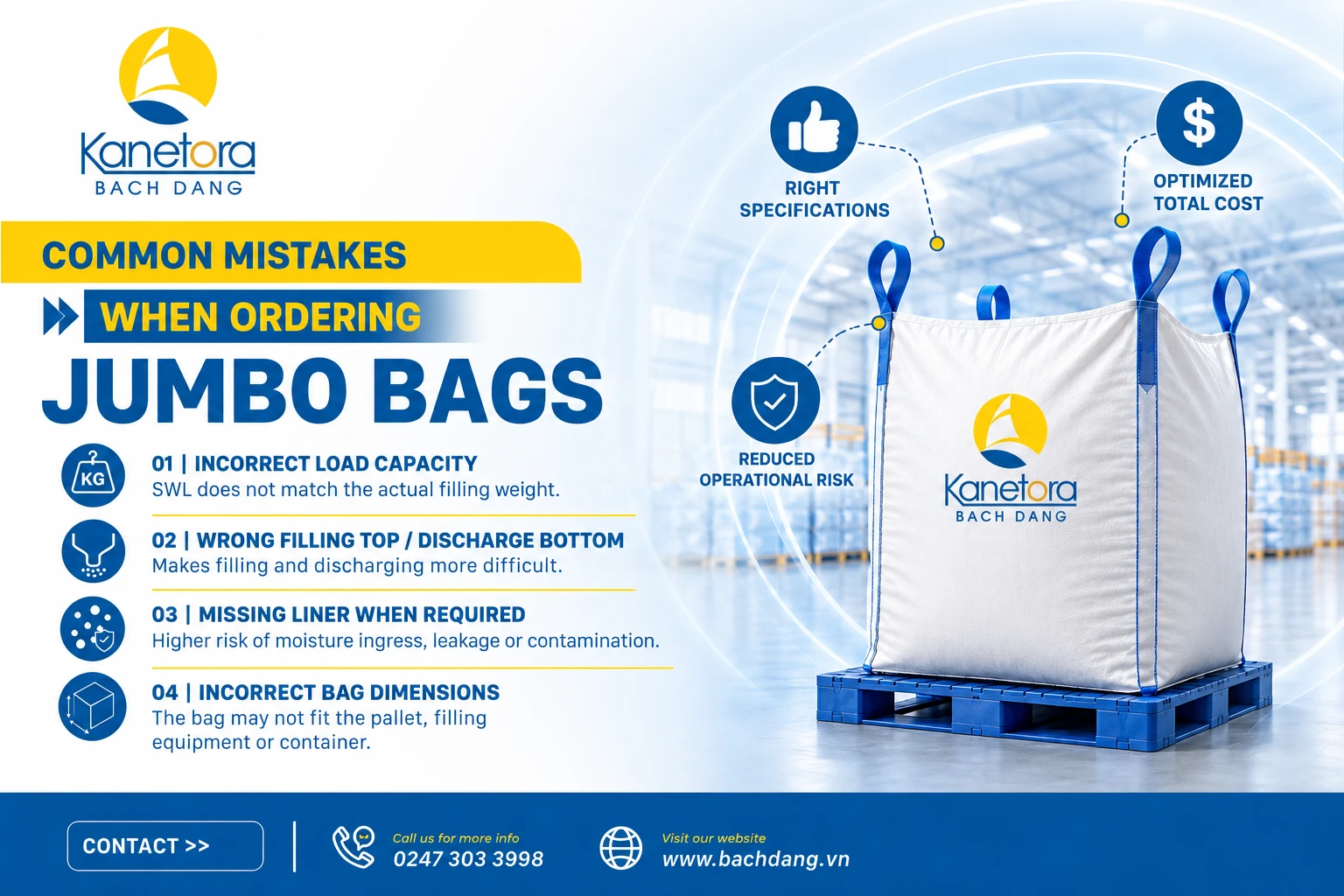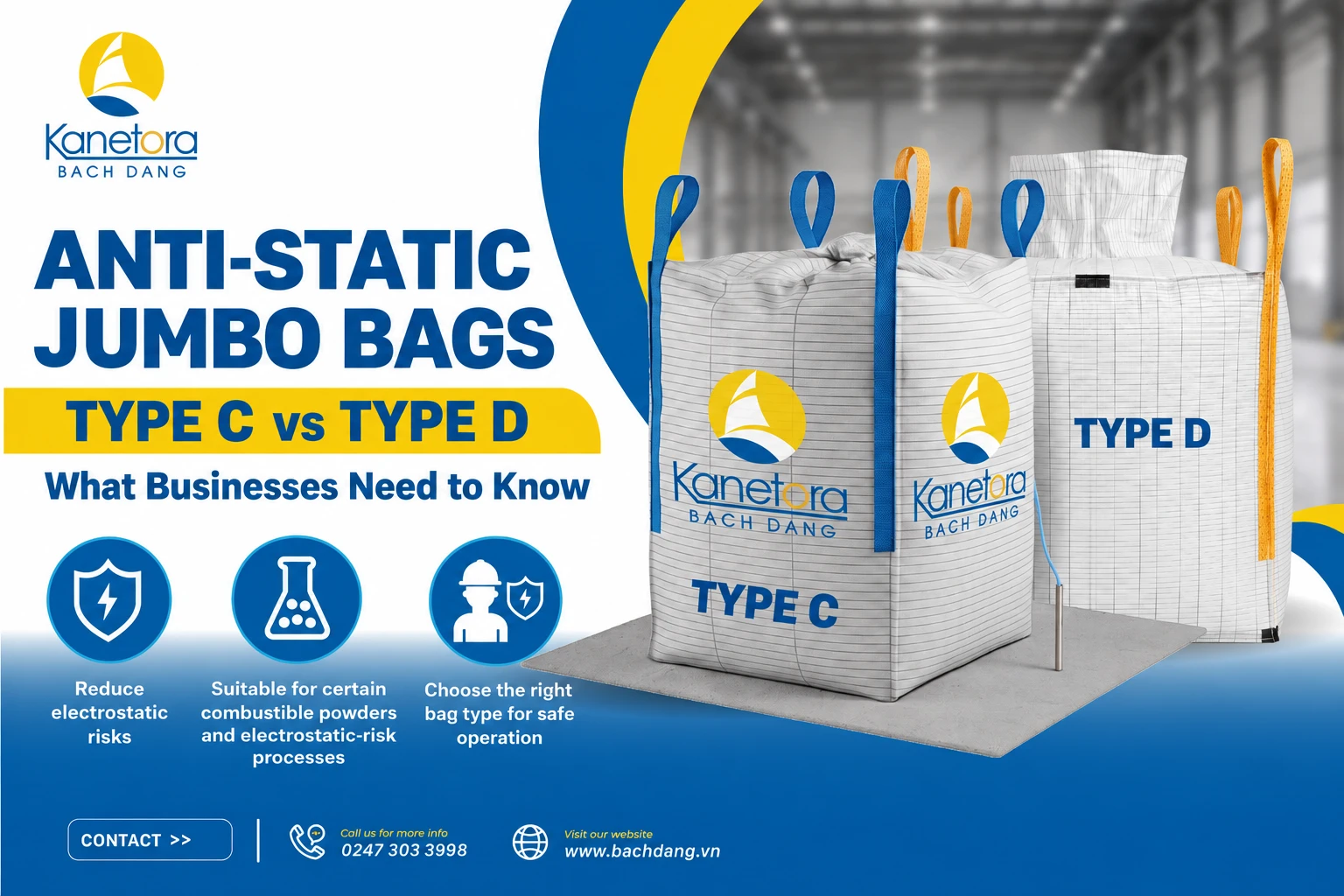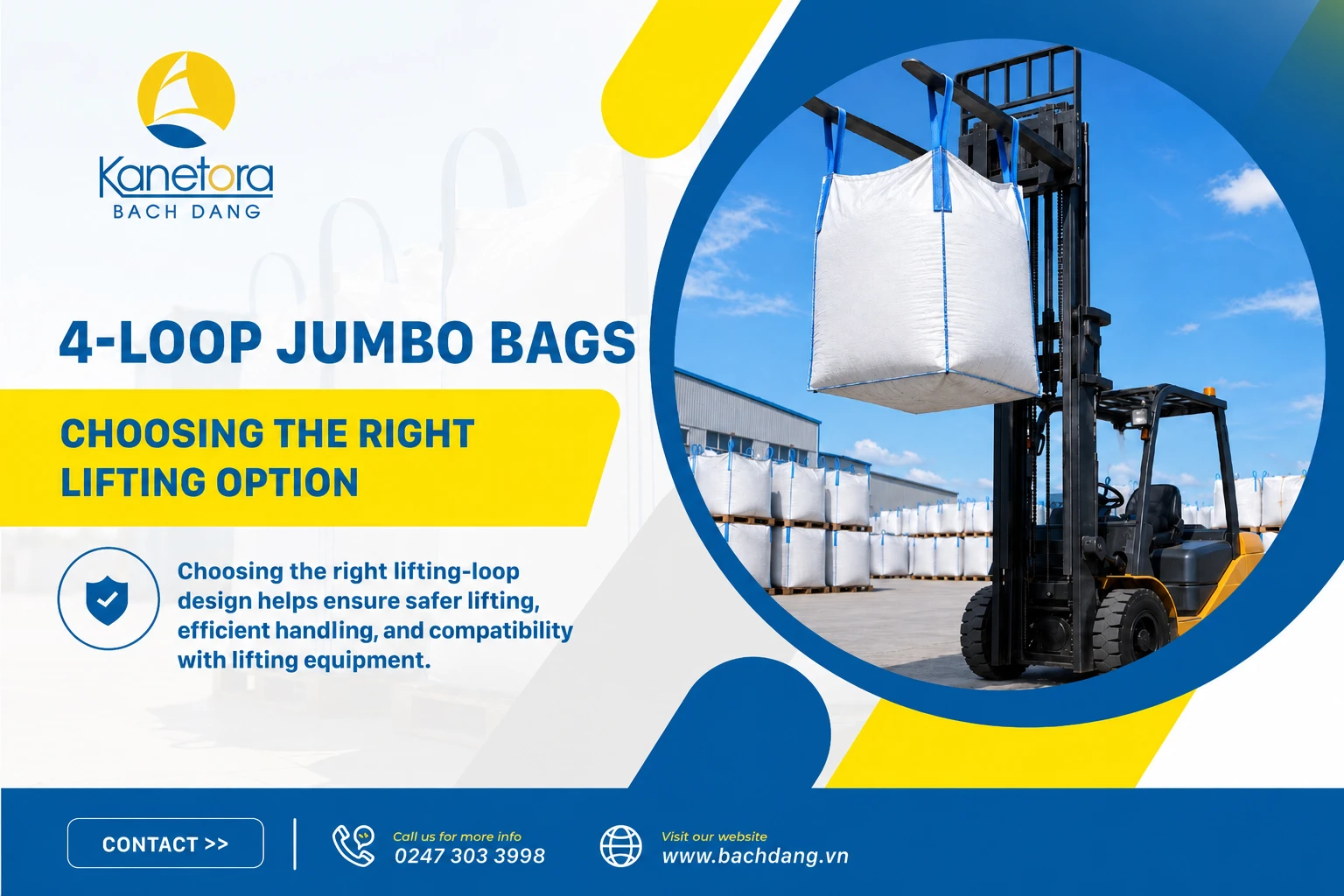


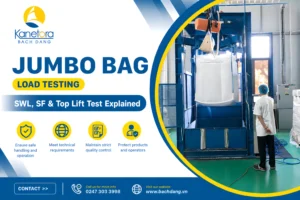
A jumbo bag may be designed to carry 500 kg, 1,000 kg, 1,500 kg or more. However, the load rating of an FIBC is not determined simply by fabric thickness, bag dimensions or the size of its lifting loops.
To evaluate the load-bearing performance of a jumbo bag or FIBC, three concepts are particularly important:
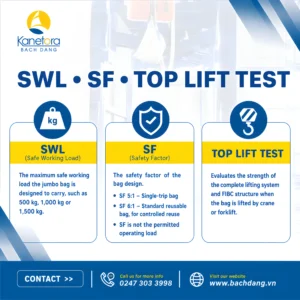
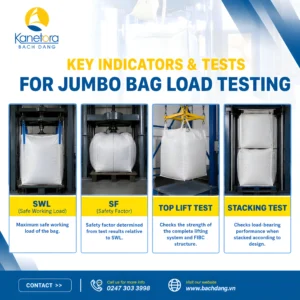
- SWL – Safe Working Load
- SF – Safety Factor
- Top Lift Test
In simple terms:
SWL is the maximum safe working load the bag is designed and qualified to carry.
SF represents the safety factor associated with the FIBC design and its type-test performance.
Top Lift Test evaluates how the complete FIBC structure performs when the bag is lifted through its designated lifting system.
One important point should always be clear:
A 5:1 Safety Factor does not mean that a 1,000 kg SWL bag can be filled with 5,000 kg. A 6:1 Safety Factor does not mean it can carry six times its rated load.
The permitted operating load remains the SWL stated for the bag.
ISO 21898:2024 covers material, construction, design, type-testing and marking requirements for FIBCs intended for non-dangerous solid materials.
What Is SWL in a Jumbo Bag?
SWL stands for Safe Working Load.
It refers to the maximum load that an FIBC is designed and qualified to carry under its intended conditions of use.
For example:
SWL: 1,000 kg
means that the packed product should not exceed 1,000 kg during normal operation, unless another specific design and qualification applies.
SWL should not be confused with:
- bag volume;
- lifting-loop breaking strength;
- the combined strength of four lifting loops;
- or the test load applied during laboratory testing.
A high-volume FIBC does not necessarily have a higher SWL. Bag dimensions and weight capacity are separate design parameters.
In practice, the appropriate SWL depends on several factors, including the packed product, bulk density, bag construction, lifting configuration and handling conditions.
Jumbo bags commonly carry loads from approximately 500 kg to 2,000 kg depending on their construction and intended application.
What Determines the SWL of an FIBC?
The load-bearing performance of a jumbo bag depends on the complete bag structure, not on one component alone.
Important factors include:
- tensile properties of the polypropylene yarn;
- woven fabric construction and weight;
- U-Panel, 4-Panel, Circular or Baffle construction;
- lifting-loop strength and dimensions;
- loop attachment configuration;
- stitching and seam construction;
- bottom construction;
- reinforcement areas;
- intended lifting method;
- packed-product characteristics;
- and actual handling conditions.
This is why two FIBCs both described as “1-ton jumbo bags” may perform differently if their materials, seams, lifting systems or overall designs are different.
Kanetora Bach Dang’s own manufacturing process covers extrusion, belt weaving, fabric weaving, laminating, cutting and printing, sewing, inspection and packing, allowing multiple load-bearing components to be controlled throughout production.
What Is the Safety Factor of an FIBC?
SF stands for Safety Factor.
For non-dangerous-goods FIBCs, Safety Factor is associated with the performance of the design during the applicable type-testing program.
It should be understood as a design and test-performance parameter, not as extra payload available to the user.
Typical classifications include:
| Safety Factor | Typical Use |
|---|---|
| 5:1 | Single-trip FIBC |
| 6:1 | Standard-duty reusable FIBC |
| 8:1 | Heavy-duty reusable FIBC in applicable designs |
What Does SF 5:1 Mean?
Suppose an FIBC is marked:
SWL: 1,000 kg
SF: 5:1
The correct interpretation is not:
“The bag can be filled with 5,000 kg.”
Its working load remains:
Maximum operating load = 1,000 kg
The Safety Factor relates to the performance requirements applied to the FIBC design during testing.
Using the safety margin as additional payload would defeat the purpose of the safety factor and could expose the lifting loops, seams, body fabric and bottom construction to loads outside the intended operating conditions.
What Is the Difference Between SF 5:1 and SF 6:1?
A 5:1 FIBC is generally associated with single-trip use.
A 6:1 FIBC is generally associated with standard-duty reusable applications under controlled conditions.
However, “reusable” does not mean unlimited reuse.
The suitability of an FIBC for another trip can depend on:
- the original design classification;
- type of packed material;
- previous handling history;
- wear on the lifting loops;
- fabric abrasion;
- seam condition;
- UV exposure;
- contamination;
- storage conditions;
- and inspection before reuse.
A reusable FIBC showing damaged loops, torn fabric, deteriorated seams or structural deformation should not continue to be used simply because it was originally designed with a 6:1 Safety Factor.
Safety Factor Is Not Additional Load Capacity
This distinction is especially important for procurement teams, warehouse operators and QA/QC personnel.
| Bag Marking | Correct Interpretation |
| SWL 1,000 kg / SF 5:1 | Maximum operating load remains 1,000 kg |
| SWL 1,000 kg / SF 6:1 | Maximum operating load remains 1,000 kg |
| SWL 1,500 kg / SF 5:1 | Maximum operating load remains 1,500 kg |
Safety Factor is not unused payload capacity.
It exists as part of the technical safety and qualification framework for the bag design.
What Is a Top Lift Test?
A Top Lift Test evaluates the FIBC while it is supported by the lifting devices for which it was designed.
Rather than testing only an individual loop or a separate piece of fabric, the test evaluates the performance of the complete load-bearing system.
The load path can be understood as:
Packed material → bag body → seams and reinforcement → lifting loops → lifting equipment
This is important because an FIBC does not necessarily fail at the loop itself.
High-stress areas can also include:
- lifting-loop attachment zones;
- loop-to-body seams;
- bag corners;
- vertical seams;
- bottom seams;
- and transitions between fabric panels.
Therefore, the strength of a jumbo bag cannot be assessed accurately by looking only at the lifting-loop width or fabric GSM.
What Does a Top Lift Test Evaluate?
During load testing, the evaluation focuses on whether the complete FIBC structure can withstand the specified test conditions without developing damage that compromises safe handling.
Areas commonly observed include:
- lifting-loop stability;
- loop attachment areas;
- body deformation;
- seams;
- fabric tearing;
- excessive seam movement;
- structural distortion;
- and loss of contents.
A heavy fabric alone does not guarantee satisfactory performance if the lifting-loop connection or stitching system is inadequate.
What Is a Cyclic Top Lift Test?
For FIBCs used with non-dangerous goods, ISO 21898:2024 includes type-testing requirements for bags designed to be lifted from above. The standard covers FIBC materials, design, testing and marking requirements.
A cyclic top lift test evaluates the bag design under repeated controlled loading conditions.
The purpose is not simply to prove that:
“The bag can be picked up once.”
Instead, the test evaluates how the lifting system, bag body, seams and other structural elements perform together under the prescribed test sequence.
This is also why casually filling a bag with one ton of material and lifting it once with a forklift should not automatically be considered equivalent to standardized FIBC type testing.
The applicable test method, sample preparation, loads, cycles and acceptance criteria need to follow the relevant technical requirements.
Is Top Lift Testing for UN FIBCs the Same?
No.
This distinction is important.
ISO 21898:2024 applies to FIBCs intended for non-dangerous solid materials.
FIBCs used for dangerous goods operate under a separate regulatory framework involving UN design types, performance tests and UN marking.
Therefore:
SWL 1,000 kg + SF 6:1 does not automatically mean that an FIBC is UN approved.
Likewise, passing an internal lifting test does not by itself make a bag a UN FIBC.
For dangerous goods, the applicable UN Number, Packing Group, packing instruction, design type and marking must be evaluated separately.
What About Drop Testing?
Drop testing is particularly relevant to the performance-testing framework for dangerous-goods IBCs.
It evaluates whether the package can maintain the required integrity after impact under specified conditions.
This is different from a Top Lift Test:
Top Lift Test → evaluates lifting performance.
Drop Test → evaluates impact performance.
They address different failure mechanisms and should not be treated as interchangeable tests.
For this reason, buyers should first determine whether they are dealing with a standard non-dangerous-goods FIBC or a UN FIBC for dangerous goods before comparing test requirements.
Why Can Dynamic Loading Be More Critical Than a Static Load?
Consider a jumbo bag with an SWL of 1,000 kg.
When the filled bag is resting steadily on a warehouse floor, the load is relatively stable.
During handling, however, the bag may experience additional forces when a forklift:
- accelerates quickly;
- stops suddenly;
- changes direction;
- causes the bag to swing;
- lifts the bag unevenly;
- or places excessive load on only part of the lifting system.
If two loops temporarily carry much more of the load than the others, stress distribution can differ significantly from the intended design condition.
This is one reason correct handling practices are essential even when the FIBC has been properly designed and tested.
The Safety Factor should never be interpreted as permission to overload the bag.
Why Fabric GSM Alone Cannot Determine FIBC Load Capacity
GSM, or grams per square metre, indicates the mass of the fabric per unit area.
It is an important specification, but it does not independently determine the SWL of an FIBC.
Load performance depends on the interaction of several components.
Body Fabric
The fabric needs appropriate tensile strength, elongation, weaving stability and construction.
Lifting Loops
The lifting system must have suitable strength and be correctly positioned on the bag.
Loop Attachment and Seams
These areas transfer forces between the lifting devices and the body of the FIBC and can become critical stress zones.
Bag Construction
U-Panel, Circular, 4-Panel and Baffle constructions distribute forces differently.
Operating Conditions
Packed-product density, filling method, lifting equipment, transportation and storage conditions can all affect the required specification.
This is why professional FIBC specification should consider the complete bag design, rather than relying on fabric GSM alone.
Where Does Load Control Fit Into the FIBC Manufacturing Process?
Load-bearing performance is built throughout the manufacturing process, not added at the final inspection stage.
A typical FIBC production sequence includes:
Extrusion → Belt Weaving → Fabric Weaving → Lamination/Coating → Cutting & Printing → Sewing → Inspection → Packing
Kanetora Bach Dang applies this standardized production flow in its FIBC manufacturing operation.
Each stage can influence final bag performance:
- extrusion affects yarn properties;
- weaving affects fabric consistency;
- belt weaving affects lifting-component quality;
- cutting influences geometry and dimensional accuracy;
- sewing creates the structural connections between panels and lifting devices;
- QC/QA checks help identify defects before shipment.
For export-oriented FIBC orders, sample approval and load testing can also help confirm that the selected specification performs as expected before mass production.
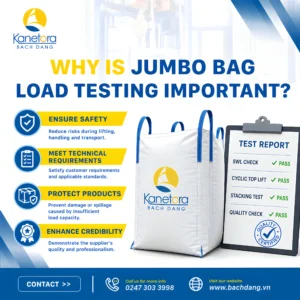
Jumbo Bag Load Testing at Kanetora Bach Dang Factory
Kanetora Bach Dang operates an integrated FIBC manufacturing facility with QC/QA controls and laboratory testing equipment. Its current company profile identifies equipment including a Top Lift Test Machine, tensile testing equipment and UV testing equipment for FIBC quality evaluation.
The factory’s current website also describes a QC/QA laboratory equipped with tensile, UV, puncture and heat-seal testing equipment as part of its production and quality-control system.
Load-performance control therefore sits within a broader manufacturing system covering:
material → weaving → lifting components → sewing → inspection → testing
rather than being treated as an isolated final check.
What Information Should Buyers Provide When Ordering Jumbo Bags?
To select the appropriate SWL and FIBC configuration, buyers should provide clear technical information before production.
Important information includes:
- Required filling weight per bag
- Bulk density of the packed product
- Product form: powder, pellet, granule, mineral, agricultural material, chemical, food ingredient, etc.
- Required bag dimensions
- FIBC construction: U-Panel, Circular, 4-Panel or Baffle
- Single-trip or reusable requirement
- Lifting-loop configuration
- Filling and discharge design
- Storage and transport conditions
- Liner, coating, UV or electrostatic requirements
- Stacking requirements
- Specific testing, certification or customer documentation requirements
Kanetora Bach Dang’s current technical quotation guidance similarly identifies SWL, Safety Factor, bag construction, fabric, lifting loops, packed product and target market as key inputs when specifying an FIBC.
Five Key Things to Remember About SWL, SF and Top Lift Testing
1. SWL is the operating load limit.
If an FIBC has an SWL of 1,000 kg, it should not normally be filled beyond 1,000 kg.
2. Safety Factor is not extra payload.
A 5:1 FIBC rated at 1,000 kg does not become a 5,000 kg bag.
3. Load capacity belongs to the complete FIBC design.
Fabric GSM, lifting-loop width or one strong component alone cannot prove the load rating of the finished bag.
4. Top Lift Test evaluates the load-bearing system as a whole.
The lifting loops, attachment areas, seams, body fabric and structural configuration all work together during lifting.
5. Standard FIBCs and UN FIBCs follow different compliance frameworks.
ISO 21898:2024 covers FIBCs for non-dangerous goods, while dangerous-goods FIBCs require the applicable UN design-type and transport requirements.
Conclusion
SWL, Safety Factor and Top Lift Test are three essential concepts for understanding jumbo bag load performance.
SWL defines how much product the FIBC is intended to carry during use.
Safety Factor relates to the safety and type-test performance of the bag design.
Top Lift testing evaluates how the complete load-bearing structure performs when the FIBC is lifted through its designated lifting system.
Most importantly, an FIBC should not be judged only by its appearance, fabric thickness or lifting-loop size.
Reliable load performance is the result of:
material selection + bag design + weaving + lifting-loop construction + sewing + quality control + testing
For industrial and export buyers, working with a direct FIBC manufacturer that can control these stages and support technical testing helps reduce the risk of under-specification, cargo damage and handling problems.
Frequently Asked Questions
What does SWL mean on a jumbo bag?
SWL means Safe Working Load. It is the maximum working load that the FIBC is designed and qualified to carry under its intended conditions of use.
What does a 5:1 Safety Factor mean on an FIBC?
A 5:1 Safety Factor relates to the safety and type-test requirements of the FIBC design. It does not mean that a 1,000 kg SWL bag may be loaded with 5,000 kg.
Can a 5:1 FIBC be reused?
A 5:1 FIBC is generally associated with single-trip use. It should not automatically be refilled after discharge simply because the bag still appears undamaged.
What does SF 6:1 mean?
A 6:1 Safety Factor is commonly associated with standard-duty reusable FIBCs. Reuse should still take place under controlled conditions and should consider the actual condition of the bag.
What does a Top Lift Test check?
A Top Lift Test evaluates the performance of the complete lifting system and FIBC structure, including lifting loops, loop attachment areas, seams, body fabric and other load-bearing components.
Is a Top Lift Test the same as a Drop Test?
No. A Top Lift Test evaluates performance under lifting loads, while a Drop Test evaluates package integrity following impact under specified conditions.
Can a 1-ton jumbo bag carry more than 1 ton if it has SF 5:1?
No. If the bag is rated with an SWL of 1,000 kg, the permitted working load remains 1,000 kg. The Safety Factor is not additional payload capacity.
How is the correct SWL selected?
The manufacturer should evaluate the required filling weight, bulk density, product characteristics, bag dimensions, construction, lifting method, storage and transport conditions, and any specific testing or compliance requirements.