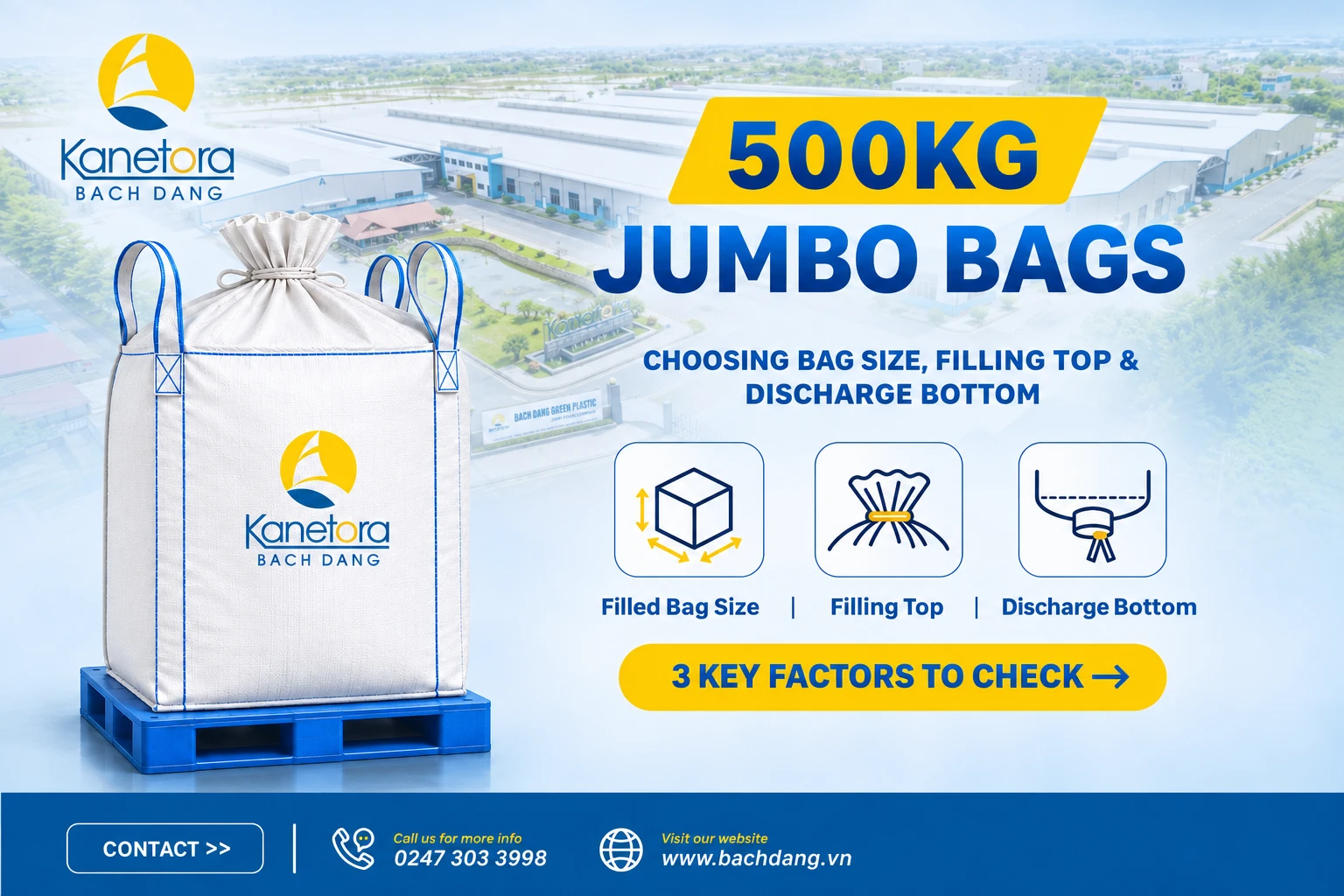


500kg jumbo bags (500kg FIBC bulk bags) are widely used industrial packaging solutions designed to store, handle and transport up to 500kg of dry bulk materials, including powders, granules, minerals, agricultural products and industrial raw materials.
Compared with larger FIBC bags rated for 1,000kg or more, 500kg bulk bags are often selected when manufacturers require smaller packaging units, controlled batch feeding or compatibility with specific material handling equipment.
However, not all 500kg jumbo bags have the same dimensions or construction.
A bulk bag designed to hold 500kg of plastic resin may require a significantly different volume from one used for 500kg of mineral powder.
Similarly, a bag intended for an automated filling line may require a different filling top and discharge configuration from a bag used for manual loading.
So, what are the standard dimensions of a 500kg jumbo bag, which filling top should you choose, and when is a discharge spout necessary?
In this guide, Kanetora Bach Dang explains how to select the right 500kg FIBC configuration based on material properties, filling equipment, discharge requirements and handling conditions.
1. What Is a 500kg Jumbo Bag?
A 500kg jumbo bag, also known as a 500kg Flexible Intermediate Bulk Container (FIBC), 500kg bulk bag or half-ton bulk bag, is an industrial packaging container designed with a Safe Working Load (SWL) of 500kg.
These bags are commonly manufactured from woven polypropylene (PP) fabric and incorporate lifting loops, filling systems and discharge configurations according to their intended applications.
Typical Specifications of 500kg Jumbo Bags
| Specification | Description |
|---|---|
| Product Name | 500kg Jumbo Bag / 500kg FIBC |
| Safe Working Load | 500kg |
| Common Material | Woven Polypropylene (PP) |
| Body Construction | U-Panel, 4-Panel, Circular or customized |
| Lifting System | Commonly four lifting loops |
| Filling Options | Open Top, Duffle Top, Filling Spout |
| Discharge Options | Flat Bottom, Discharge Spout |
| Protective Features | Coating, PE Liner |
| Safety Factor | Determined by design, intended use and testing requirements |
| Applications | Plastic resin, minerals, food ingredients, agricultural products, chemicals and other dry bulk materials |
Note: These are common configuration options rather than fixed specifications for every 500kg FIBC. Final designs must be confirmed according to product characteristics and technical requirements.
One of the main advantages of FIBC packaging is its flexibility in design.
Manufacturers can customize the bag’s dimensions, lifting system, filling and discharge components to match specific operational requirements.
At Kanetora Bach Dang, FIBC configurations can be developed according to the customer’s material characteristics, handling equipment, storage conditions and transportation requirements.
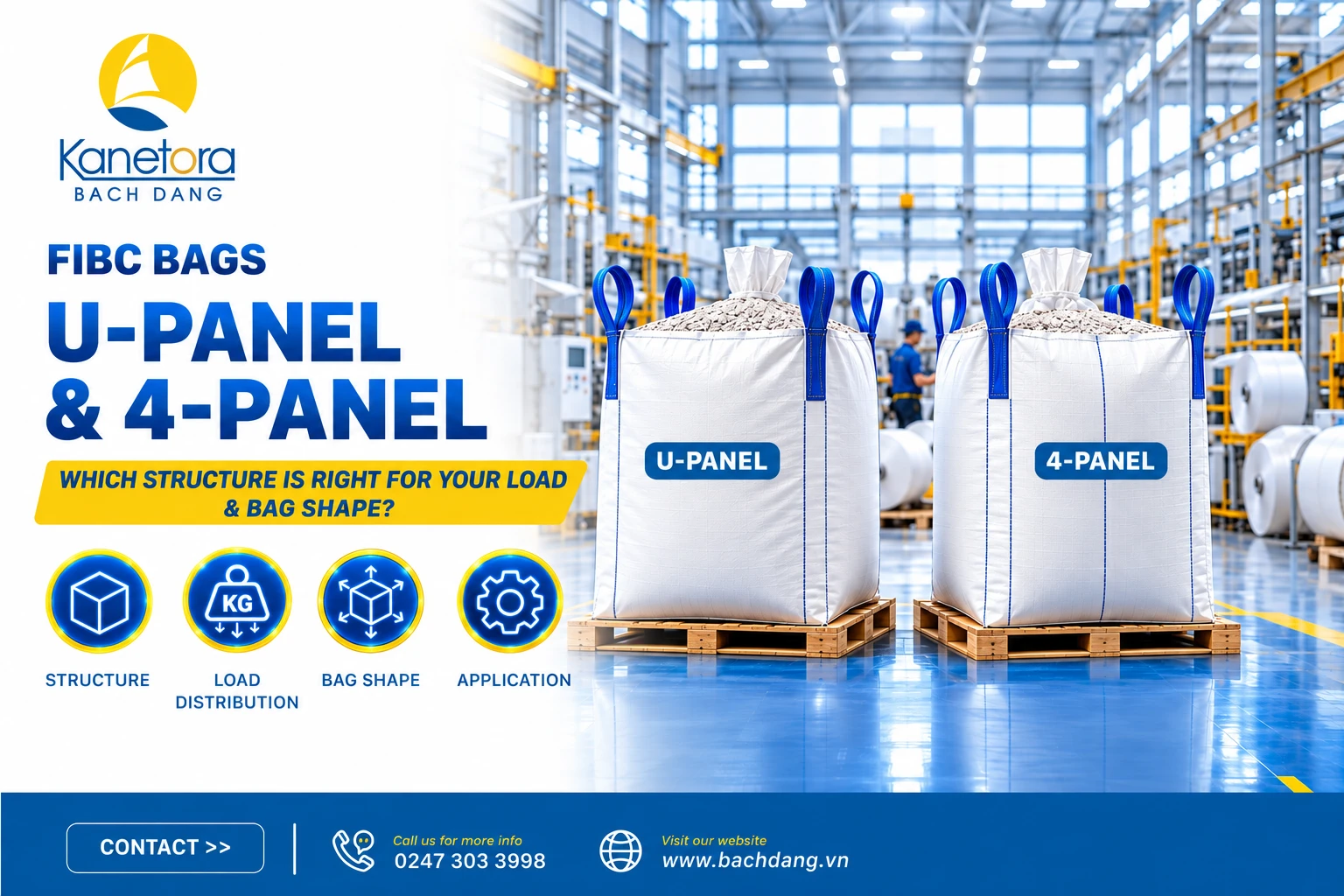
For further information on bag construction, see our guide to U-Panel vs. 4-Panel Jumbo Bags.
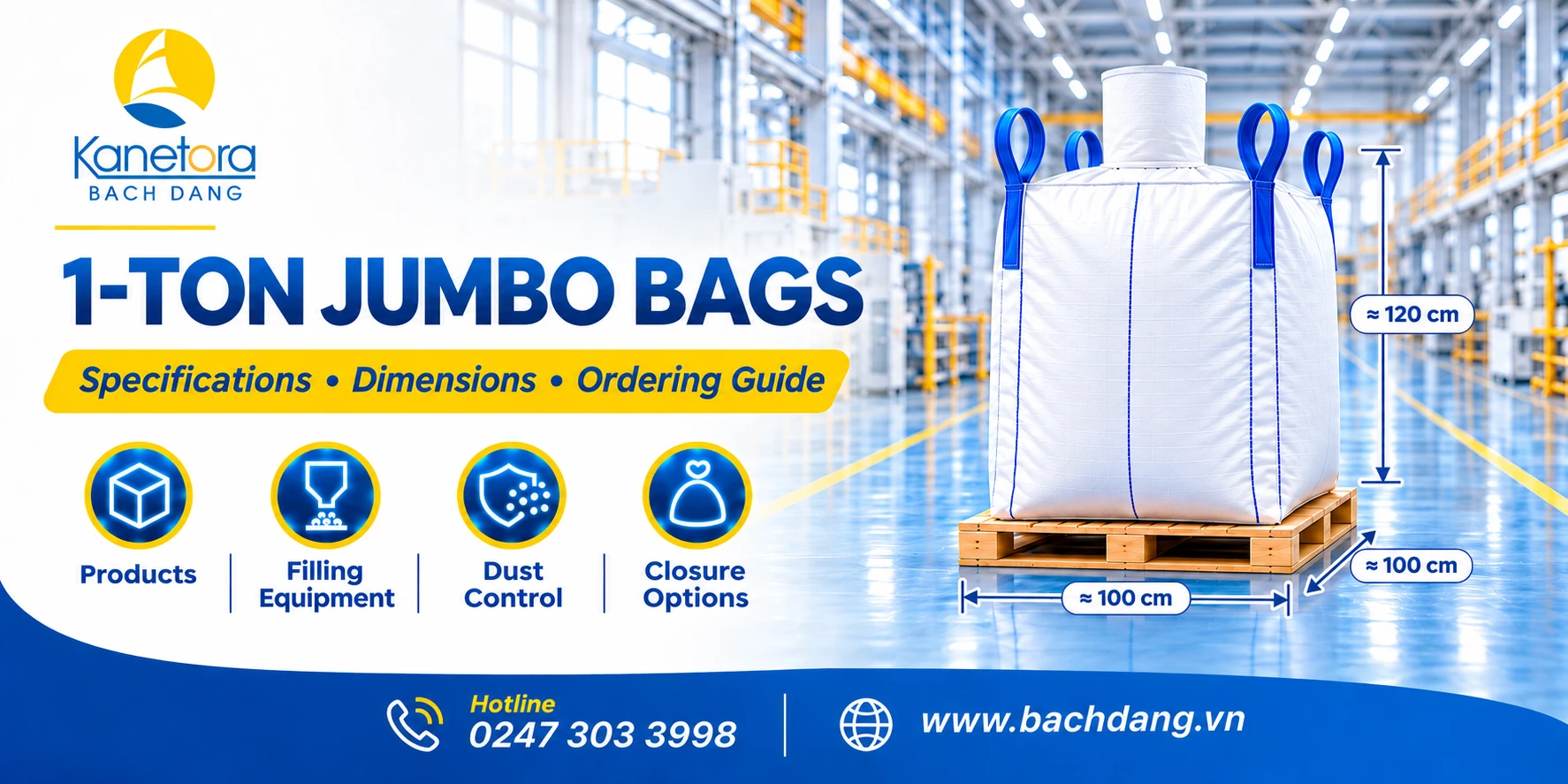
2. What Are the Dimensions of a 500kg Jumbo Bag?
There is no single standard dimension that applies to every 500kg jumbo bag.
The appropriate bag size depends primarily on three factors:
- The weight of the material being packed.
- The material’s bulk density.
- The required usable filling volume and the actual shape of the filled bag.
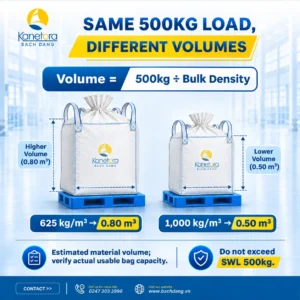
2.1. How to Calculate the Required Volume
The first step in selecting 500kg FIBC dimensions is to calculate the volume occupied by the material.
The basic formula is:
Required Material Volume (m³) = Material Weight (kg) ÷ Bulk Density (kg/m³)
For example:
A manufacturer needs to package 500kg of material with a bulk density of 800kg/m³.
The required material volume is:
500 ÷ 800 = 0.625m³
Therefore, the selected bulk bag must provide at least approximately 0.625m³ of usable filling volume.
However, the geometric volume calculated from the bag’s nominal dimensions does not necessarily represent its actual usable capacity.
During filling, the bag may expand, bulge or assume a shape different from an ideal rectangular container.
The final dimensions should therefore be confirmed through technical design and practical filling trials.
2.2. Required Volume for Different Bulk Densities
The following table illustrates how bulk density affects the volume required to package 500kg of material.
| Bulk Density (kg/m³) | Material Weight | Required Material Volume |
|---|---|---|
| 600 | 500kg | 0.833m³ |
| 800 | 500kg | 0.625m³ |
| 1,000 | 500kg | 0.500m³ |
| 1,200 | 500kg | 0.417m³ |
The calculation demonstrates that two materials weighing 500kg can require significantly different packaging volumes.
Materials with lower bulk density generally require larger bags.
Conversely, denser materials may reach the same weight within a smaller volume.
Important: Sufficient filling volume does not automatically mean that a bag is suitable for the application.
The FIBC must also meet the required structural strength, lifting performance, stability and handling conditions.
2.3. Example Dimensions for 500kg Jumbo Bags
The following dimensions can be used as preliminary references when evaluating potential FIBC configurations.
| Example Dimensions (L × W × H) | Approximate Geometric Volume | General Considerations |
|---|---|---|
| 75 × 75 × 90cm | 0.506m³ | Relatively compact; may be considered for higher-density materials |
| 80 × 80 × 90cm | 0.576m³ | Intermediate size requiring usable-volume verification |
| 85 × 85 × 100cm | 0.723m³ | Provides a larger nominal volume |
| 90 × 90 × 100cm | 0.810m³ | May be considered when greater volume is needed |
Technical Note:
These dimensions are illustrative examples, not standardized sizes or confirmed stock products available from Kanetora Bach Dang.
The volumes are calculated geometrically and do not represent verified usable filling capacities.
It is also important to distinguish between nominal unfilled dimensions, internal dimensions and the final dimensions of a filled FIBC.
For example, a material requiring 0.625m³ of space should not automatically be packed into a bag with a nominal geometric volume of exactly 0.625m³.
Bag shape, filling level, fabric deformation and material flow behavior must also be considered.
3. How to Select 500kg Jumbo Bag Dimensions for Different Materials
Bulk density is an essential starting point, but it is not the only parameter affecting FIBC selection.
Different materials may also require specific filling systems, discharge configurations and protective features.
3.1. 500kg Jumbo Bags for Plastic Resin
Plastic resin pellets, including PP, PE and other polymer materials, generally offer relatively good flowability.
When selecting 500kg FIBC bags for plastic resin, manufacturers should consider:
- Bulk density of the resin.
- Pellet size and shape.
- Silo or automated filling equipment.
- Pellet loss and dust control requirements.
- Discharge methods at the receiving facility.
For automated packaging lines, a filling spout may be preferred because it can connect directly to the filling equipment.
If the material needs to be discharged into a hopper or feeding system, a discharge spout may provide greater operational convenience than a closed bottom.
Learn more about FIBC Packaging Solutions for Plastic Resin.
3.2. 500kg Jumbo Bags for Minerals and Powdered Materials
Mineral powders, limestone powder and certain construction materials may have relatively high bulk densities.
For these applications, particular attention should be given to:
- Overall bag strength.
- Fabric and lifting loop performance.
- Seam integrity.
- Dust leakage prevention.
- Bottom discharge construction.
For fine powders, coated fabric, sift-proof seams or PE liners may be considered depending on the required level of protection.
A suitable FIBC design must account for both the weight and the physical characteristics of the material.
3.3. 500kg Jumbo Bags for Food Ingredients
For products such as sugar, starch, rice and dry food ingredients, hygiene and contamination control are important considerations.
Relevant requirements may include:
- Materials suitable for the intended food-contact application.
- Controlled manufacturing conditions.
- Foreign matter prevention.
- Appropriate filling and discharge closures.
- Liner requirements.
- Storage and transportation conditions.
Not every woven PP bag is automatically suitable for food-contact applications.
The required compliance documentation depends on the type of food, intended contact conditions and destination market.
Learn more about Food Grade FIBC Bags.
4. Which Filling Top Is Best for a 500kg Jumbo Bag?
The filling top plays an important role in packaging efficiency, equipment compatibility and material containment.
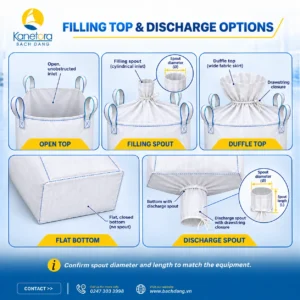
Three common configurations are Open Top, Filling Spout and Duffle Top.
4.1. Open Top FIBC Bags
An Open Top FIBC has a fully open upper section that allows material to be introduced directly into the bag.
Advantages:
- Simple construction.
- Convenient for certain manual or large-hopper filling methods.
- Easy access to the bag opening.
Limitations:
- Additional arrangements may be required for covering or sealing.
- Dust exposure and material loss must be evaluated.
Open Top designs may be suitable when flexible loading operations are required and a sealed connection to the filling equipment is unnecessary.
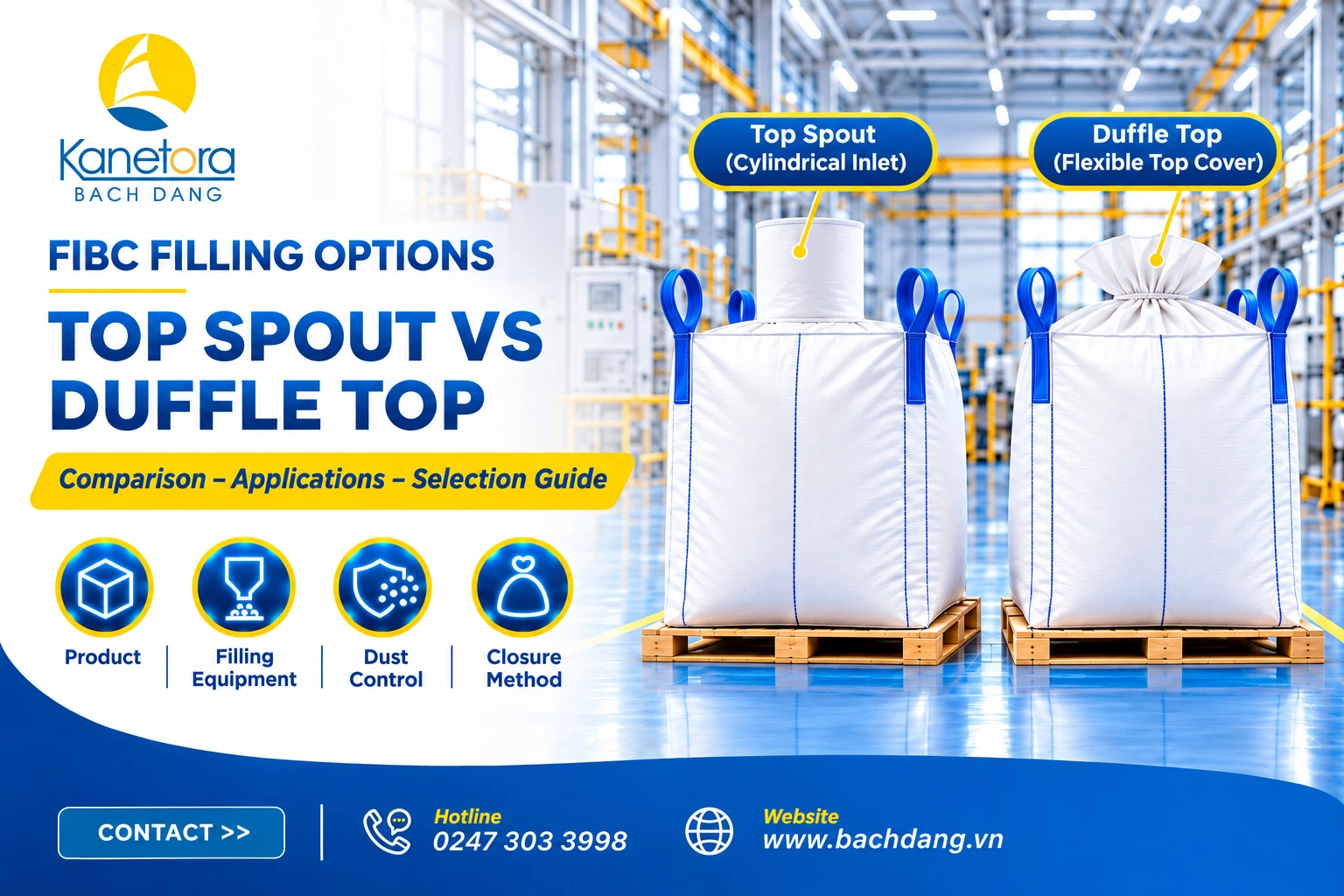
4.2. Filling Spout FIBC Bags
A Filling Spout is a tubular inlet sewn into the top of the bag.
This configuration is commonly used when materials are transferred through an automated or semi-automated filling system.
Advantages:
- Convenient connection to filling equipment.
- Supports controlled material transfer.
- Can be integrated with appropriate dust collection and closure systems.
Important Specifications:
- Filling spout diameter.
- Filling spout length.
- Clamping or attachment method.
- Closure mechanism after filling.
The filling spout diameter should not be selected independently of the packaging equipment.
An incorrectly sized spout may create operational difficulties or reduce filling efficiency.
4.3. Duffle Top FIBC Bags
A Duffle Top features an extended fabric skirt attached to the upper section of the bag.
The skirt can be gathered and tied after filling.
Advantages:
- Wide filling opening.
- Flexible loading operations.
- Can be closed using an appropriate tying system.
Duffle Top bags may be considered when users need a combination of flexible filling access and a coverable upper opening.
4.4. Comparison of Filling Top Options
| Feature | Open Top | Filling Spout | Duffle Top |
|---|---|---|---|
| Construction | Fully open | Tubular inlet | Extended fabric skirt |
| Manual Filling | Convenient | Equipment-dependent | Convenient |
| Equipment Connection | Additional arrangements may be needed | Well suited | Design-dependent |
| Closure | Requires additional configuration | Spout can be tied | Skirt can be tied |
| Dust Control | System-dependent | Advantage when properly connected | Closure-dependent |
| Typical Application | Flexible loading | Automated filling | Flexible filling and covering |
There is no universally superior filling top for every 500kg bulk bag.
The appropriate design should be selected according to the actual filling equipment, material properties and containment requirements.
5. Flat Bottom vs. Discharge Spout: Which Should You Choose?
The bottom construction determines how material is removed from the FIBC.
Two common options are Flat Bottom and Discharge Spout.
5.1. Flat Bottom Jumbo Bags
A Flat Bottom FIBC has a permanently closed bottom without an integrated discharge opening.
This configuration may be appropriate when:
- Bottom discharge is not required.
- The product is handled using a separate unloading process.
- The receiving facility uses alternative methods for emptying or processing the bag.
A flat-bottom design does not automatically mean that the bag is reusable.
Reusability depends on the approved design, labeling, bag condition and validated handling procedures.
5.2. Discharge Spout Jumbo Bags
A Discharge Spout is a tubular outlet integrated into the bottom of the FIBC.
The outlet is typically secured using a suitable closure system before use.
During unloading, the operator opens the closure according to the approved procedure, allowing material to flow into the receiving equipment.
Advantages:
- Supports controlled material discharge.
- Convenient for hopper connections.
- May reduce the need to cut open the bag.
- Compatible with many material feeding systems.
5.3. When Should a 500kg Jumbo Bag Have a Discharge Spout?
A discharge spout is often considered when material needs to be transferred directly into:
- Hoppers.
- Silos.
- Industrial mixers.
- Material feeding systems.
- Processing equipment.
However, discharge performance depends on material flow characteristics.
Some powders may bridge, compact or form lumps, preventing complete gravity discharge.
In such cases, additional evaluation of the material properties and unloading equipment may be necessary.
5.4. Important Discharge Spout Specifications
| Specification | What to Consider |
|---|---|
| Spout Diameter | Compatibility with material and receiving equipment |
| Spout Length | Connection and operating requirements |
| Closure System | Ties or specialized closure mechanisms |
| Material Flow | Flowability, bridging and caking tendencies |
| Dust Control | Containment requirements |
| Receiving Equipment | Hopper, silo, mixer or other systems |
| Operating Procedure | Safe lifting, positioning and opening |
For fine powders, potential leakage around seams and closure points should also be assessed.
The presence of a PE liner does not automatically make a bulk bag completely dustproof or waterproof.
Protection depends on the complete construction and closure system.
6. Recommended 500kg FIBC Configurations by Application
The following table provides preliminary guidance for selecting filling and discharge configurations.
| Application | Suggested Filling Top | Suggested Bottom | Key Considerations |
|---|---|---|---|
| Plastic Resin | Filling Spout | Discharge Spout | Equipment compatibility |
| Industrial Mineral Powder | Filling Spout | Discharge Spout | Dust control and closure integrity |
| Granular Materials | Open Top / Duffle Top | Flat Bottom | Loading and unloading methods |
| Dry Food Ingredients | Filling Spout / Duffle Top | Application-dependent | Hygiene and liner requirements |
| Moisture-Sensitive Materials | Closable filling top | Suitable sealed configuration | Coating, liner and storage conditions |
| Materials Fed into Mixers | Filling Spout | Discharge Spout | Flowability and connection requirements |
These recommendations are preliminary. Final specifications must be based on actual material properties, equipment and operating conditions.
A properly designed jumbo bag should be considered part of the overall bulk material handling system.
It must perform effectively during filling, lifting, storage, transportation and discharge.
7. Do 500kg Jumbo Bags Need Four Lifting Loops?
500kg jumbo bags can be manufactured with different lifting configurations, including the widely used four-loop design.
In a four-loop FIBC, lifting points are generally positioned near the bag corners to accommodate the intended handling equipment.
However, the number of loops alone does not determine the bag’s lifting capacity.
Important factors include:
- Body construction.
- Lifting loop strength.
- Loop attachment design.
- Seam strength.
- Safe Working Load.
- Actual lifting method.
What Does SWL 500kg Mean?
SWL stands for Safe Working Load.
It represents the maximum working load specified for the complete FIBC design under its intended operating conditions.
For a bag rated at SWL 500kg, the material weight must not exceed 500kg.
A Safety Factor (SF) of 5:1 or 6:1 does not mean that the bag can be used to carry 2,500kg or 3,000kg.
Safety factors relate to design and testing requirements rather than permissible operating loads.
For further guidance, see our article on Jumbo Bag Safe Working Load, Safety Factor and Top Lift Testing.
8. 500kg vs. 1000kg Jumbo Bags: Which Is Better?
Choosing between a 500kg and a 1000kg jumbo bag depends on more than the amount of material being transported.
Manufacturers should evaluate their entire packaging and handling process.
| Criteria | 500kg Jumbo Bag | 1000kg Jumbo Bag |
|---|---|---|
| Nominal SWL | 500kg | 1,000kg |
| Weight per Package | Lower | Higher |
| Number of Bags for the Same Quantity | More | Fewer |
| Volume per Bag | Generally smaller for the same material | Generally larger |
| Handling Equipment | Must support actual load | Must support actual load |
| Batch Feeding | Suitable for smaller units | Suitable for larger units |
| Overall Packaging Cost | Depends on bag quantity and handling | Depends on equipment and logistics |
When Are 500kg Jumbo Bags a Good Choice?
500kg FIBCs may be appropriate when:
- Production lines require smaller batch quantities.
- Receiving equipment has weight limitations.
- Materials need to be divided into smaller packaging units.
- Customers specify 500kg packaging.
- Storage and logistics arrangements favor smaller bags.
When Should You Consider 1000kg Jumbo Bags?
1000kg FIBCs may be preferred when:
- Receiving systems can handle larger quantities.
- Manufacturers want fewer packaging units.
- Handling equipment and storage facilities are suitable.
- Larger packaging units improve overall operational efficiency.
Explore our guide to 1000kg Jumbo Bag Dimensions and Specifications.
9. Common Mistakes When Ordering 500kg Jumbo Bags
9.1. Providing Only the 500kg Load Requirement
SWL alone is insufficient to determine the correct FIBC configuration.
The supplier also needs information about bulk density, material properties, dimensions and intended use.
9.2. Copying Dimensions from Another Product
Two materials weighing 500kg may occupy very different volumes.
Using dimensions from an unrelated application may result in improper filling levels or equipment incompatibility.
9.3. Ignoring Filling Equipment Dimensions
For bags with filling spouts, inlet dimensions must match the actual filling equipment.
Incorrect sizing may affect packaging efficiency.
9.4. Selecting a Discharge Spout Without Evaluating Flowability
Not all bulk materials flow freely.
Some powders may bridge, compact or form lumps near the discharge opening.
9.5. Overlooking Lifting Requirements
Customers should confirm whether the bag will be handled using forklifts, cranes, lifting frames or other equipment.
The lifting configuration must be suitable for the intended handling method.
9.6. Skipping Sample Testing
For new or customized configurations, practical trials should be considered to verify:
- Ability to accommodate 500kg of material.
- Filled bag shape and stability.
- Compatibility with lifting equipment.
- Material discharge performance.
- Filling and discharge closure integrity.
- Storage and transportation suitability.
10. Technical Checklist for Ordering 500kg Jumbo Bags
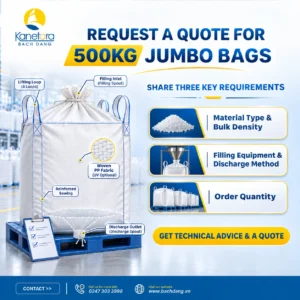
Providing complete technical information helps manufacturers evaluate the application and recommend suitable FIBC configurations.
| Parameter | Required Information |
|---|---|
| Material Name | Product to be packed |
| Packaging Weight | 500kg per bag |
| Bulk Density | kg/m³ |
| Material Properties | Powder, granules, flowability, moisture sensitivity and special hazards |
| Bag Dimensions | Preferred size or space limitations |
| Filling Top | Open Top, Duffle Top, Filling Spout |
| Bottom Construction | Flat Bottom, Discharge Spout |
| Lifting System | Configuration and handling equipment |
| PE Liner | Required or not required; material specifications |
| Coating | Required or not required |
| Safety Factor | According to intended use and testing requirements |
| Special Requirements | Food Grade, antistatic or other technical requirements |
| Printing | Logo, product information and handling symbols |
| Order Quantity | Estimated quantity per order |
| Destination Market | Domestic or export |
| Testing | Required sample evaluation and testing methods |
For applications involving dangerous goods or potentially explosive atmospheres, additional information is necessary to identify the appropriate FIBC type and applicable requirements.
11. Custom 500kg Jumbo Bag Manufacturing at Kanetora Bach Dang
Kanetora Bach Dang is an industrial packaging manufacturer based in the My Loc area of Ninh Binh Province, Vietnam, supplying FIBC and jumbo bag solutions to domestic and international customers.
According to the company’s 2026 introduction materials, the factory has a production capacity of approximately 300,000 FIBC bags per month.
Its manufacturing operations cover extrusion, fabric weaving, webbing production, coating, cutting, printing, sewing, quality inspection and packaging.
11.1. Customized FIBC Design for Different Materials
For 500kg jumbo bag requirements, Kanetora Bach Dang can work with customers to determine suitable specifications, including:
- Bag dimensions.
- U-Panel, 4-Panel or other body constructions.
- Lifting loop configurations.
- Filling top designs.
- Discharge bottom options.
- Coating and PE liners.
- Dust and moisture protection requirements.
- Storage and transportation conditions.
Each configuration is evaluated according to the intended application rather than applying a single fixed design to all materials.
11.2. Manufacturing Quality Control
Kanetora Bach Dang implements QC and QA activities throughout its FIBC manufacturing operations to support product consistency.
The factory is equipped with testing systems for evaluating material properties and relevant FIBC construction requirements.
Testing specifications for individual products should be agreed upon with customers before production.
11.3. Supporting B2B Buyers with Technical Specifications
For businesses sourcing 500kg jumbo bags, the consultation process may include:
Step 1: Review material properties, packaging weight and operating conditions.
Step 2: Evaluate bulk density and required filling volume.
Step 3: Recommend bag dimensions, construction, filling top, discharge bottom and lifting configuration.
Step 4: Confirm technical specifications and sample testing requirements.
Step 5: Finalize production requirements, order quantity and delivery schedule.
For applications involving direct connection to filling or discharge equipment, customers are encouraged to provide equipment drawings or technical specifications.
12. Frequently Asked Questions About 500kg Jumbo Bags
1. What are the standard dimensions of a 500kg jumbo bag?
There is no single standard size for all 500kg jumbo bags. Dimensions depend on the material’s bulk density, required filling volume, bag construction and handling conditions. Manufacturers should evaluate the specific application before confirming the dimensions.
2. Can a 500kg jumbo bag have a discharge spout?
Yes. A 500kg FIBC can be designed with a discharge spout for transferring materials into hoppers, silos, mixers and other receiving systems. The outlet design must match the material’s flow characteristics and the unloading equipment.
3. Which is better: a filling spout or a duffle top?
A filling spout is often suitable for automated filling equipment with a dedicated inlet connection. A duffle top may be preferable when a wider opening and flexible loading are required. The choice depends on the filling process and closure requirements.
4. Can a 500kg jumbo bag carry 600kg?
No. A bag with an SWL of 500kg should not be loaded beyond its rated capacity. If 600kg packaging is required, an FIBC specifically designed and tested for the appropriate Safe Working Load must be selected.
5. Does a 500kg jumbo bag need a PE liner?
Not necessarily. PE liners may be considered for moisture-sensitive materials, fine powders or applications requiring additional product protection. Liner specifications should be selected according to the actual operating conditions.
6. Can 500kg jumbo bags be used for food ingredients?
Yes, provided the bag is designed and manufactured to meet the relevant material, hygiene and intended food-contact requirements. Compliance depends on the specific food product, contact conditions and destination market.
7. Can a company logo be printed on 500kg jumbo bags?
Yes. Custom printing may include company logos, product information, handling instructions and identification markings. Printing specifications should be confirmed before production.
8. Can 500kg jumbo bags be manufactured in custom sizes?
Yes. Kanetora Bach Dang offers customized FIBC solutions. Customers can provide material properties, bulk density, preferred dimensions, filling and discharge requirements, and handling conditions for technical evaluation.
13. Conclusion: Choosing the Right 500kg Jumbo Bag Starts with Understanding Your Material
500kg jumbo bags provide a flexible packaging solution for various industrial materials, agricultural products, powders and granules.
However, selecting the appropriate FIBC should involve more than checking its nominal load capacity or external dimensions.
An effective bag configuration should:
- Accommodate the required 500kg load.
- Provide sufficient usable volume for the material’s bulk density.
- Match the filling equipment.
- Support safe lifting and handling.
- Allow efficient material discharge.
- Meet storage and transportation requirements.
For B2B buyers, providing complete technical specifications from the beginning can help reduce design adjustments and improve operational efficiency.
Contact Kanetora Bach Dang for Custom 500kg Jumbo Bags
KANETORA BACH DANG JOINT STOCK COMPANY
- Location: Cau Mai, My Loc Area, Ninh Binh Province, Vietnam.
- Email: info@kanetora.com
- Website: www.bachdang.vn
Looking for a reliable 500kg jumbo bag manufacturer in Vietnam?
Share your material type, bulk density, preferred bag dimensions, filling and discharge requirements, and estimated order quantity.
Our team can help evaluate suitable FIBC configurations for your packaging and bulk material handling operations.