

In industrial production, packaging is not only used to contain products. For powders, fine granules and free-flowing materials such as mineral powder, dry mortar, chemical additives, animal feed, cement, fertilizer and agricultural ingredients, the right packaging can directly affect filling speed, warehouse efficiency, product protection and brand presentation.
This is why the block bottom valve bag has become a preferred packaging solution for many manufacturers using semi-automatic and automatic packing lines.
Compared with conventional sewn PP bags, block bottom valve bags are designed to stand firmly, keep a square shape after filling and support cleaner, faster and more efficient packaging operations. For manufacturers that need high-volume packing, neat palletizing and stable product appearance, this bag type offers clear operational advantages.
At Kanetora Bach Dang, block bottom valve bags are developed as part of a comprehensive industrial packaging portfolio, alongside FIBC jumbo bags and multi-layer PE films. The factory’s block-bottom valve bag production capacity is listed at 10,000,000 pieces per month, together with FIBC bags and multilayer plastic film production capability.
What Is a Block Bottom Valve Bag?
A block bottom valve bag is an industrial packaging bag with a square or box-shaped bottom and a valve opening for product filling. The bottom is formed and sealed to help the bag maintain a stable rectangular shape after it is filled.
The valve allows products to be filled directly into the bag through a packing machine. Once the target weight is reached, the valve can close by internal pressure or be sealed depending on the product type, packing method and customer requirements.
This design makes block bottom valve bags especially suitable for powdery, granular and free-flowing materials that require fast filling, reduced dust emission, better stacking performance and a more professional appearance.
In the market, this product may also be called:
Block bottom bag, valve bag, PP block bottom bag, block bottom valve sack, pasted bottom bag or square bottom valve bag.
Although the names may vary, the core purpose remains the same: to provide a stable, efficient and clean packaging solution for industrial products.
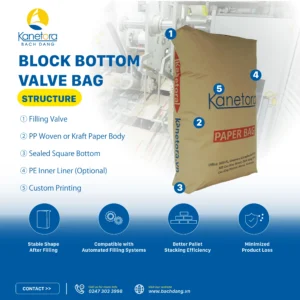
Basic Structure of a Block Bottom Valve Bag
The detailed structure of a block bottom valve bag can be customized based on product characteristics, packing line requirements and logistics conditions. In general, it includes the following main components.
1. Bag Body
The body of the bag can be made from woven polypropylene, kraft paper layers, laminated film or a combination of different materials.
For products that require high tensile strength, tear resistance and stable load-bearing performance, woven PP is commonly used. For products that require a premium printed surface or a more retail-oriented appearance, kraft paper combined with an inner PE or PP layer can also be considered.
The choice of material depends on the product inside the bag. For example, construction materials often require strong mechanical resistance, while food or feed ingredients may require better cleanliness, moisture protection and controlled production conditions.
2. Block Bottom Structure
The block bottom is the key difference between this packaging type and a conventional PP bag.
Instead of having a simple sewn or folded bottom, the bag is formed into a square or rectangular base. This allows the filled bag to stand upright, maintain a neat shape and stack more efficiently on pallets.
A well-designed block bottom helps reduce empty space between bags during palletizing. It also improves load stability during storage, handling and container loading.
3. Valve Filling System
The valve is typically located at one end of the bag. During packing, the product is filled into the bag through this valve using a valve packing machine.
This system helps reduce manual handling because the bag does not need to be opened, filled and sewn in the same way as a traditional open-mouth bag. For production lines that handle large volumes every day, this can significantly improve packing speed and process consistency.
The valve design can be adjusted based on the flowability, particle size and dust level of the product.
4. Lamination, Inner Liner or Moisture Barrier
Depending on the application, block bottom valve bags may include lamination, coating or an inner liner to improve product protection.
For powders, chemicals, additives and moisture-sensitive materials, these layers help reduce moisture penetration, dust leakage and contamination risks. For products that require better shelf stability, the correct liner or coating structure can be a decisive factor.
Businesses that need packaging for larger-volume bulk cargo may also compare this option with FIBC bags to determine which format is more suitable for their product, filling process and transport method.
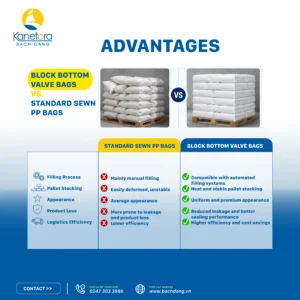
Key Benefits of Block Bottom Valve Bags
1. Better Shape Retention and Pallet Stability
One of the biggest advantages of block bottom valve bags is their ability to keep a clean, square shape after filling.
This is especially important for manufacturers that need to stack products on pallets, store them in warehouses or load them into containers. A stable bag shape helps reduce leaning, shifting and uneven stacking.
For export goods, neat palletizing also contributes to better container utilization and a more professional presentation when the shipment reaches customers.
2. Faster Packing Process
Block bottom valve bags are highly compatible with automatic and semi-automatic packing lines.
Because the product is filled through the valve, the packing process becomes faster and more consistent compared with traditional open-mouth bags that require separate filling and sewing steps.
For manufacturers with high daily output, this can reduce labor dependency, improve weight accuracy and support a more stable production flow.
3. Reduced Dust and Product Loss
For powder-based products such as cement, dry mortar, mineral powder, chemical powder, starch or additives, dust control is a major concern.
A valve filling system helps limit dust emission during the packing process. When the bag structure, valve design and material selection are correctly matched with the product, the packaging can reduce leakage, minimize waste and create a cleaner working environment.
This is particularly valuable for factories that need to improve hygiene, operator safety and production area cleanliness.
4. Professional Product Appearance
Block bottom valve bags have a flat surface and stable structure, making them suitable for clear printing, product information, branding, technical instructions, QR codes and traceability data.
For products sold through distributors, construction channels, agricultural supply chains or export markets, packaging appearance matters. A bag that stands well, prints clearly and stacks neatly can strengthen product credibility and brand recognition.
5. Improved Logistics and Warehousing Efficiency
Because the bag keeps a regular shape, it is easier to arrange on pallets, wrap with stretch film, handle by forklift and load into trucks or containers.
This can support better logistics efficiency, especially for manufacturers with large-volume shipments or long-distance transportation.
In many cases, improving packaging format is not only about protecting the product. It also helps optimize the total supply chain cost from filling, storage and handling to final delivery.
Common Applications of Block Bottom Valve Bags
1. Powders and Fine Granules
Block bottom valve bags are widely used for powder and fine granular products, including mineral powder, calcium carbonate, starch, flour, plastic powder, construction additives, dry mix products and other industrial ingredients.
For this group of products, the key packaging requirements usually include valve tightness, dust control, moisture resistance and compatibility with filling equipment.
A poorly designed bag may cause dust leakage, unstable stacking or product loss. A well-designed block bottom valve bag can help improve both packing efficiency and product protection.
2. Chemicals and Industrial Additives
In the chemical industry, packaging must meet several requirements at the same time: strength, cleanliness, moisture resistance, dust control and compatibility with the specific chemical properties of the product.
Block bottom valve bags can be used for chemical powders, granules, industrial additives, minerals and processing materials.
For products with special safety or handling requirements, businesses should work closely with the packaging manufacturer to define the right material structure, valve design, inner liner, coating and inspection standards.
For larger-volume chemical or industrial raw material packaging, manufacturers may also consider FIBC jumbo bag solutions depending on the required filling weight and transportation method.
3. Construction Materials
Construction materials are one of the most common applications for block bottom valve bags.
Products such as cement, dry mortar, tile adhesive, wall putty, gypsum, lime powder, stone powder and construction additives require packaging that is strong, dust-resistant and stable during repeated handling.
Because these products are usually heavy and powdery, the bag must be designed to withstand filling pressure, stacking weight and transport conditions.
A block bottom valve bag helps improve pallet appearance, reduce deformation and support more efficient movement throughout the supply chain.
4. Animal Feed, Fertilizer and Agricultural Products
Block bottom valve bags can also be used for animal feed, fertilizer, seeds, grains and other agricultural materials.
For these products, businesses often focus on bag strength, moisture protection, printing quality and stability during storage.
A well-designed bag can help protect product quality while also improving shelf presentation and distribution efficiency.
Block Bottom Valve Bag vs. Conventional PP Bag
| Criteria | Block Bottom Valve Bag | Conventional PP Bag |
|---|---|---|
| Shape after filling | Square, stable and neat | May bulge or deform depending on product |
| Packing speed | Suitable for automatic and semi-automatic filling | Often requires filling and sewing |
| Palletizing | More stable and space-efficient | Less uniform when stacked |
| Dust control | Better when valve and liner are properly designed | More dust may be generated during filling and sewing |
| Product appearance | Professional, flat and easy to print | Depends on bag type and printing method |
| Cost | Usually higher than basic PP bags | More economical for standard packaging |
| Best used for | Powders, chemicals, construction materials, feed and industrial products | General-purpose goods with lower technical requirements |
In general, conventional PP bags remain suitable for standard products that do not require high-speed packing, strong shape retention or premium appearance.
Block bottom valve bags are more suitable for manufacturers that want to improve packing efficiency, reduce dust, optimize palletizing and upgrade the overall quality of their packaging system.
When Should Businesses Use Block Bottom Valve Bags?
A block bottom valve bag is a strong option when a business needs to solve one or more of the following challenges.
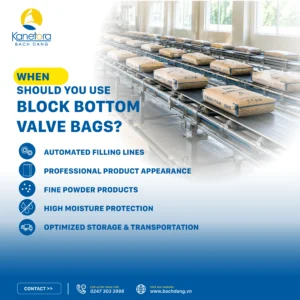
The product is powdery, fine, granular or dusty. The current packaging does not stack neatly on pallets. The production line needs faster packing speed. The company wants to reduce manual sewing operations. The product requires better protection against moisture or contamination. The brand needs a cleaner and more professional packaging appearance. The goods are transported over long distances or exported to demanding markets.
However, if the product is low-value, transported only over short distances, does not require automatic packing and does not need a neat square shape, a conventional PP bag may still be the more cost-efficient choice.
The right decision depends on product value, filling method, storage conditions, logistics requirements and the brand positioning of the final product.
What Information Should Be Prepared Before Ordering Block Bottom Valve Bags?
To design the right bag structure, the packaging manufacturer needs clear information about the product and production process.
Businesses should prepare the product name, product form, bulk density, moisture sensitivity, dust level and filling weight per bag. It is also important to provide the packing method, such as automatic valve packing, semi-automatic packing or manual filling.
Other important details include bag dimensions, pallet size, storage conditions, transport method, required printing design, number of colors, moisture protection requirements, liner requirements and any specific testing standards.
The more complete the information, the easier it is for the factory to recommend the right material, structure, valve type and cost-optimized specification.
This helps avoid common problems such as bags being too thin, too thick, difficult to fill, unstable on pallets or incompatible with the customer’s packing equipment.
Kanetora Bach Dang – Block Bottom Valve Bag Manufacturer in Vietnam
Kanetora Bach Dang is an industrial packaging manufacturer in Vietnam, providing solutions such as FIBC jumbo bags, block bottom valve bags and multi-layer PE films.
The company’s product portfolio includes block bottom valve bags, FIBC bags and flexible film solutions for multiple industries. Its website lists block bottom valve bags as suitable for feed, chemicals and construction materials, while also showing key factory capabilities and certifications.
For businesses in powders, chemicals, agriculture, animal feed and construction materials, Kanetora Bach Dang can support packaging development from specification consultation and material selection to printing, quality control and commercial production.
The company’s broader manufacturing capability can also be explored through related articles such as Inside the Export-Standard FIBC Jumbo Bag Manufacturing Process and What Capabilities Should a Jumbo Bag Factory in Vietnam Have?.
Conclusion
A block bottom valve bag is more than a simple industrial sack. With its square bottom structure, valve filling system, stable shape and strong compatibility with modern packing lines, it provides a practical solution for many industrial manufacturers.
For powders, chemicals, construction materials, agricultural products and feed ingredients, choosing the right block bottom valve bag can help reduce dust, improve filling speed, optimize palletizing and enhance product presentation.
For businesses that want to upgrade their packaging system, improve production efficiency and build a more professional product image, block bottom valve bags are a packaging solution worth considering.
Kanetora Bach Dang can support businesses in developing suitable block bottom valve bag specifications based on product characteristics, production requirements and logistics conditions.
FAQ – Block Bottom Valve Bag
What is a block bottom valve bag?
A block bottom valve bag is an industrial packaging bag with a square bottom and a valve opening for filling. It is designed to stand firmly, keep a neat shape after filling and support fast packing for powders, granules, chemicals, feed and construction materials.
What products are suitable for block bottom valve bags?
Block bottom valve bags are suitable for cement, dry mortar, tile adhesive, wall putty, mineral powder, chemical powder, fertilizer, animal feed, starch, flour and other powder or granular materials.
How is a block bottom valve bag different from a conventional PP bag?
A block bottom valve bag keeps a more stable square shape, stacks better on pallets and works well with automatic or semi-automatic valve packing lines. A conventional PP bag is usually simpler and more economical but may require sewing and may not stack as neatly.
Can block bottom valve bags reduce dust during packing?
Yes. When the valve design and material structure are suitable for the product, block bottom valve bags can help reduce dust emission and product leakage during filling.
Can block bottom valve bags be customized?
Yes. The bag size, material, valve type, printing design, lamination, liner, perforation and moisture protection structure can be customized based on product requirements and packing conditions.
Are block bottom valve bags suitable for export goods?
Yes. Their stable shape, neat palletizing and professional appearance make them suitable for export goods, especially products that require efficient storage, container loading and long-distance transportation.