

When buyers request jumbo bag pricing, they often expect a simple unit price. However, in real industrial packaging projects, a jumbo bag is not a one-size-fits-all product. The final quotation depends on many technical and commercial factors, including bag size, Safe Working Load, fabric specification, liner, coating, printing, MOQ, lead time and compliance requirements.
A jumbo bag, also known as an FIBC bag or bulk bag, is a flexible industrial container used to store, handle and transport dry bulk materials such as agricultural products, food ingredients, plastic resin, chemicals, minerals and construction materials. If you are new to this packaging type, you can first read: What Is a Jumbo Bag? Structure and Industrial Applications.
So, what exactly affects the price of a jumbo bag? Below are the key factors buyers should prepare before requesting a quotation from a direct FIBC manufacturer.
Why Jumbo Bag Pricing Must Be Based on Technical Specifications
Unlike standard retail packaging, jumbo bags are usually customized according to the product, filling system, discharge method, handling process, storage condition and export requirements.
For example, a bag used for sand, gravel or minerals is different from a bag used for flour, sugar, starch, plastic resin or fine chemical powder. Some applications only require standard uncoated woven polypropylene fabric, while others need inner liners, coating, dustproof sewing, anti-static protection, food-grade production or UN-certified packaging.
This is why a reliable manufacturer cannot provide an accurate quotation based only on the phrase “one-ton jumbo bag”. To calculate the right price, the factory needs to understand what product will be packed, how much weight each bag must carry, how the bag will be filled and discharged, and what handling or export standards must be met.
1. Jumbo Bag Size
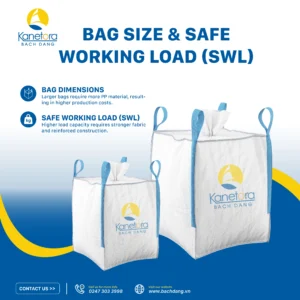
Bag size is one of the first factors that affects jumbo bag pricing. A larger bag requires more woven polypropylene fabric, more sewing work and often more complex quality control.
The basic dimensions usually include:
- Length
- Width
- Height
However, the total cost is not determined by these three numbers alone. Buyers should also provide details such as loop length, filling spout size, discharge spout size, top and bottom construction, liner dimensions and any special reinforcement requirements.
A bigger bag is not always the most cost-efficient option. If the bag size does not match the bulk density of the packed material, the bag may bulge, become difficult to stack or reduce container loading efficiency. For buyers who need better shape retention and optimized storage space, Baffled FIBC Bags may be a suitable option.
2. Safe Working Load
Safe Working Load, commonly known as SWL, refers to the maximum weight that a jumbo bag is designed to safely carry under proper handling conditions.
Most jumbo bags are designed for loads ranging from 500 kg to 2,000 kg, depending on the application and bag construction. When the required load increases, the factory may need to adjust several components, such as:
- Fabric weight and tensile strength
- Webbing strength
- Loop construction
- Sewing pattern
- Reinforcement at stress points
- Safety factor
- Load testing requirements
A bag used for dense minerals, construction materials or products with sharp edges usually requires stronger construction than a bag used for lightweight granules. This naturally affects the final price.
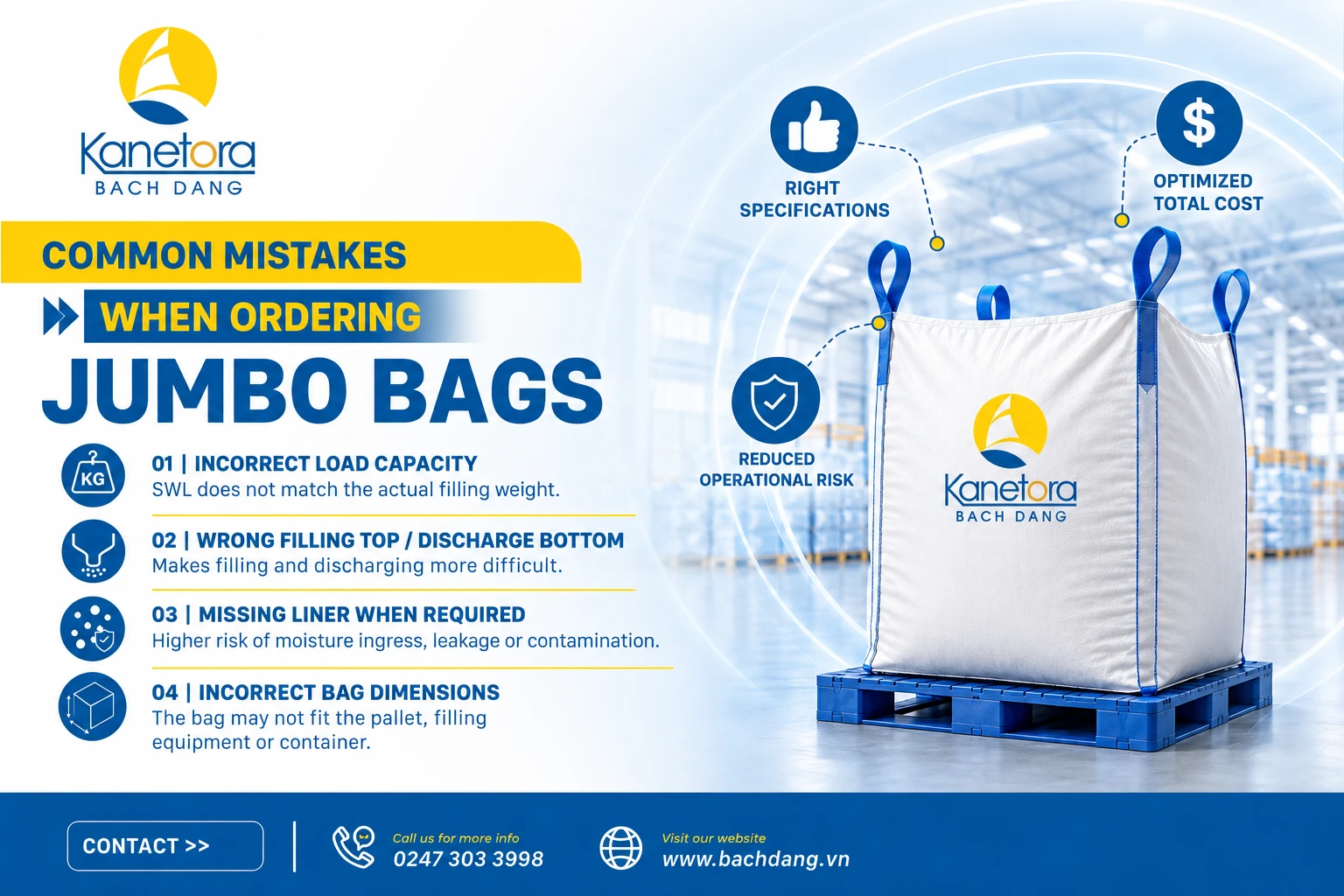
When requesting a quotation, buyers should not only say “1-ton bag”. It is better to provide the product name, bulk density, lifting method, filling method, discharge method and storage condition so that the manufacturer can recommend the most suitable design.
3. Woven Polypropylene Fabric and Fabric Weight
Most jumbo bags are made from woven polypropylene fabric. Since fabric is one of the largest cost components in an FIBC bag, its quality, weight and technical properties directly affect the quotation.
A standard industrial bag may use uncoated PP woven fabric. However, if the product requires moisture protection, dust control or leakage prevention, the bag may need coating or an inner liner.
Fabric-related factors include:
- Coated or uncoated fabric
- Fabric weight, usually measured in GSM
- Tensile strength
- UV resistance
- Fabric color
- Anti-slip requirement
- Anti-static requirement
- Food-grade or hazardous-goods compliance
- Special weaving or breathable fabric requirements
For common structural options, buyers can refer to U-Panel FIBC Bags and Circular FIBC Bags to better understand how different bag constructions affect performance and cost.
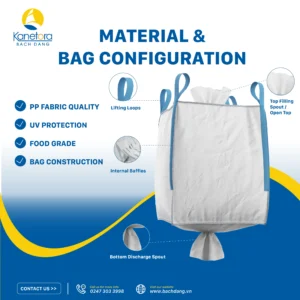
4. Bag Construction Type
The construction of a jumbo bag also plays an important role in pricing. Even with the same load capacity, different bag structures can require different amounts of fabric, labor, sewing time and quality inspection.
Common jumbo bag constructions include:
U-Panel FIBC Bags
U-Panel bags are widely used for industrial applications because they offer a good balance between strength, flexibility and cost efficiency.
Circular or Tubular FIBC Bags
Circular bags are woven in a tubular form, reducing vertical seams and making them suitable for many dry bulk applications. In some cases, they can also help optimize production efficiency.
4-Panel FIBC Bags
4-Panel bags are made from four side panels and one base panel. They are often selected when buyers need better shape stability compared with some basic bag designs.
Baffled FIBC Bags
Baffled bags, also known as Q-bags or form-stable bags, include internal baffle panels to reduce bulging and improve stacking efficiency. Because this structure is more complex, it is usually more expensive than standard jumbo bags.
For more insight into what a capable factory should be able to produce and control, you can read: What Capabilities Should a Jumbo Bag Factory in Vietnam Have?.
5. Inner Liner
An inner liner is a PE, PP or multi-layer film inserted inside the jumbo bag to provide additional protection against moisture, dust, leakage or contamination.
Adding a liner usually increases the price because it requires extra material, film production, cutting, sealing, insertion and inspection. Depending on the application, liner options may include:
- Standard PE liner
- Tabbed liner
- Form-fit liner
- Bottle-shaped liner
- Conductive liner
- Aluminum barrier liner
- Multi-layer barrier liner
- Food-contact liner
Liners are often recommended for fine powders, starch, sugar, food ingredients, plastic resin, chemical powders and moisture-sensitive products. For applications with strict hygiene and product safety requirements, buyers can consider Food Grade FIBC Bags.
6. Coating or Lamination
Coating is a laminated layer applied to the woven PP fabric to improve moisture resistance, reduce dust leakage and provide better product protection.
Compared with a separate liner, coating is often suitable for applications that need moderate dust or moisture protection but do not require a full inner bag. For very fine powders or highly moisture-sensitive materials, the manufacturer may recommend combining coating with an inner liner.
Coating costs may vary depending on:
- One-side or two-side coating
- Coating thickness
- Gloss, matte or anti-skid surface
- Moisture-resistance requirement
- Printing surface requirement
- Storage and transport environment
Before requesting a quotation, buyers should clearly describe whether the product is dusty, moisture-sensitive or likely to be stored outdoors or at port before shipment.
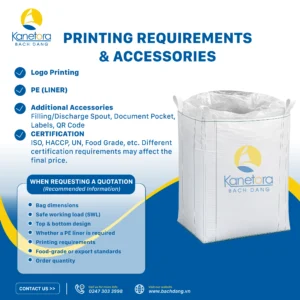
7. Printing Requirements
Printing is important for branding, product identification, safety warnings, handling instructions, export markings and batch traceability.
Printing cost depends on:
- Number of printed sides
- Number of colors
- Printing area size
- Artwork complexity
- Number of SKUs
- Logo, barcode or QR code requirements
- Warning marks or technical symbols
For export orders, printing information must be carefully checked before production. Incorrect product codes, weight information, handling marks or importer details may lead to operational issues during shipping or customs clearance.
If a single order includes many different artwork versions, the factory may need additional setup time and management control, which can affect the final unit price.
8. MOQ – Minimum Order Quantity
MOQ is one of the most important commercial factors in jumbo bag pricing. Larger order quantities usually allow the factory to optimize raw material purchasing, machine setup, production scheduling, printing, sewing, inspection and packing.
In general, a higher quantity can help reduce the unit price. On the other hand, small orders or many mixed specifications may increase the cost per bag because of additional setup, material waste and production management.
Pricing may increase when the order includes:
- Low quantity
- Many different bag sizes
- Multiple artwork versions
- Different top and bottom designs
- Special fabric colors
- Special liner or coating requirements
- Urgent delivery
To optimize cost, buyers should consolidate demand by product group, standardize bag specifications where possible and plan orders ahead of time.
9. Lead Time
Lead time affects pricing because it directly influences raw material planning, production scheduling, labor arrangement, quality inspection and shipment preparation.
If an order is urgent, the factory may need to prioritize production lines, arrange overtime, split packing schedules or adjust existing production plans. This can increase the total cost compared with a standard lead time.
Lead time usually depends on:
- Order quantity
- Bag design complexity
- Raw material availability
- Sample approval time
- Printing requirements
- Liner or coating requirements
- Testing or certification requirements
- Container loading schedule
For export orders, buyers should also consider time for sample development, sample approval, mass production, final inspection, baling, labeling and transportation to port.
10. Certification and Testing Requirements
Some industries require jumbo bags to meet specific standards for safety, hygiene or transport compliance. These requirements can also affect the quotation.
Examples include:
- Food-grade bags for food ingredients
- UN-certified bags for hazardous materials
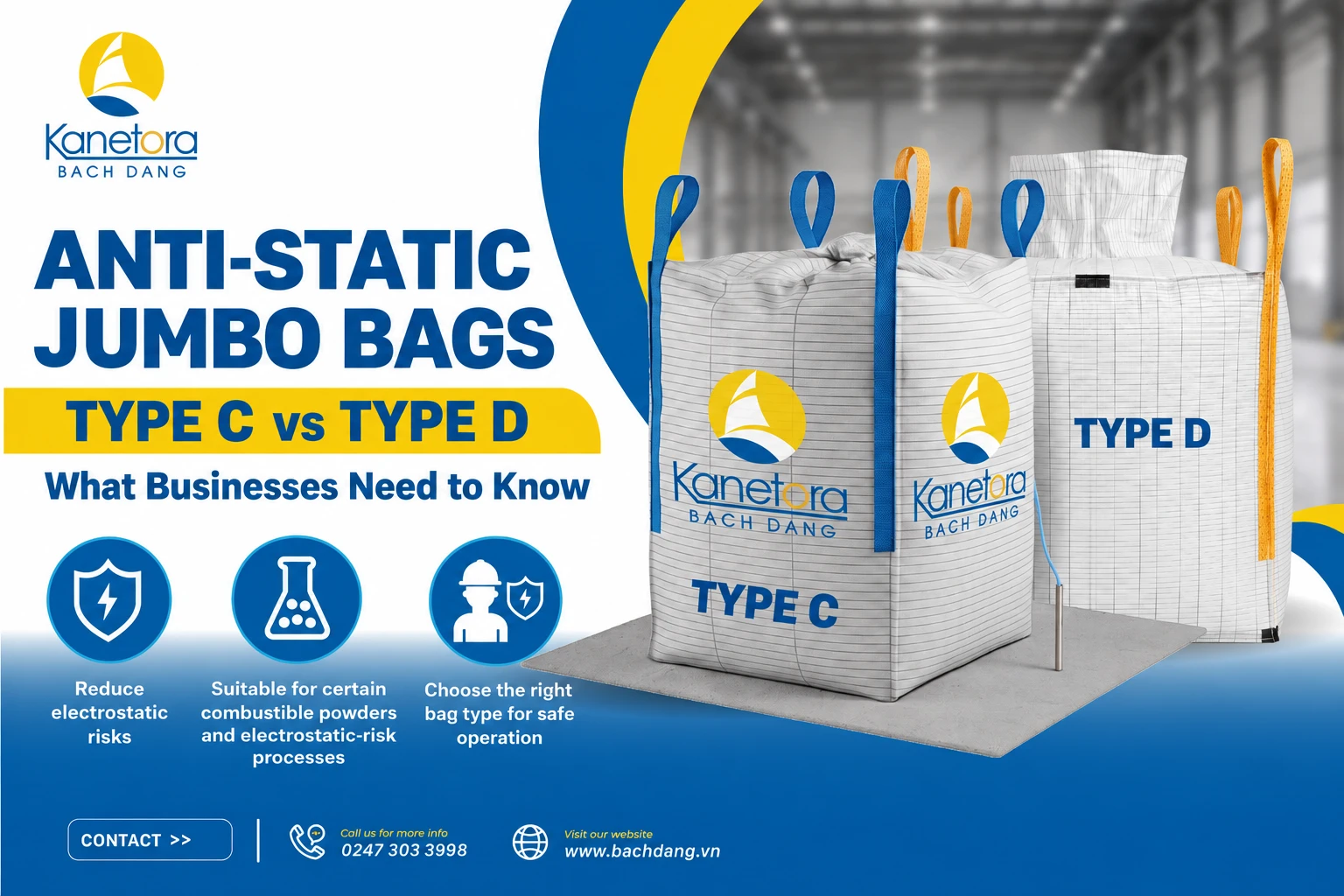
- Type C or Type D bags for electrostatic control
- UV-resistant bags for outdoor storage
- Load testing for heavy-duty applications
- Metal detection or dust control for sensitive products
- Batch traceability for export customers
For hazardous goods, buyers may need UN Certified Bulk Bags. For applications involving electrostatic risks, FIBC Type C Bulk Bags or Type D FIBC Bulk Bags may be required depending on the operating environment.
11. Packing, Warehousing and Container Loading
The cost of a jumbo bag is not only about the bag itself. Finished packing requirements can also affect the total quotation.
After production, jumbo bags are usually pressed into bales, wrapped, labeled and arranged by item code. Some customers may require special packing methods to support warehouse control, container loading or export documentation.
Packing-related cost factors may include:
- Number of bags per bale
- Pallet or non-pallet packing
- Moisture-protection wrapping
- Labeling requirements
- Separation by SKU or batch number
- Container loading requirements
- Special inspection or counting requirements
For high-volume export orders, confirming the packing standard early can reduce the risk of mixed items, counting errors or logistics delays.
How to Get a More Accurate Jumbo Bag Quotation
To receive a faster and more accurate quotation, buyers should prepare the following information before contacting a jumbo bag manufacturer:
| Information Group | Details to Provide |
|---|---|
| Packed product | Product name, powder/granule/lump form, bulk density, moisture sensitivity, dust or leakage risk |
| Load requirement | Weight per bag, SWL and safety factor |
| Bag size | Length × width × height, or required pallet/container optimization |
| Bag construction | U-Panel, Circular, 4-Panel, Baffled or existing sample design |
| Top filling design | Open top, duffle top, filling spout or special filling system |
| Bottom discharge design | Flat bottom, discharge spout, full open discharge or conical discharge |
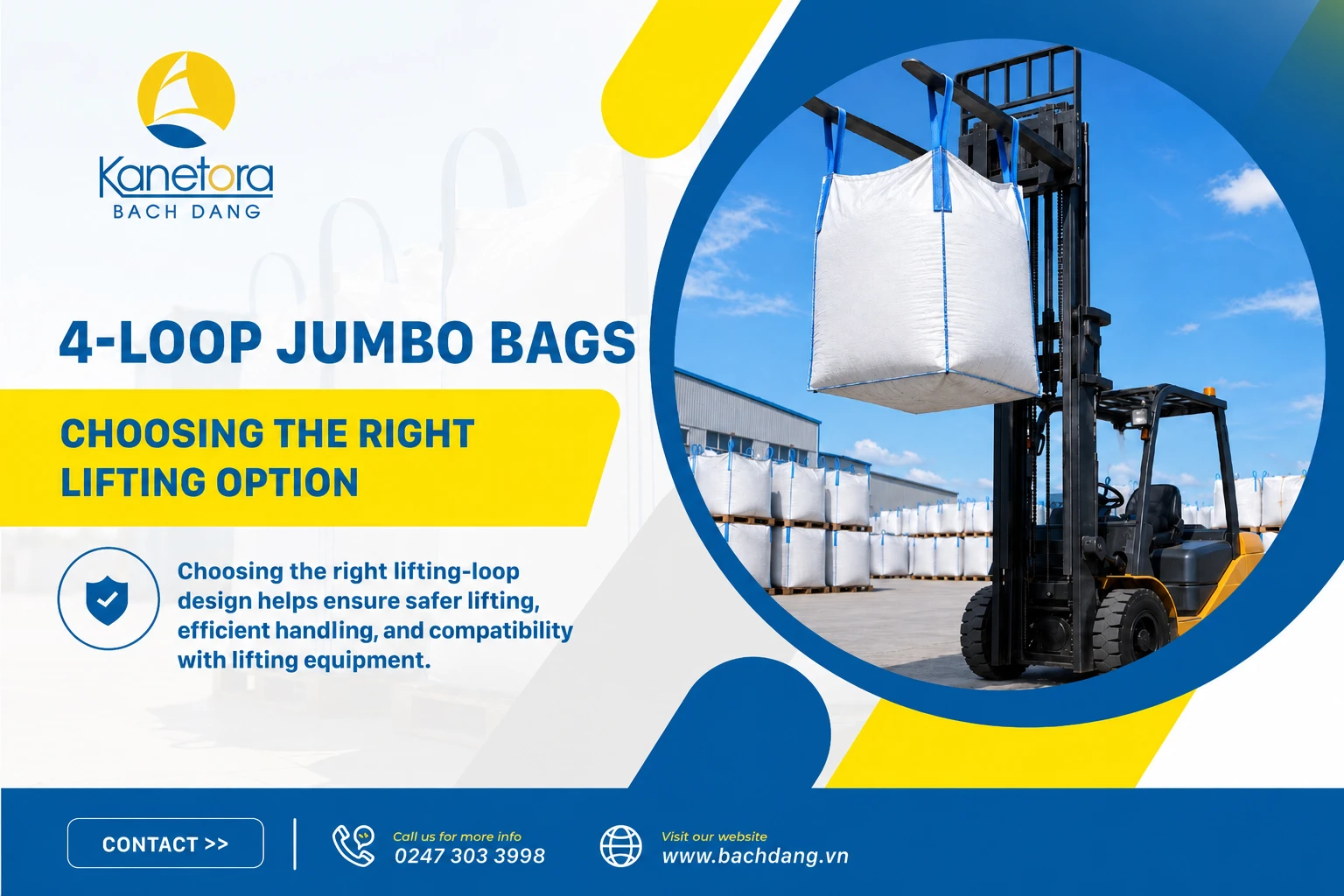
| Lifting loops | Cross-corner loops, corner loops, stevedore loops or other lifting options |
| Liner/coating | With or without liner, with or without coating, moisture/dust protection level |
| Printing | Number of printed sides, colors, logo, warning marks and product codes |
| Order quantity | MOQ, monthly demand or project quantity |
| Lead time | Required delivery schedule, urgent order or container loading plan |
| Standards | Food grade, UN, Type C/D, UV resistance, load testing or other compliance requirements |
The clearer the specification, the more accurate the price. It also helps the manufacturer recommend a safer and more cost-effective FIBC solution.
Kanetora Bach Dang – Direct Jumbo Bag Manufacturer in Vietnam
Kanetora Bach Dang is a direct industrial packaging manufacturer in Vietnam, providing FIBC jumbo bags, sling bags, block bottom valve bags and multi-layer PE films for industries such as food, agriculture, plastics, chemicals, minerals and construction materials. The company’s website lists its main product categories and manufacturing capability, including FIBC bags, block-bottom valve bags and multilayer plastic film.
The factory supplies a wide range of FIBC solutions, including standard jumbo bags, bags with inner liners, coated bags, dustproof bags, food-grade bags, UN-certified bags, U-Panel bags, Circular bags, Baffled bags and customized designs based on customer requirements.
Kanetora Bach Dang also applies a structured production process covering extrusion, belt weaving, fabric weaving, laminating, cutting/printing, sewing, inspecting and packing, helping ensure product durability, safety and export-standard quality control. You can explore the full process here: Inside the Export-Standard FIBC Jumbo Bag Manufacturing Process.
As a direct manufacturer, Kanetora Bach Dang can support buyers from specification review and sample development to mass production and delivery, helping businesses balance strength, safety, handling efficiency and total packaging cost.
Conclusion: Jumbo Bag Pricing Depends on the Right Packaging Solution
Jumbo bag pricing depends on much more than bag size or load capacity. The final quotation is shaped by fabric specification, SWL, construction type, liner, coating, printing, MOQ, lead time, certification and packing requirements.
A low-cost bag is not always the best option if it does not match the product, filling process, lifting method, storage condition or export requirement. On the other hand, a well-designed FIBC bag can help reduce product loss, improve handling safety, optimize container loading and lower total operating cost.
If your business needs a customized jumbo bag quotation for agricultural products, food ingredients, plastic resin, chemical powders, minerals or construction materials, contact Kanetora Bach Dang for technical consultation and a suitable FIBC packaging solution.
Looking for a reliable jumbo bag manufacturer in Vietnam? Contact Kanetora Bach Dang to receive technical consultation, sample support and a customized FIBC quotation based on your actual product and handling requirements.
FAQ
What affects jumbo bag pricing?
Jumbo bag pricing is affected by bag size, Safe Working Load, fabric weight, construction type, liner, coating, printing, MOQ, lead time, certification and packing requirements.
Why do two 1-ton jumbo bags have different prices?
Two 1-ton jumbo bags can have different prices because they may use different fabric weights, loop designs, sewing patterns, liners, coatings, printing requirements, safety factors or certification standards.
Are jumbo bags with liners more expensive?
Yes. Jumbo bags with liners usually cost more because they require additional film material, liner production, sealing, insertion and quality inspection. However, liners provide better protection against moisture, dust, leakage and contamination.
What is the difference between coating and liner in an FIBC bag?
Coating is a laminated layer applied to the woven fabric, while a liner is a separate inner bag inserted inside the FIBC. Coating provides moderate protection, while liners offer stronger moisture, dust and contamination control.
Does a larger MOQ reduce jumbo bag unit price?
In many cases, yes. A larger MOQ allows the factory to optimize raw material purchasing, machine setup, production planning, printing and packing, which can help reduce the unit price.
What information should buyers provide for a jumbo bag quotation?
Buyers should provide product type, load weight, bag dimensions, construction type, top and bottom design, lifting loop type, liner/coating requirements, printing details, quantity, lead time and any required standards such as food grade, UN or anti-static protection.