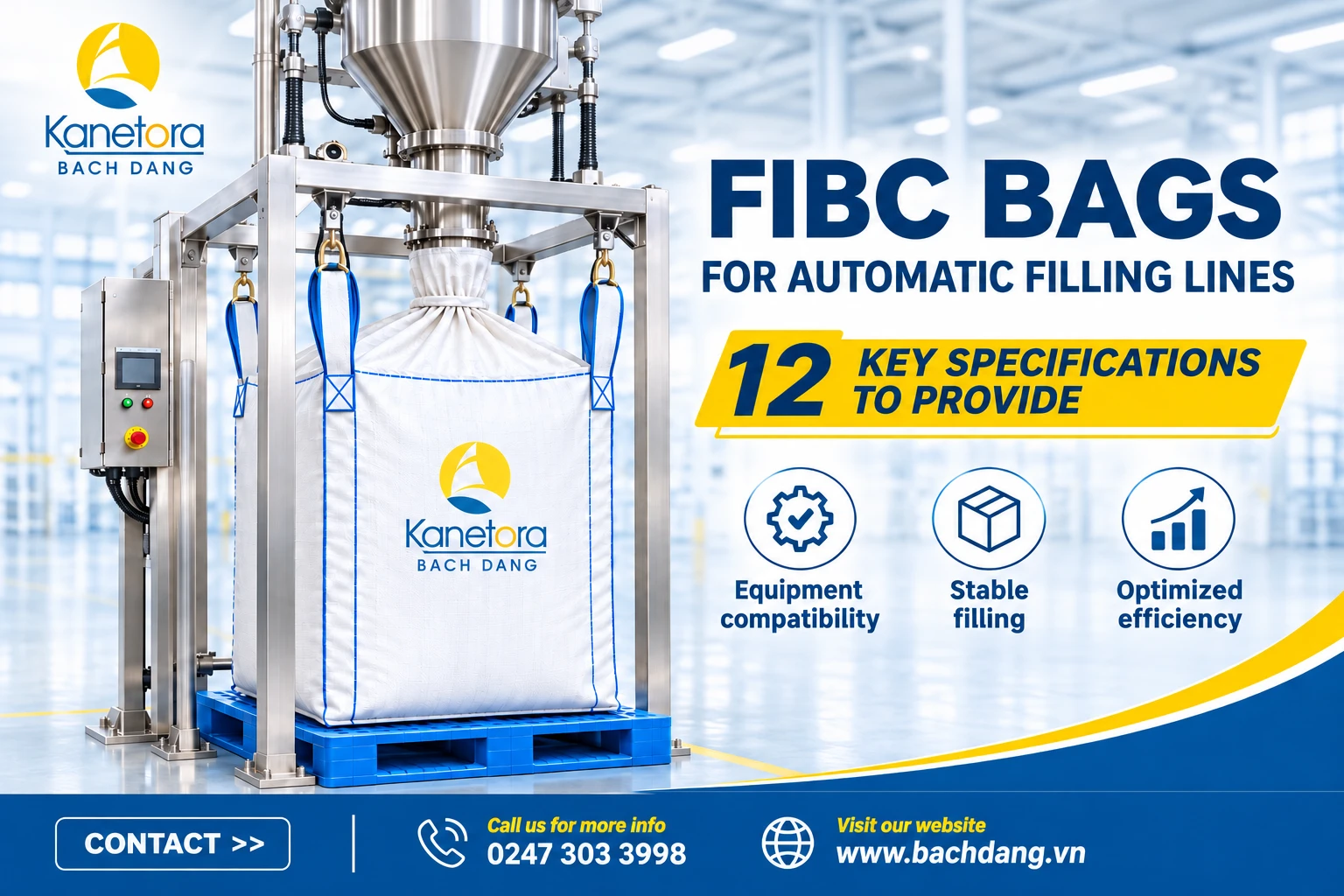


In industries such as plastics, chemicals, food processing, minerals, and construction materials, automatic and semi-automatic filling systems are increasingly adopted to improve productivity, maintain filling accuracy, and reduce manual handling.
However, the efficiency of a filling line depends not only on the performance of the equipment but also on the design and consistency of the packaging.
An FIBC bag with the correct load capacity but an incompatible filling spout, lifting loop configuration, or inner liner can cause production interruptions, material leakage, excessive dust generation, and longer filling cycles.
FIBC bags for automatic filling lines must be engineered to match the filling equipment, bulk material characteristics, and actual operating conditions of the production facility.
What technical specifications should manufacturers provide when ordering customized FIBC bags? This guide from Kanetora Bach Dang explores 12 essential groups of specifications to help businesses develop a reliable and efficient bulk packaging solution.
1. What Are FIBC Bags for Automatic Filling Lines?
FIBC bags for automatic filling lines are Flexible Intermediate Bulk Containers, also known as jumbo bags or bulk bags, designed or customized to operate with industrial weighing, material feeding, filling, and bag-handling systems.
Unlike conventional manual filling applications, FIBCs used in automated or semi-automated production environments must meet several requirements simultaneously:
-
Compatibility with filling heads and spout-clamping mechanisms.
-
Compatibility with lifting hooks and bag-support systems.
-
Dimensional consistency within equipment operating limits.
-
Effective dust and material leakage control.
-
Compatibility with the required filling rate.
-
Consistent specifications across production batches.
-
Compatibility with conveyors, pallets, and downstream handling equipment.
Depending on the level of automation, operations such as positioning the bag, attaching lifting loops, connecting the filling spout, and closing the bag may still require operator involvement.
Explore Kanetora Bach Dang’s range of custom-manufactured FIBC bulk bags to identify suitable packaging configurations for different industrial applications.
2. How Do FIBC Bags Work on Automatic Filling Lines?
A typical industrial bulk bag filling system may include a material hopper, feeding mechanism, weighing system, filling head, bag-support frame, dust extraction equipment, and downstream handling system.
The filling process generally consists of seven stages:
-
Bag positioning: An empty FIBC is placed at the filling station.
-
Loop attachment: The lifting loops are connected to the supporting hooks or frame.
-
Spout connection: The filling spout is attached and secured to the filling head.
-
Material filling: Bulk materials are fed into the bag according to the target weight.
-
Material stabilization: Vibration or settling equipment may be used where applicable.
-
Bag closure: The filling connection is released, and the filling spout or liner is closed.
-
Finished bag handling: The filled FIBC is transferred to storage, palletizing, or dispatch areas.
At each stage, the bag’s design can influence the overall performance of the filling system.
Providing only the required filling weight is therefore insufficient to determine the most suitable FIBC configuration for an automated production line.
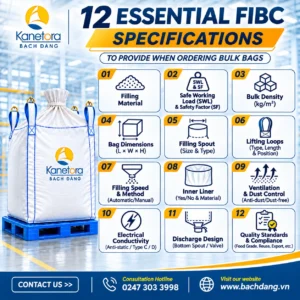
3. 12 Essential Specifications for FIBC Bags Used on Automatic Filling Lines
3.1. Bulk Material Characteristics
The characteristics of the bulk material form the foundation of FIBC design and material selection.
Manufacturers should provide information about the product name, particle size, material form, moisture content, filling temperature, dust generation, chemical properties, and potential ignition hazards.
| Bulk Material | Key Packaging Considerations |
|---|---|
| PP, PE and PET resin | Cleanliness, electrostatic risks, liner requirements |
| Cement and mineral powders | Dust leakage control, seam strength |
| Sugar, flour and starch | Food safety, cleanliness, contamination prevention |
| Chemical powders | Material compatibility, electrostatic protection |
| Fertilizers | Moisture protection, chemical compatibility |
| Minerals and aggregates | Load capacity, durability, abrasion resistance |
For chemical products and potentially hazardous materials, the relevant Safety Data Sheet (SDS) and application-specific safety requirements should also be provided.
Discover more about UN-certified FIBC bulk bags for solid dangerous goods where applicable transport regulations permit the use of flexible IBCs.
3.2. Safe Working Load (SWL) and Safety Factor (SF)
Safe Working Load (SWL) defines the rated maximum working load for which an FIBC is designed and tested under its specified conditions of use.
Common industrial filling capacities include:
-
500 kg
-
1,000 kg
-
1,250 kg
-
1,500 kg
-
2,000 kg
In addition to the target filling weight, customers should provide information about weighing tolerances, lifting methods, handling conditions, and the required Safety Factor (SF).
The Safety Factor must not be interpreted as additional usable filling capacity. An FIBC must never be intentionally filled beyond its rated SWL.
Read our detailed guide on How to Read an FIBC Specification Sheet: SWL, SF, Dimensions and Tolerances to better understand these technical parameters.
3.3. Bulk Density of the Material
Bulk density is one of the most important parameters when determining the required volume and dimensions of an FIBC.
For the same filling weight, materials with lower bulk density require a larger packaging volume than materials with higher bulk density.
The theoretical material volume can be calculated using the following formula:
Where:
-
V: Material volume (m³).
-
M: Target filling weight (kg).
-
ρ: Bulk density (kg/m³).
| Illustrative Bulk Density | Filling Weight | Material Volume |
|---|---|---|
| 400 kg/m³ | 1,000 kg | 2.50 m³ |
| 600 kg/m³ | 1,000 kg | 1.67 m³ |
| 800 kg/m³ | 1,000 kg | 1.25 m³ |
| 1,000 kg/m³ | 1,000 kg | 1.00 m³ |
| 1,500 kg/m³ | 1,000 kg | 0.67 m³ |
The values above are illustrative examples and do not represent the fixed bulk density of any specific material.
Actual bag dimensions must also account for material aeration, settling behavior, bag deformation, filling conditions, and the headspace required for bag closure.
3.4. Bag Dimensions and Equipment Operating Space
An FIBC must fit both the filling station before filling and the downstream handling system after it has been filled.
The following dimensions should be confirmed:
-
Bag length, width, and body height.
-
Overall height, including lifting loops.
-
Maximum external dimensions after filling.
-
Pallet or weighing-platform dimensions.
-
Distance between the filling head and weighing platform.
-
Conveyor width and height limitations.
-
Available space for spout or liner closure.
Different FIBC constructions offer different advantages depending on the material characteristics and operational requirements.
| FIBC Construction | Key Design Characteristics |
|---|---|
| Circular / Tubular | Continuous woven body with fewer vertical seams |
| U-Panel | U-shaped main panel combined with two side panels |
| 4-Panel | Four separate side panels forming the bag body |
| Baffle | Internal baffles designed to restrict excessive bulging |
For production lines with strict dimensional limitations, Baffle FIBC bags may provide improved dimensional stability after filling.
Customers can also explore U-Panel FIBC bags and Circular FIBC bags to compare alternative bag constructions.
3.5. Filling Spout Dimensions and Design
The filling spout provides the direct connection between the FIBC and the material filling head.
It is one of the most critical interfaces between the packaging and the filling equipment.
Customers should provide the following specifications:
| Parameter | Required Information |
|---|---|
| Filling head diameter | External diameter of the machine filling head |
| Filling spout diameter | Required nominal spout diameter |
| Filling spout length | Usable length for connection and closure |
| Clamping position | Location of the machine’s sealing or clamping mechanism |
| Dimensional tolerance | Permitted manufacturing variation |
| Connection method | Mechanical clamp, inflatable seal, or other system |
| Closure method | Tie, heat sealing, or other specified closure |
D: Filling spout diameter
L: Filling spout length
Clamping Zone: Area used to connect and seal the spout to the filling equipment.
Illustration of essential FIBC filling spout dimensions.
A spout that is too short may provide insufficient space for secure attachment. Conversely, an excessively long or oversized spout may create folds that interfere with sealing and post-filling operations.
For this reason, filling spout dimensions should be determined according to the equipment interface rather than the bag’s load capacity alone.
3.6. Lifting Loop Configuration and Dimensions
Lifting loops must be compatible with the filling station’s bag-support and handling mechanisms.
The required technical information includes:
-
Number of lifting loops.
-
Lifting loop configuration.
-
Free loop length.
-
Webbing width.
-
Loop opening dimensions.
-
Loop attachment positions.
-
Distance between machine lifting hooks.
-
Dimensional and positional tolerances.
Common lifting configurations include Corner Seam Loops, Cross Corner Loops, and other customized lifting arrangements.
For systems equipped with automatic loop-release mechanisms or automated bag transfer equipment, consistent loop dimensions and attachment positions are particularly important.
Incorrect loop geometry may cause misalignment, uneven load distribution, or difficulties during bag positioning.
Read more about 4-Loop Jumbo Bags: Choosing the Right Lifting Option for Forklifts and Cranes.
3.7. Filling Rate and Material Feeding Method
Different industrial filling systems operate with different feeding mechanisms and production capacities.
Common material feeding methods include gravity feeding, screw feeders, belt feeders, rotary valves, and pneumatic conveying systems.
Customers should provide:
-
Target production capacity in bags per hour or tonnes per hour.
-
Material flow rate.
-
Average filling cycle time.
-
Material temperature during filling.
-
Material settling or vibration requirements.
-
Bag inflation requirements, if applicable.
-
Air displacement and dust extraction requirements.
High-speed filling applications require careful coordination between material flow, filling spout geometry, air displacement, fabric permeability, and liner configuration.
Not every FIBC design is suitable for every filling rate.
The most appropriate configuration should be validated under actual operating conditions.
3.8. FIBC Inner Liner Requirements
An FIBC inner liner is commonly used to provide additional protection against moisture, fine particle leakage, and contamination.
For automatic filling applications, the liner must also remain compatible with bag inflation, filling head connection, material flow, and post-filling closure.
| Liner Configuration | Main Characteristics |
|---|---|
| Lay-flat Liner | Simple flat-film construction |
| Gusseted Liner | Folded sides that expand with the bag body |
| Form-fit Liner | Shaped to match the FIBC body and spouts |
| Fixed Liner | Secured to the outer bag to restrict movement |
| Conductive Liner | Used within compatible electrostatic-control systems |
| Barrier Liner | Provides enhanced protection against moisture or oxygen, depending on its material structure |
Customers should specify the liner material, film thickness, dimensions, attachment method, barrier requirements, and closure method.
For filling lines equipped with automatic heat-sealing systems, the sealing properties and dimensions of the liner opening must also be evaluated.
Kanetora Bach Dang’s in-house production of multi-layer PE films and flexible packaging materials supports the coordinated development of FIBC and inner liner configurations.
3.9. Air Displacement and Dust Control
As bulk material enters an FIBC, the air inside the bag must be displaced through an appropriate ventilation or extraction arrangement.
Fine powders may generate dust around the filling connection, seams, or other packaging interfaces.
Important design considerations include:
-
Air permeability of woven polypropylene fabric.
-
Coated or uncoated fabric requirements.
-
Sift-resistant seam construction.
-
Liner configuration.
-
Air displacement pathways.
-
Compatibility with dust extraction equipment.
-
Required level of material containment after filling.
A coated or lined FIBC is not automatically the most suitable option for every filling application.
An excessively restrictive bag configuration without adequate air displacement may negatively affect filling performance.
For powder-handling applications, the FIBC design should be evaluated together with the filling equipment and facility dust-control systems.
Sift-resistant packaging must not be considered a substitute for industrial dust extraction or explosion prevention measures.
Explore our guide to Jumbo Bags for Cement and Construction Materials for additional information about demanding powder and mineral packaging applications.
3.10. Electrostatic Protection Requirements
Electrostatic charges may accumulate as powders or granular materials move through feeding equipment, filling heads, and packaging surfaces.
Where combustible materials or potentially explosive atmospheres are present, selecting an appropriate FIBC electrostatic classification is a critical safety consideration.
| FIBC Type | Electrostatic Characteristics |
|---|---|
| Type A | No specialized electrostatic protection |
| Type B | Low breakdown voltage fabric that limits certain hazardous discharge mechanisms |
| Type C | Conductive construction requiring proper grounding |
| Type D | Static-dissipative construction that does not require grounding of the FIBC itself when used as specified |
Businesses should provide the relevant SDS, material ignition characteristics, dust hazard assessment, operating environment, and requirements established by their Environment, Health and Safety (EHS) team.
FIBC and liner selection should be based on a qualified risk assessment, relevant testing documentation, and applicable requirements such as IEC 61340-4-4.
Learn more about the differences between Type C and Type D anti-static jumbo bags.
Kanetora Bach Dang also offers customized Type C FIBC bulk bags and Type D FIBC bulk bags for appropriate industrial applications.
3.11. Bottom Construction and Discharge Method
An FIBC must be designed for its complete application cycle, not only the initial filling operation.
For businesses supplying raw materials to other industrial facilities, the customer’s unloading method can directly influence the required bag configuration.
Common bottom constructions include:
| Bottom Construction | Typical Function |
|---|---|
| Flat Bottom | Closed base for applications without a dedicated discharge spout |
| Discharge Spout | Controlled material discharge |
| Conical Discharge | Supports material flow for suitable applications |
| Iris Closure | Additional protection around the discharge opening |
| Full Open Discharge | Larger discharge opening for specialized unloading requirements |
If the end customer operates an automatic or semi-automatic bulk bag discharge station, additional specifications should include discharge spout diameter, spout length, closure design, and compatibility with the receiving equipment.
Coordinating the filling requirements at the supplier’s facility with the discharge requirements at the customer’s facility helps improve packaging functionality throughout the supply chain.
3.12. Quality Requirements, Dimensional Tolerances and Traceability
Automated production environments require consistency not only within individual FIBCs but also across production batches and repeated orders.
Customers and manufacturers should establish agreed specifications for:
-
Bag body dimensions.
-
Filling and discharge spout dimensions.
-
Lifting loop dimensions and attachment positions.
-
Fabric weight and mechanical properties.
-
Seam construction and strength.
-
Liner dimensions and film properties.
-
Product inspection and acceptance criteria.
-
Labeling and batch identification.
-
Testing documentation and traceability.
For food-contact applications, relevant material compliance documentation should match the actual bag construction and intended conditions of use.
Explore Kanetora Bach Dang’s Food Grade FIBC bags for applications requiring enhanced packaging hygiene and contamination control.
4. FIBC Technical Specification Checklist for Automatic Filling Lines
To simplify the quotation and product development process, businesses can use the following checklist when submitting a Request for Quotation (RFQ) to an FIBC manufacturer.
| No. | Specification | Required Information |
|---|---|---|
| 01 | Bulk Material | Product name, material form, moisture, temperature and properties |
| 02 | SWL and SF | Target filling weight and required Safety Factor |
| 03 | Bulk Density | Bulk density in kg/m³ |
| 04 | Bag Dimensions | Length × width × height |
| 05 | Filling Spout | Diameter, length, connection method and tolerances |
| 06 | Lifting Loops | Quantity, construction, free length and position |
| 07 | Filling Rate | Bags/hour, tonnes/hour and feeding method |
| 08 | Inner Liner | Material, thickness, configuration and attachment |
| 09 | Dust Control | Coating, seam construction, ventilation and extraction |
| 10 | Electrostatic Protection | FIBC Type A/B/C/D based on risk assessment |
| 11 | Discharge Method | Bottom construction and discharge requirements |
| 12 | Quality Requirements | Standards, tolerances, inspection and traceability |
Supporting documents should ideally include the filling equipment’s technical drawings, machine model, operational photographs or videos, existing FIBC samples, applicable SDS documentation, expected order quantity, and delivery requirements.
If all 12 specification groups are not yet available, customers can begin by providing the bulk material, target filling weight, bulk density, and existing equipment information.
These details provide a starting point for further technical discussions and product development.
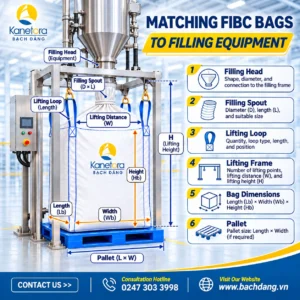
5. Common FIBC Compatibility Issues on Automatic Filling Lines
Even a bulk bag with adequate mechanical strength may perform poorly if its design is incompatible with the filling equipment.
| Common Issue | Potential Operational Impact |
|---|---|
| Incorrect filling spout dimensions | Difficult attachment, poor sealing or material leakage |
| Inconsistent lifting loops | Bag misalignment or positioning difficulties |
| Inner liner movement | Interrupted material flow or additional manual handling |
| Excessive body deformation | Conveyor, pallet or storage compatibility issues |
| Inadequate air displacement | Longer filling cycles or unstable filling performance |
| Inconsistent dimensional tolerances | Repeated equipment adjustments and production interruptions |
These issues can increase the time required to process each bag, create additional manual operations, and reduce overall production efficiency.
Confirming the technical specifications and conducting sample trials before mass production are therefore important steps in developing a suitable FIBC solution.
Read more: 10 Common Mistakes When Ordering Jumbo Bags for the First Time.
6. How to Order Customized FIBC Bags for Automatic Filling Lines
A structured product development process helps manufacturers and customers identify potential compatibility issues before mass production.
The recommended process consists of six stages.
Step 1. Technical Information Collection
Collect information about the bulk material, filling weight, bulk density, filling equipment, and operating environment.
Step 2. Application and Compatibility Assessment
Evaluate the required bag construction, lifting loops, filling spout, inner liner, discharge configuration, and other application-specific features.
Step 3. Technical Drawing and Specification Approval
Confirm the proposed dimensions, tolerances, material specifications, and quality acceptance criteria.
Step 4. Sample Production
Prepare FIBC samples according to the agreed technical specifications.
Step 5. On-Line Filling Trials
Evaluate the sample bags on the customer’s actual filling equipment, focusing on:
-
Bag positioning and loop attachment.
-
Filling spout connection and sealing.
-
Material flow and filling cycle.
-
Dust control and air displacement.
-
Filled bag stability.
-
Post-filling closure.
-
Downstream handling compatibility.
Step 6. Final Approval and Mass Production
Review the trial results, confirm any required adjustments, and proceed with production according to the approved specifications.
Where necessary, the filling equipment supplier should also participate in the technical evaluation.
The objective is not simply to manufacture a bag that meets the required SWL, but to develop a packaging configuration that performs consistently under actual production conditions.
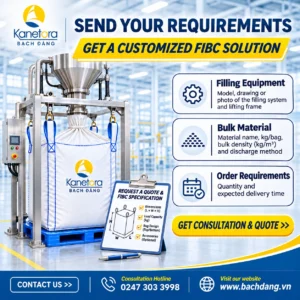
7. Kanetora Bach Dang – Customized FIBC Manufacturer for Industrial Filling Applications
With nearly 30 years of packaging industry experience across the Kanetora manufacturing system, Kanetora Bach Dang develops industrial FIBC solutions for domestic and international customers.
Our manufacturing capabilities support customized packaging requirements across industries, including plastics, chemicals, food ingredients, minerals, agriculture, and construction materials.
300,000
Bags per month
500
Tonnes per month
04
Sewing workshops
08
Manufacturing stages
Integrated Manufacturing Capabilities
Kanetora Bach Dang manufactures a wide range of semi-finished components in-house, including woven polypropylene fabric, lifting webbings, inner liners, labels, and other FIBC accessories.
This integrated manufacturing approach supports material consistency, production flexibility, and customization according to customer-specific technical requirements.
Comprehensive Quality Control and Testing
Our manufacturing facility is equipped with specialized FIBC testing and inspection equipment, including:
-
Top Lift Test machines.
-
Tensile strength testers.
-
Seam strength testing equipment.
-
UV accelerated weathering testers.
-
Liner puncture resistance testers.
-
Heat-sealing strength testers.
-
Liner visual inspection systems.
Quality Control (QC) and Quality Assurance (QA) procedures are implemented throughout the manufacturing process to support consistent product quality.
Learn more about our FIBC Bag Quality Control and Testing capabilities.
Customized FIBC Packaging Solutions
Kanetora Bach Dang offers customized FIBC configurations covering bag dimensions, body construction, lifting loops, filling spouts, discharge systems, inner liners, fabric coating, and sift-resistant seam designs.
By coordinating these specifications with the customer’s filling equipment and operating conditions, we aim to deliver practical and reliable industrial packaging solutions.
8. Frequently Asked Questions (FAQs)
Can standard FIBC bags be used on automatic filling lines?
Yes, provided that the bag dimensions, lifting loops, filling spout, and other technical characteristics are compatible with the equipment. However, specification verification and sample trials are recommended before large-scale implementation.
Is there a standard filling spout size for automatic FIBC filling machines?
There is no universal filling spout size suitable for all filling machines. The diameter, length, and dimensional tolerances should be determined according to the filling head, clamping mechanism, and bag closure method.
Can the same 1-ton FIBC be used for different bulk materials?
Not necessarily. Different materials have different bulk densities, flow characteristics, moisture levels, and safety requirements. Two materials with the same filling weight may require significantly different bag dimensions and configurations.
Are FIBC bags with inner liners suitable for automatic filling systems?
Yes. The liner should be designed to match the bag construction, filling head, air displacement arrangement, and closure system. Appropriate liner attachment methods can also help restrict movement during filling.
Do all automatic filling lines require anti-static FIBC bags?
No. The appropriate electrostatic classification must be determined according to the material characteristics, ignition hazards, and operating environment. Type A, B, C, or D FIBCs should be selected based on a qualified risk assessment.
Can customized FIBC bags improve filling line productivity?
A compatible FIBC design can help reduce equipment adjustments, manual interventions, and operational interruptions. Actual productivity improvements depend on the equipment, bulk material, operating conditions, and validation results.
Can FIBC bags be manufactured according to an existing filling machine drawing?
Yes. Technical equipment drawings, filling head dimensions, lifting hook positions, and machine specifications provide valuable information for evaluating and developing a customized FIBC configuration.
Does Kanetora Bach Dang support sample production before mass ordering?
Customers can discuss sample production, technical evaluations, filling trials, and specification approval with Kanetora Bach Dang’s sales and technical teams before proceeding with commercial orders.
9. Request a Customized FIBC Solution for Your Automatic Filling Line
An effective industrial packaging solution must do more than meet the required load capacity.
It must also be compatible with the production equipment, material characteristics, operational procedures, and downstream supply chain requirements.
Providing comprehensive technical specifications during the initial quotation stage can help reduce unnecessary adjustments, improve packaging consistency, and support long-term operational efficiency.
Kanetora Bach Dang works with industrial customers to develop FIBC packaging solutions based on their specific materials, filling equipment, and technical requirements.
Whether you are commissioning a new automatic filling line or improving an existing packaging operation, our team is ready to discuss your application and assist in identifying a suitable FIBC configuration.
Contact Kanetora Bach Dang
Submit Your Technical Specifications – Request a Customized FIBC Solution
KANETORA BACH DANG JOINT STOCK COMPANY
Committed Production – Outstanding Quality
-
Factory: Cau Mai, My Loc Ward, Ninh Binh Province, Vietnam
-
Hotline: +84 (0)24 7303 3998
-
Email: info@kanetora.vn
-
Website: www.bachdang.vn