

In industrial packaging, many buyers use the term “PP woven bag” to describe different types of polypropylene-based packaging. However, in real manufacturing and export operations, a standard PP woven bag and a jumbo bag, also known as an FIBC or bulk bag, are not the same.
Both are commonly made from woven polypropylene fabric, but they are designed for different purposes. A standard PP woven bag is usually used for smaller packing units such as 10 kg, 25 kg, 40 kg, or 50 kg. A jumbo bag, on the other hand, is engineered for bulk handling, commonly carrying 500 kg to 2,000 kg of loose materials depending on the bag design, safety factor, and product density.
Understanding the difference between PP woven bags and jumbo bags helps businesses choose the right packaging solution for cost efficiency, safe handling, storage optimization, and export compliance.
What Is a PP Woven Bag?
A PP woven bag is a packaging bag made from polypropylene, commonly known as PP. The PP resin is extruded into tapes, woven into fabric, then cut, printed, sewn, laminated, or converted into different bag structures depending on the application.
PP woven bags are widely used for rice, flour, animal feed, fertilizer, chemicals, minerals, construction materials, agricultural products, and many other industrial goods. They are popular because they are lightweight, cost-effective, durable, and easy to customize.
A standard PP woven bag normally includes a bag body, top opening, bottom closure, and optional features such as lamination, printing, PE liner, valve opening, or block-bottom structure. For powdery materials or automated packing lines, businesses can also consider block bottom valve bags to improve pallet stability, dust control, and packing efficiency.
What Is a Jumbo Bag?
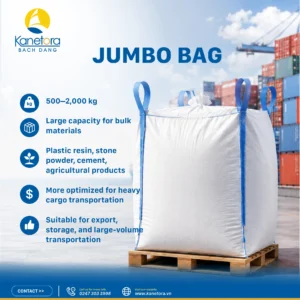
A jumbo bag is a large-capacity industrial packaging solution designed for storing and transporting bulk materials. It is also known internationally as an FIBC, which stands for Flexible Intermediate Bulk Container.
Unlike standard PP woven bags, jumbo bags are designed with a more complex structure. A complete jumbo bag may include the body fabric, bottom panel, top filling system, discharge system, lifting loops, reinforced seams, safety stitching, liner, coating, baffle panels, anti-UV treatment, or electrostatic control features.
Jumbo bags are commonly used for plastic resin, minerals, sand, cement, fertilizer, grain, sugar, flour, starch, chemicals, animal feed, and other dry bulk materials. To understand the basic structure and industrial applications of this packaging type, buyers can refer to this guide: What Is a Jumbo Bag? Structure and Industrial Applications.
PP Woven Bag vs Jumbo Bag: Quick Comparison
| Criteria | Standard PP Woven Bag | Jumbo Bag / FIBC |
|---|---|---|
| Main material | Woven polypropylene fabric | Woven polypropylene fabric with reinforced structure |
| Common load capacity | 5–50 kg per bag | 500–2,000 kg per bag or customized |
| Packing volume | Small to medium | Large bulk volume |
| Structure | Simpler: body, top, bottom, optional liner or lamination | More complex: body, lifting loops, filling spout, discharge spout, liner, baffle, coating |
| Handling method | Manual handling, conveyor, palletizing | Forklift, crane, lifting system, container loading |
| Main application | Retail, distribution, small-to-medium industrial packing | Bulk storage, export cargo, large-volume industrial materials |
| Cost per bag | Lower | Higher due to structure and technical requirements |
| Cost per ton | Can be higher for bulk cargo due to more bags and labor | Can be more efficient for large-volume cargo |
| Best for | 10–50 kg packed goods | 500 kg, 1 ton, or 2 ton bulk materials |
Difference in Load Capacity
The most obvious difference between PP woven bags and jumbo bags is load capacity.
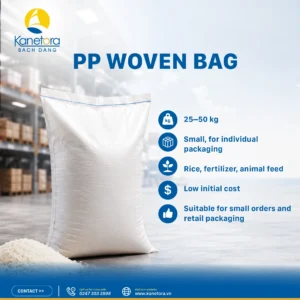
Standard PP woven bags are usually designed for smaller packing units. Depending on the product and fabric specification, they are commonly used for 5 kg, 10 kg, 20 kg, 25 kg, 40 kg, or 50 kg packaging. This makes them suitable for manual handling, retail distribution, pallet stacking, and domestic transportation.
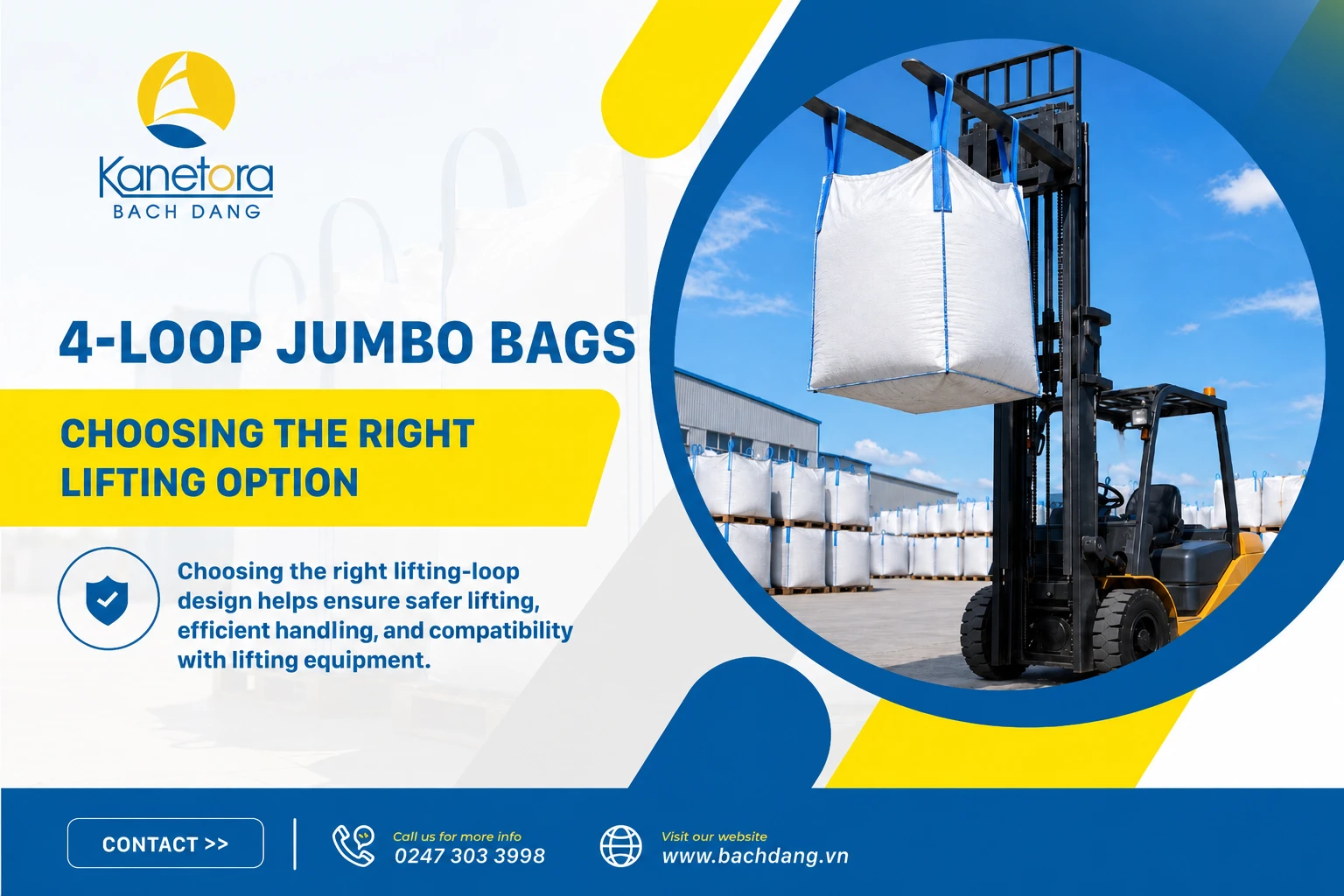
Jumbo bags are built for bulk loading. A typical FIBC bag can carry 500 kg, 1,000 kg, 1,250 kg, 1,500 kg, or 2,000 kg depending on the design, fabric strength, seam construction, lifting loop structure, and safety factor.
For jumbo bags, load capacity is not determined by fabric thickness alone. It also depends on fabric GSM, yarn strength, seam strength, lifting loop design, top and bottom construction, filling method, discharge method, and testing requirements. That is why buyers should work directly with a reliable jumbo bag factory in Vietnam when developing bags for export or heavy-duty applications.
Difference in Packing Volume
PP woven bags are suitable when products need to be divided into smaller units for sale, distribution, or manual use. For example, animal feed may be packed in 25 kg or 40 kg bags, while cement, fertilizer, or powder materials may be packed in 20 kg or 50 kg bags.
Jumbo bags are more suitable when businesses need to store or ship large volumes of loose materials. Instead of using hundreds or thousands of small bags, companies can use fewer jumbo bags to pack the same total quantity of goods. This helps reduce handling time, labor cost, loading complexity, and warehouse operation pressure.
However, bag volume should not be selected based on dimensions alone. Buyers must also consider product density. The same bag size may carry different weights depending on whether the product is plastic resin, calcium carbonate, rice, sugar, sand, mineral powder, or chemical granules.
For products that need better shape retention during storage or container loading, baffle jumbo bags can be a practical choice because internal baffle panels help reduce bulging and maintain a more square shape.
Difference in Applications
Standard PP woven bags are widely used for products that need to be packed in small or medium-sized units. Common applications include rice, grain, animal feed, fertilizer, seed, chemicals, construction additives, minerals, activated carbon, cement, and other industrial materials.
For fine powder or materials that generate dust, businesses may consider laminated PP woven bags, PP bags with PE liner, or block bottom valve bags. These options can improve moisture protection, reduce leakage, and support more stable palletizing.
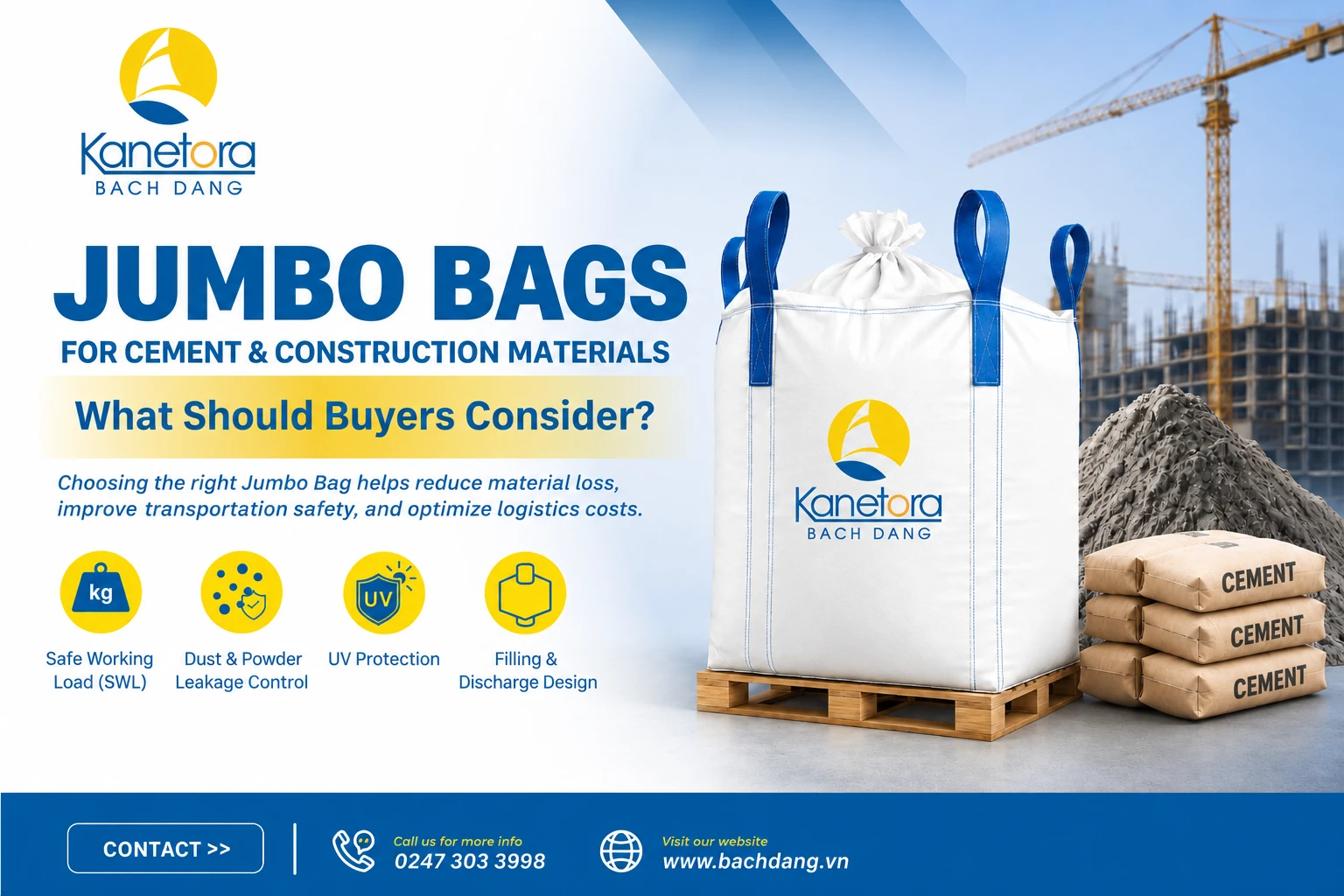
Jumbo bags are designed for bulk industrial applications. In the plastic industry, they are commonly used for PP, PE, PET, masterbatch, compound, and recycled resin. In the mineral and construction industries, they are used for calcium carbonate, sand, lime, gypsum, cement, and other dry bulk materials. In food and agriculture, food-grade FIBC bags can be used for rice, sugar, flour, starch, coffee beans, cashew nuts, and other sensitive products.
For export cargo, jumbo bags are often preferred because they allow faster loading, easier container handling, and better cost control per ton of material. Buyers who want to understand how export-standard FIBC bags are produced can read more here: Inside the Export-Standard FIBC Jumbo Bag Manufacturing Process.
Difference in Cost
If buyers compare only the price per bag, standard PP woven bags are usually cheaper than jumbo bags. This is because they have a simpler structure, lower material consumption, and fewer technical components.
However, industrial packaging decisions should not be based only on unit price. Businesses should also calculate the total packaging cost per ton, labor cost, handling time, storage efficiency, loading method, transportation safety, and the risk of product loss or damage.
For high-volume cargo, jumbo bags may help reduce the total number of bags used, shorten loading and unloading time, and improve container handling efficiency. One 1-ton jumbo bag can replace many smaller PP woven bags, especially in export, warehousing, and bulk material transportation.
On the other hand, if the product needs to be sold in small units, distributed through dealers, or handled manually, standard PP woven bags may remain the more economical choice.
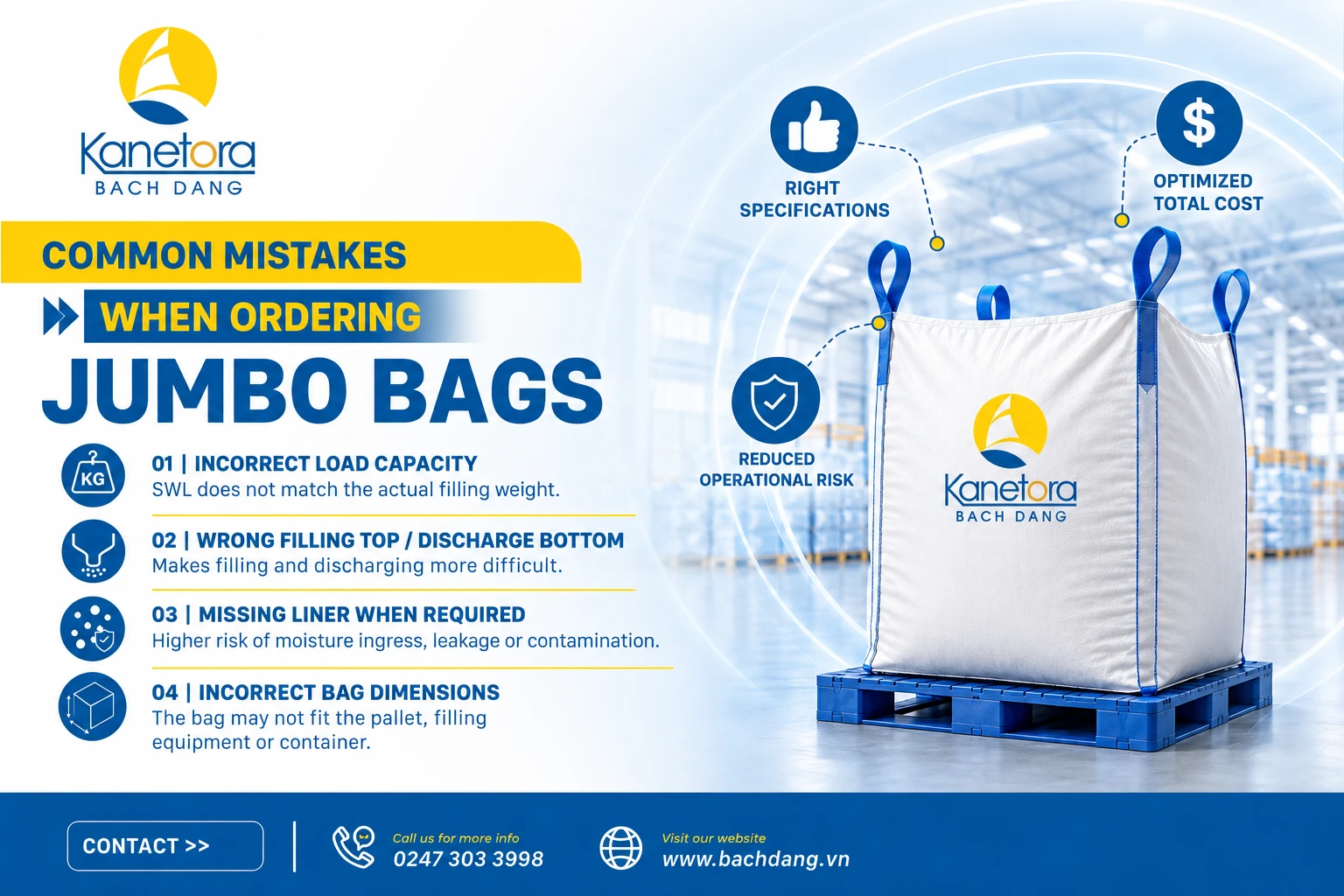
The cost of a jumbo bag depends on many factors, including bag size, safe working load, fabric GSM, construction type, coating, liner, baffle design, anti-UV treatment, anti-static requirements, filling spout, discharge spout, lifting loops, printing, testing standards, and order quantity. Buyers can refer to this article for more details: What Affects Jumbo Bag Pricing? Key Factors Buyers Should Know.
How to Choose Between PP Woven Bags and Jumbo Bags
Businesses should choose standard PP woven bags when the product is packed in 5 kg to 50 kg units, distributed through retail or dealer networks, handled manually, or does not require heavy-duty lifting equipment.
PP woven bags are also suitable when the main goal is to control packaging cost per bag and maintain flexible distribution.
Businesses should choose jumbo bags when the product needs to be packed in 500 kg, 1 ton, or larger units; handled by forklift or crane; stored in bulk; exported in containers; or moved through industrial supply chains.
Jumbo bags are also more suitable when products require technical features such as PE liner, lamination, baffle panels, anti-UV protection, dustproof construction, food-grade compliance, or anti-static control.
A simple selection guide:
| Practical Requirement | Recommended Packaging |
|---|---|
| Packing 25 kg or 50 kg units | PP woven bag |
| Packing 500 kg, 1,000 kg, or more | Jumbo bag / FIBC |
| Retail or dealer distribution | PP woven bag |
| Bulk export by container | Jumbo bag / FIBC |
| Automated powder packing line | Block bottom valve bag |
| Reducing manual handling | Jumbo bag / FIBC |
| Moisture or dust protection | Bag with liner or coating |
| Better pallet shape | Block bottom bag or baffle jumbo bag |
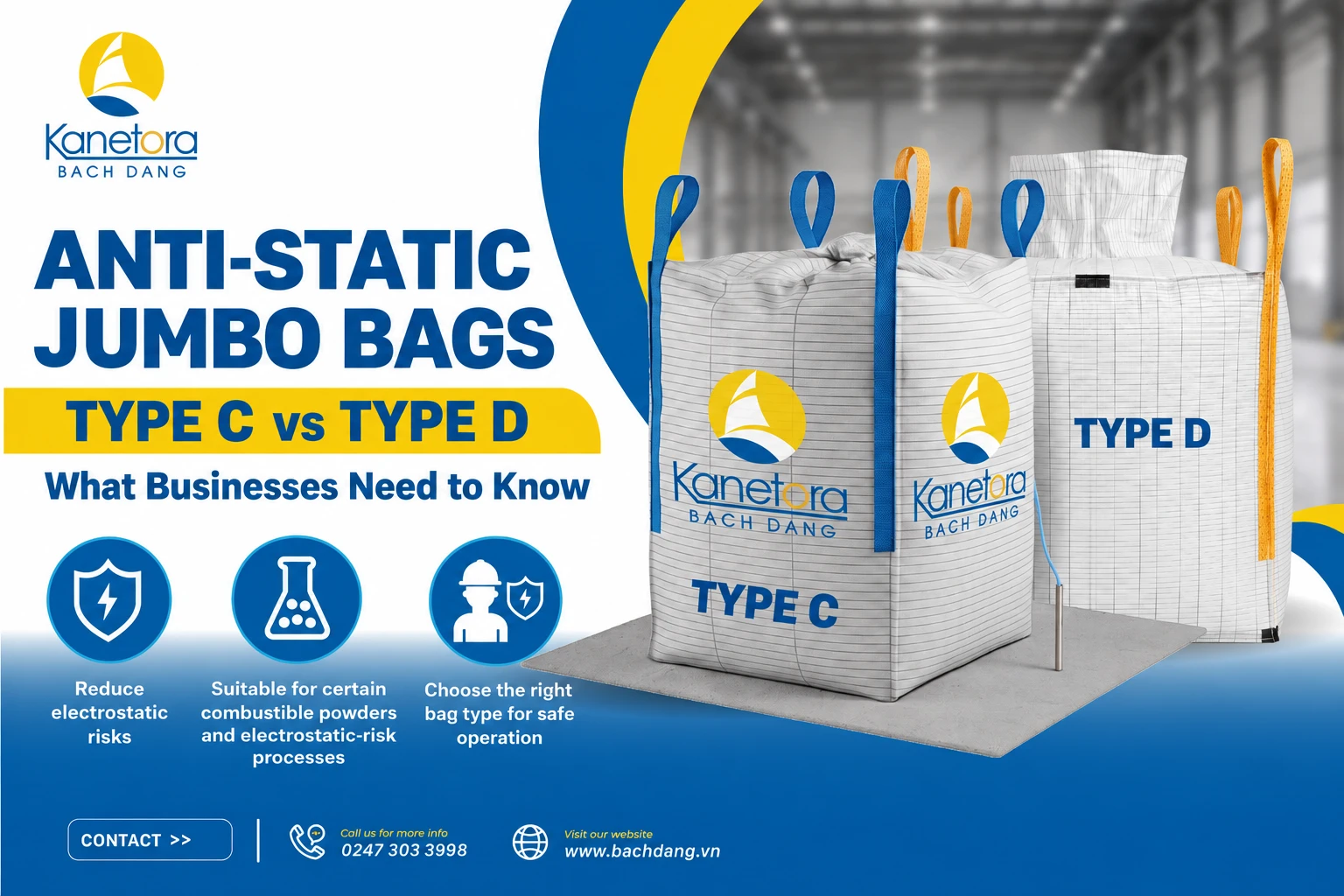
| Static-sensitive materials | Type B, Type C, or Type D FIBC depending on application |
Kanetora Bach Dang: PP Woven Bag and Jumbo Bag Manufacturer in Vietnam
Kanetora Bach Dang is a direct industrial packaging manufacturer in Vietnam, providing PP woven bags, jumbo bags, FIBC bags, block bottom valve bags, and multi-layer PE film for different industries.
The factory’s product portfolio includes Type A, Type B, Type C, Type D, UN-certified, food-grade, liner, baffle, and dustproof FIBC bags. Its production system covers key manufacturing stages such as extrusion, belt weaving, fabric weaving, laminating, cutting, printing, sewing, inspection, and packing.
Working directly with a manufacturer allows buyers to control technical specifications more effectively, including bag size, fabric strength, safety factor, lifting loop design, filling and discharge structure, liner requirements, printing, packaging method, and delivery schedule.
For buyers sourcing from Vietnam, this direct manufacturing model can help reduce communication gaps, improve production consistency, and support more flexible customization for different applications.
Conclusion
PP woven bags and jumbo bags are closely related, but they are not the same packaging solution. A jumbo bag is usually made from woven polypropylene fabric, but it is engineered for much higher load capacity, larger volume, industrial handling, and more demanding safety requirements.
If the product is packed in 10–50 kg units for distribution, a standard PP woven bag is usually the right choice. If the product is shipped in bulk, stored in large quantities, handled by forklift or crane, or exported by container, a jumbo bag or FIBC is usually more efficient.
To choose the right packaging, businesses should provide the manufacturer with key information such as product type, bulk density, target weight per bag, bag dimensions, filling method, discharge method, storage condition, transportation method, moisture protection needs, anti-static requirements, printing requirements, and order quantity.
Contact Kanetora Bach Dang to receive technical consultation for PP woven bags, jumbo bags, and customized industrial packaging solutions based on your real production and export requirements.
FAQ
Are PP woven bags and jumbo bags the same?
Not exactly. Jumbo bags are usually made from woven polypropylene fabric, but they are designed for much larger load capacity and include reinforced structures such as lifting loops, strong seams, filling systems, discharge systems, and optional liners or coatings.
How much weight can a PP woven bag carry?
A standard PP woven bag is commonly used for 5 kg to 50 kg packaging, depending on product type, bag size, fabric specification, and handling requirements.
How much weight can a jumbo bag carry?
A jumbo bag or FIBC commonly carries 500 kg to 2,000 kg. The exact safe working load depends on fabric strength, bag construction, lifting design, seam strength, safety factor, and testing requirements.
When should I use PP woven bags?
PP woven bags are suitable for products packed in smaller units, manual handling, retail distribution, dealer networks, and applications where cost per bag is a key consideration.
When should I use jumbo bags?
Jumbo bags are suitable for bulk materials, export cargo, warehouse storage, container loading, forklift handling, and high-volume industrial supply chains.
Do jumbo bags need liners?
Not always. Liners are recommended when the product needs moisture protection, dust control, contamination prevention, or higher barrier performance. Common examples include food ingredients, plastic resin, fine powder, chemicals, and hygroscopic materials.
Which is more cost-effective: PP woven bag or jumbo bag?
It depends on the packing purpose. PP woven bags are usually cheaper per bag, while jumbo bags can be more cost-effective per ton for bulk cargo because they reduce the number of bags, labor handling, and loading time.