

When international buyers search for a jumbo bag factory in Vietnam, the first question is often about price. However, for B2B packaging orders, especially those used for food, plastic resin, chemicals, minerals, agriculture, or export logistics, price is only one part of the sourcing decision.
A capable jumbo bag factory must prove that it can manufacture consistently, control quality across production stages, meet international standards, support technical customization, and deliver within a realistic lead time.
In other words, a reliable FIBC factory in Vietnam is not simply a sewing workshop. It should be a complete manufacturing system that controls raw materials, extrusion, weaving, lamination, cutting, printing, sewing, inspection, packing, and shipment preparation.
Quick answer: A professional jumbo bag factory should have six core capabilities: modern machinery, standardized production process, strong QA/QC system, international certifications, proven experience across different FIBC designs, and transparent quotation and lead-time management.
1. Machinery Capability: The Foundation of Stable Production
Machinery is one of the first indicators of a factory’s real manufacturing capacity. For jumbo bags, a factory needs more than sewing machines. It should have equipment covering multiple stages of FIBC production, including yarn extrusion, fabric weaving, belt weaving, coating, cutting, printing, liner production, testing, inspection, and packing.
Key machinery groups usually include:
- PP or mono yarn extruders.
- Circular or flat loom weaving machines.
- Webbing and belt weaving machines.
- Coating or lamination machines.
- Automatic cutting machines.
- Printing machines.
- Industrial sewing machines.
- Blowing machines for liners.
- Cleaning machines and metal detectors.
- Laboratory testing equipment.
A strong machine system helps the factory control consistency from semi-finished components to final products. This is especially important when buyers need repeated orders, customized bag specifications, or export-standard packaging for sensitive goods.
At Kanetora Bach Dang, many semi-finished components used in FIBC production, such as sling belts, webbings, labels, document pouches, liners, and supporting components, are manufactured in-house. This supports better quality consistency, faster coordination, and greater flexibility for customized requirements.
2. Standardized Production Process from Raw Material to Finished Bag
A professional jumbo bag manufacturer in Vietnam should operate under a clear and traceable production process. For FIBC bags, the typical production flow includes:
- Extrusion.
- Belt weaving.
- Fabric weaving.
- Laminating or coating.
- Cutting and printing.
- Sewing.
- Inspecting.
- Packing.
Each stage affects the final performance of the bag. For example, extrusion quality influences yarn strength. Weaving quality affects fabric stability. Sewing quality determines load-bearing safety. Inspection and packing determine whether the product can meet export requirements.
Kanetora Bach Dang applies a standardized 8-step production process designed to ensure product durability, safety, and international quality compliance.
This matters because different industries require different packaging solutions. A jumbo bag for plastic resin may need moisture protection and anti-contamination control. A bag for minerals may prioritize strength and loading efficiency. A food-grade FIBC requires stricter hygiene, cleaning, and packing standards.
3. QC/QA Capability: Controlling Quality Before Problems Happen
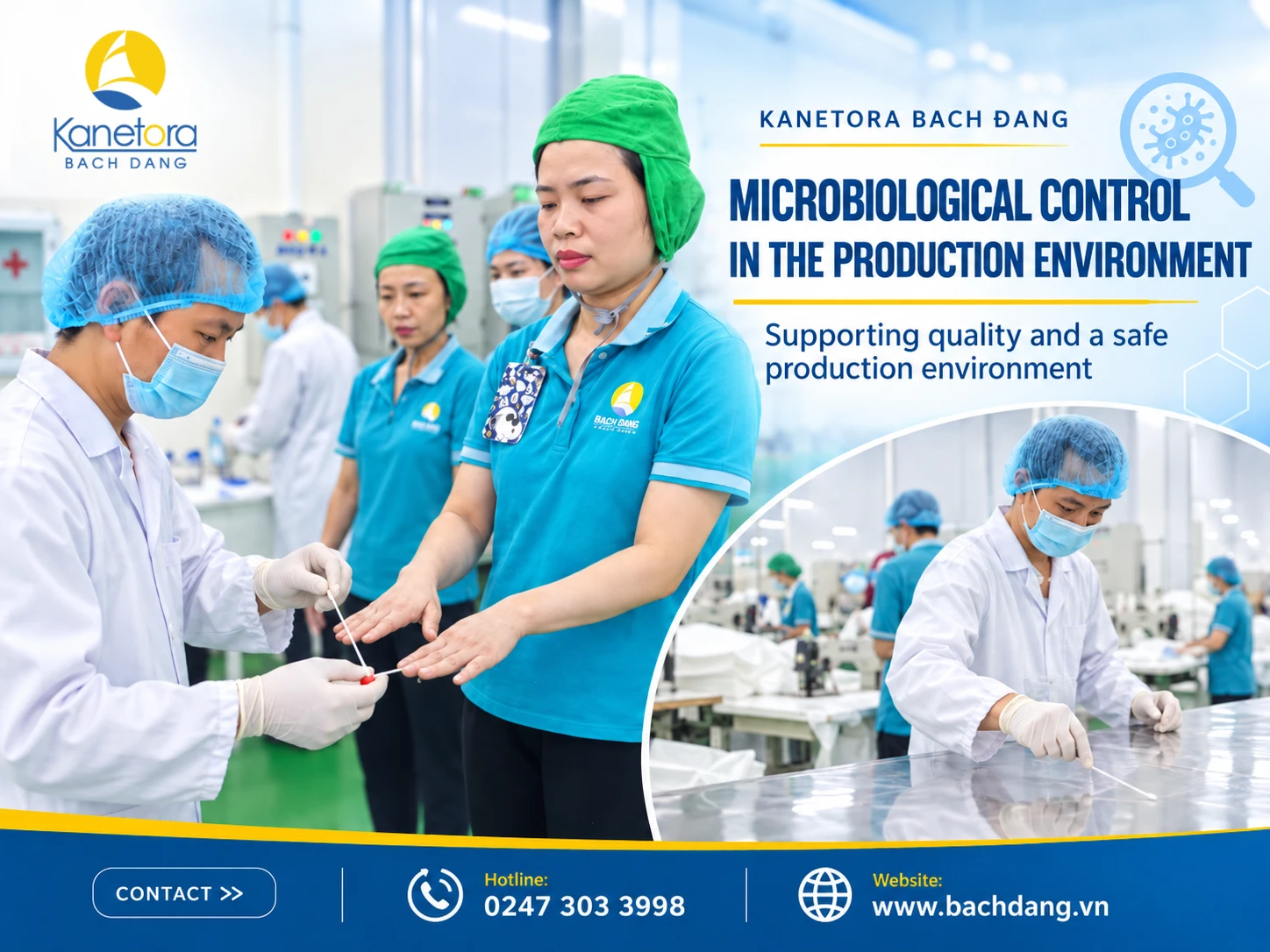
For export orders, quality cannot be checked only at the final stage. A capable FIBC factory should implement both Quality Control and Quality Assurance throughout the production process.
QC focuses on direct inspection at each production stage. QA ensures that the entire manufacturing system follows defined standards and procedures. When both systems work together, the factory can detect issues earlier, reduce defects, and maintain product consistency across shipments.
Important quality checkpoints include:
- Raw material inspection.
- Yarn denier and tensile strength testing.
- Fabric weight and strength checking.
- Webbing strength testing.
- Cutting dimension control.
- Printing quality control.
- Sewing quality inspection.
- Seam strength checking.
- Liner inspection.
- Metal detection.
- Final product inspection.
- Bale labeling and packing verification.
For high-requirement products such as food-grade FIBC bags, bags with liners, baffle bags, dustproof bags, and FIBC bags for chemical or plastic resin applications, QC/QA capability becomes even more critical.
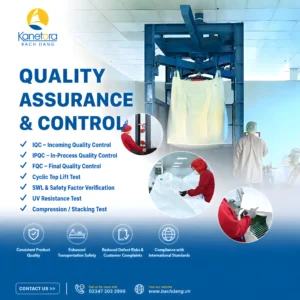
Kanetora Bach Dang operates a comprehensive QC and QA system across production stages, including in-process checks on sewing lines and final inspection before shipment. The factory also uses testing equipment for FIBC and FIBC inner liners, including tensile strength testing, UV resistance testing, top lift testing, liner visual checking, puncture resistance testing, coefficient of friction testing, and heat sealing strength testing.
4. International Certifications: A Key Requirement for Global Buyers
For global supply chains, certifications are not just supporting documents. In many cases, they are required before a supplier can be approved.
A qualified bulk bag factory in Vietnam should be able to demonstrate relevant certifications and test reports based on the customer’s industry and market requirements.
Common certifications and compliance documents include:
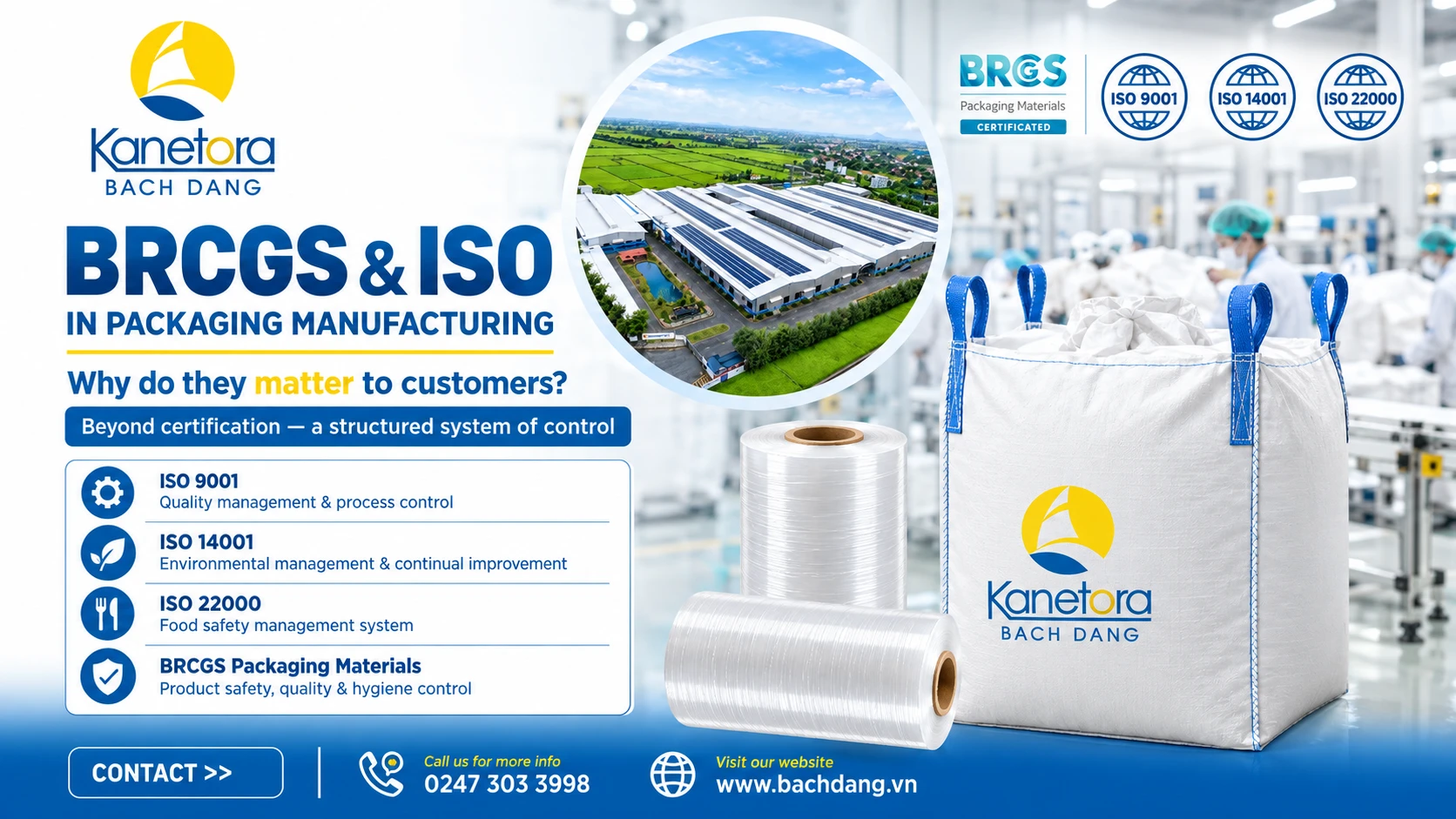
- ISO 9001:2015 for quality management.
- ISO 14001:2015 for environmental management.
- ISO 22000:2018 for food safety management.
- BRCGS or BRC Grade A for product safety, hygiene, and quality assurance.
- Food contact test reports for specific markets.
- FDA-related test reports for polypropylene materials when required.
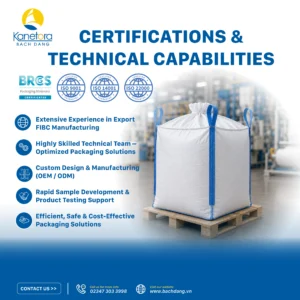
Kanetora Bach Dang has obtained certifications including ISO 9001:2015, ISO 14001:2015, ISO 22000:2018, and BRC Grade A. The company profile also highlights food contact test results for EU Regulation No. 10/2011 and US FDA 21 CFR 177.1520.
For buyers in food, agriculture, chemical, mineral, and plastic resin industries, these certifications help reduce supplier approval risk and support more reliable long-term cooperation.
5. Experience Across Different Jumbo Bag Designs
A capable jumbo bag factory should not only produce one standard bag design. In real industrial applications, different products require different FIBC structures.
Common jumbo bag designs include:
- U-panel FIBC bags.
- 4-panel FIBC bags.
- Circular or tubular FIBC bags.
- Baffle bags.
- Food-grade FIBC bags.
- FIBC bags with liners.
- Coated or laminated FIBC bags.
- Dustproof bags.
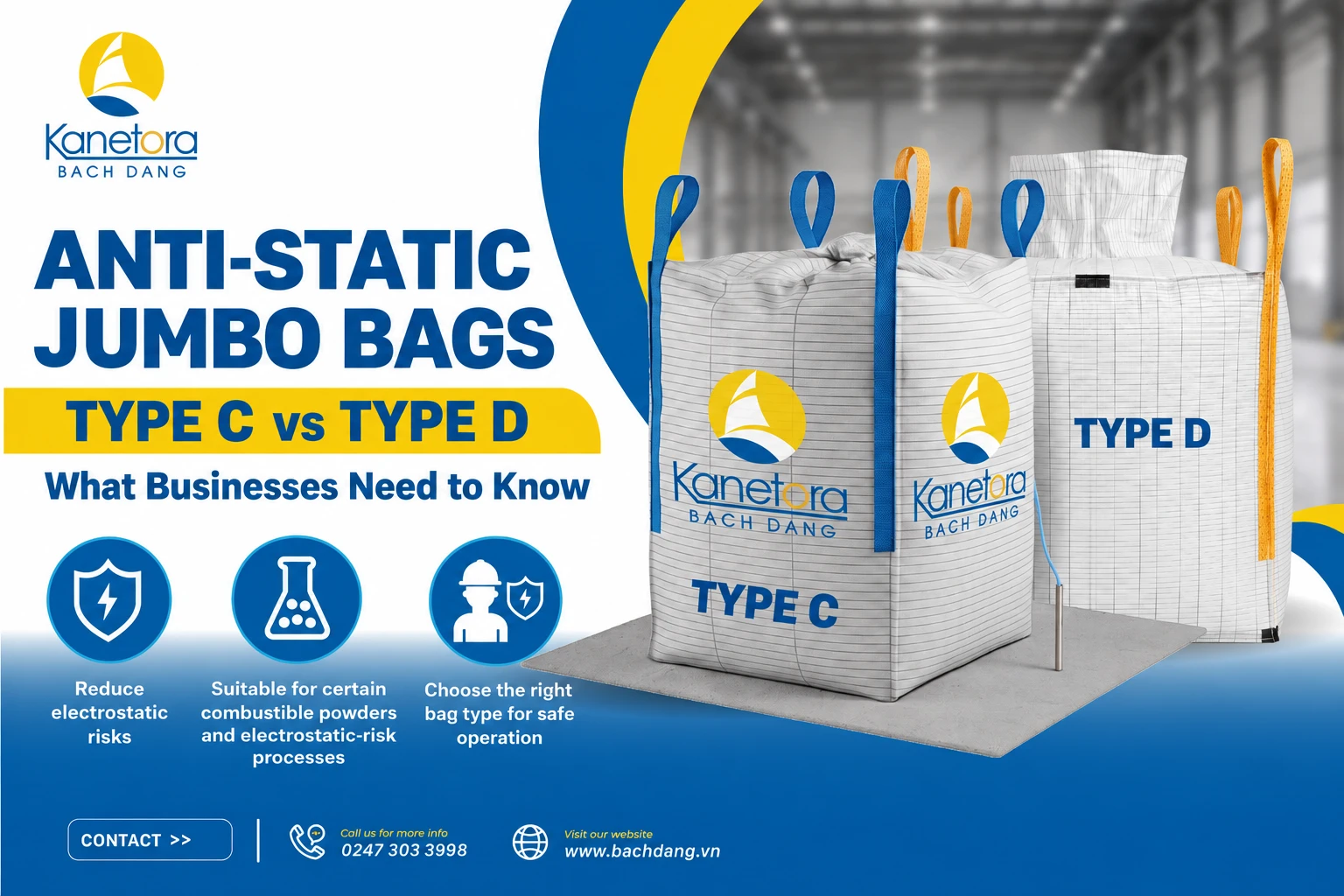
- Type A, Type B, Type C, and Type D FIBC bags.
- UN-certified FIBC bags.
- Sling bags.
In addition to the bag body structure, the factory should also advise on top filling options, bottom discharge options, and lifting loop designs.
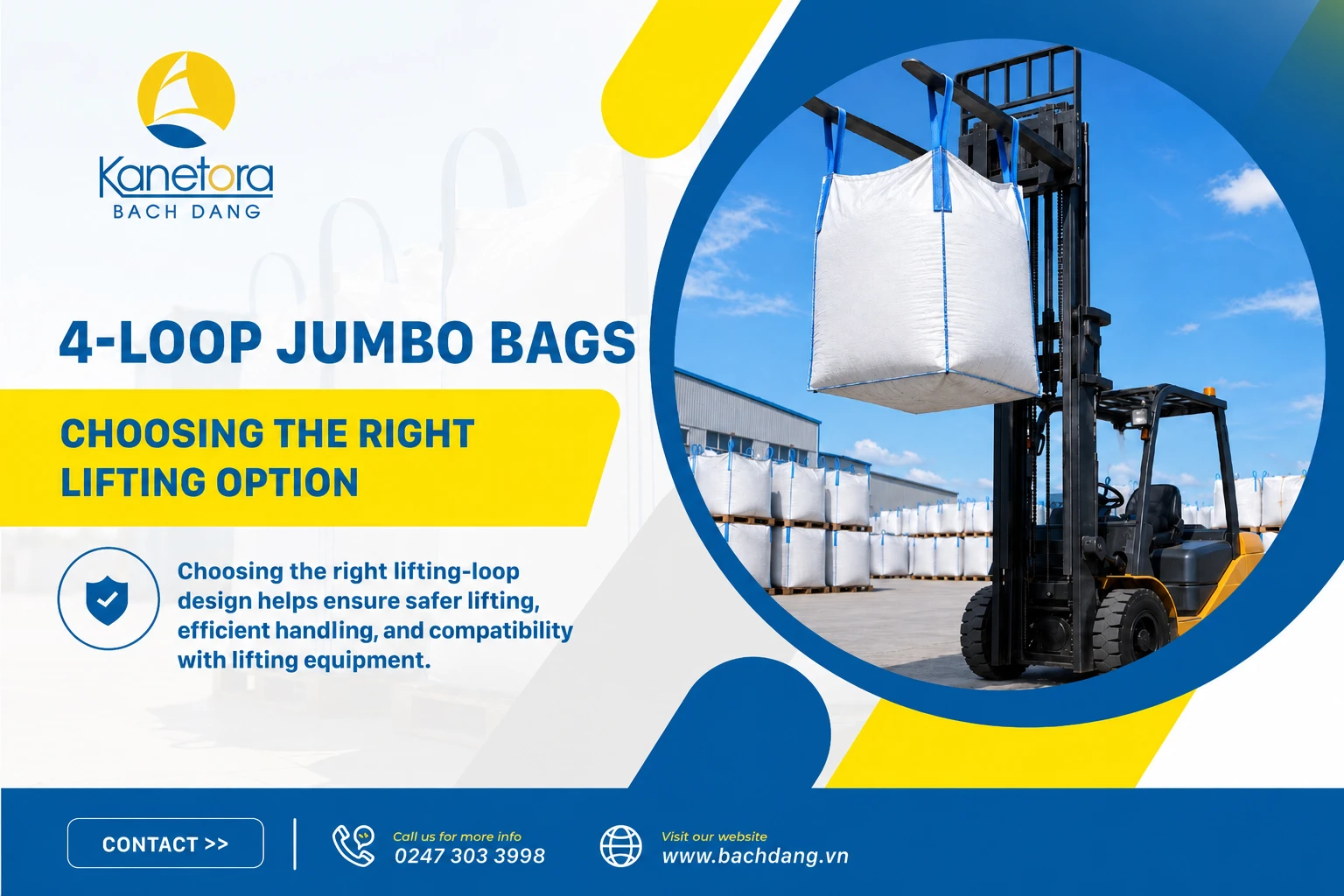
For example, a buyer may need an open top for fast filling, a duffle top for better contamination control, a filling spout for controlled loading, a flat bottom for simple storage, or a discharge spout for easier emptying. Lifting options such as corner loops, cross-corner loops, and stevedore loops also affect handling efficiency.
Kanetora Bach Dang’s product portfolio includes FIBC bags, jumbo bags, sling bags, food-grade bags, bags with inner liners, baffle and dustproof bags, Type A/B/C FIBC bags, UN bags, block bottom valve bags, and multi-layer PE film.
This range allows the factory to support buyers across different industries instead of offering only one basic packaging solution.
6. Stable Production Capacity and Realistic Lead Time
Lead time is one of the most important factors for international buyers. A low price is not valuable if the factory cannot deliver on schedule.
A strong FIBC factory should be able to maintain stable production capacity and provide realistic timelines based on the order specifications.
Lead time is influenced by many factors, including:
- Raw material availability.
- In-house semi-finished component production.
- Sewing capacity.
- Current production schedule.
- Bag design complexity.
- Printing requirements.
- Liner, coating, or baffle requirements.
- Required testing or certification documents.
- Packing and container loading plan.
Kanetora Bach Dang has a stated FIBC production capacity of 300,000 pieces per month, alongside production capacity for block bottom valve bags and multi-layer plastic film.
For buyers planning repeated orders, this type of capacity is important because it supports supply continuity, production planning, and long-term procurement stability.
7. Technical Quotation and Engineering Support
A professional jumbo bag factory should not quote only based on dimensions and quantity. A proper quotation requires complete technical information.
To prepare an accurate quotation, the factory usually needs:
- Bag dimensions.
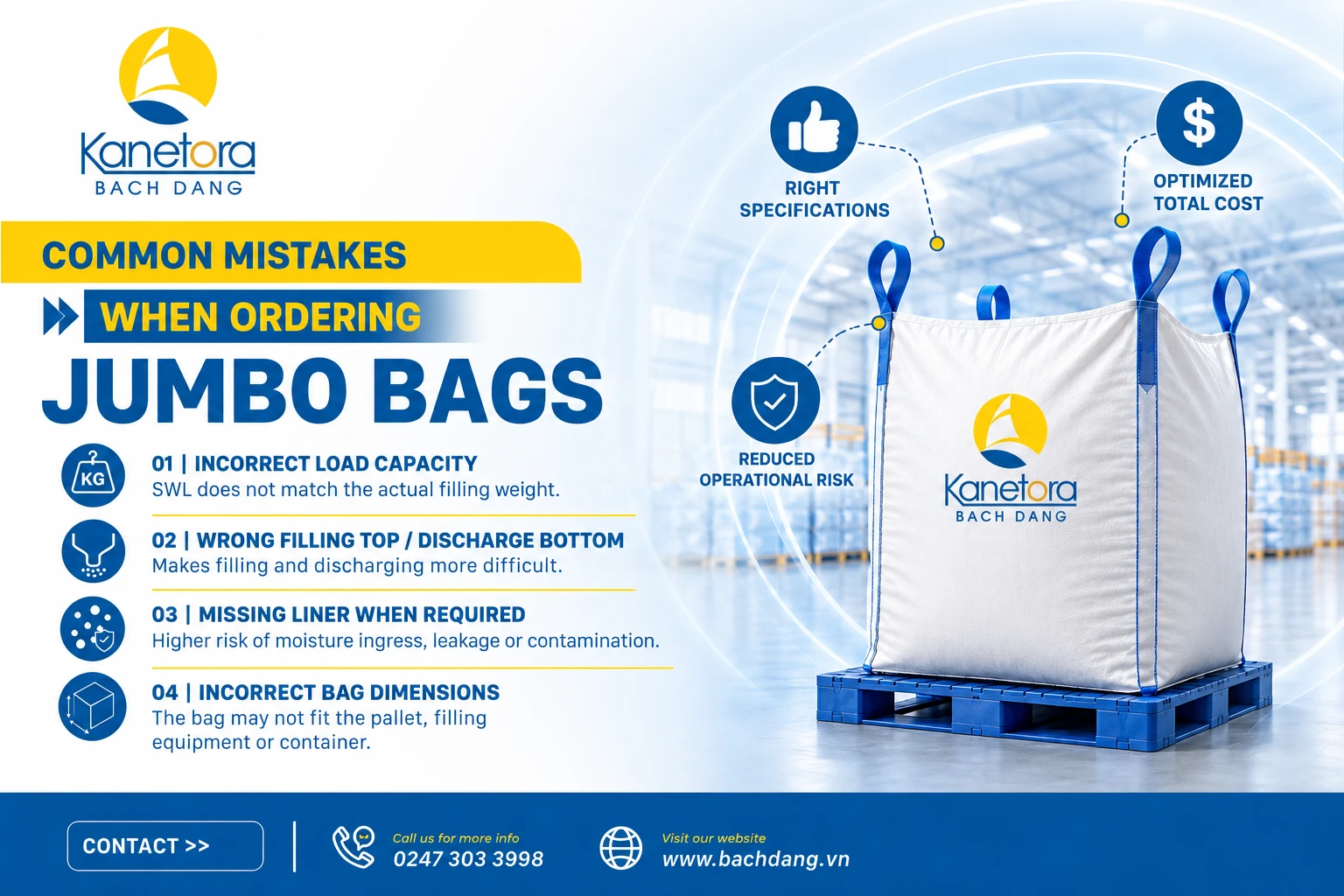
- Safe Working Load, or SWL.
- Safety factor, such as 5:1 or 6:1.
- Bag construction: U-panel, 4-panel, circular, or baffle.
- Fabric weight.
- Coating requirement.
- Liner requirement.
- Top filling design.
- Bottom discharge design.
- Lifting loop type.
- Printing requirement.
- Packed product.
- Order quantity.
- Target market.
- Delivery terms such as FOB, CIF, or CNF.
The difference between a trading supplier and a direct factory is technical understanding. A direct manufacturer should be able to explain why a certain fabric weight is suitable, when liner is necessary, when coating is recommended, when baffle panels help optimize storage, or when a standard construction is enough to control cost.
This technical support helps buyers avoid over-specification, under-specification, and unnecessary cost.
8. Why Work with a Direct Jumbo Bag Factory in Vietnam?
Vietnam has become an important sourcing destination for industrial packaging thanks to its manufacturing capability, export orientation, and growing role in global supply chains.
Working directly with a jumbo bag factory in Vietnam can offer several advantages:
- Better control over product specifications.
- More direct technical communication.
- Easier sample development.
- Clearer production planning.
- Better quality traceability.
- More flexibility for customized orders.
- Stronger support for long-term supply programs.
- Easier factory audit and supplier evaluation.
For industries such as plastic resin, food ingredients, agriculture, minerals, and chemicals, working directly with a factory helps reduce communication gaps between buyer, trader, and production team.
9. Quick Checklist for Evaluating a Jumbo Bag Factory
Before choosing an FIBC supplier, buyers can use the following checklist:
| Capability Area | Key Questions to Ask |
|---|---|
| Machinery | Does the factory have extrusion, weaving, coating, cutting, printing, sewing, liner, inspection, and testing equipment? |
| Production Capacity | Can the factory support monthly volume and repeated orders? |
| QC/QA | Are inspections performed across production stages or only at the final stage? |
| Certifications | Does the factory have ISO, BRCGS/BRC, food safety, or food contact documentation? |
| Product Range | Can the factory produce U-panel, 4-panel, circular, baffle, liner, food-grade, and UN FIBC bags? |
| Lead Time | Is the delivery schedule realistic and clearly communicated? |
| Technical Support | Can the factory advise on bag design based on the packed product and handling conditions? |
| Export Readiness | Can the factory support packing, labeling, container loading, and international shipment requirements? |
10. Kanetora Bach Dang: A Direct Jumbo Bag Factory in Vietnam
Kanetora Bach Dang is a direct industrial packaging manufacturer in Vietnam, focusing on FIBC bags, jumbo bags, sling bags, block bottom valve bags, and multi-layer PE film.
As part of the Kanetora ecosystem, the factory is positioned to serve both domestic and international customers with export-oriented manufacturing capability, standardized production processes, in-house semi-finished component production, QC/QA control, testing equipment, and internationally recognized certifications.
For buyers looking for a jumbo bag factory in Vietnam with technical support, flexible customization, stable production capacity, and quality-focused manufacturing, Kanetora Bach Dang is a strong partner for both standard FIBC orders and customized packaging projects.
Frequently Asked Questions
1. What is a jumbo bag factory?
A jumbo bag factory is a manufacturing facility that produces FIBC bags, also known as bulk bags or jumbo bags. These bags are used to pack, store, and transport dry bulk materials such as food ingredients, plastic resin, chemicals, minerals, agricultural products, and construction materials.
2. What capabilities should a jumbo bag factory have?
A reliable jumbo bag factory should have machinery for extrusion, weaving, coating, cutting, printing, sewing, liner production, inspection, and packing. It should also have QC/QA systems, testing equipment, certifications, and experience with different bag designs.
3. What certifications should an FIBC factory have?
Common certifications include ISO 9001, ISO 14001, ISO 22000, and BRCGS or BRC Grade A. Depending on the application, buyers may also require food contact test reports, FDA-related documents, or other market-specific compliance records.
4. When should buyers choose FIBC bags with liners?
FIBC bags with liners are recommended when the packed product needs protection from moisture, dust, contamination, or leakage. They are commonly used for food powders, plastic resin, chemicals, fine powders, and moisture-sensitive materials.
5. Why should buyers work directly with a jumbo bag factory instead of a trading company?
Working directly with a factory provides better control over technical specifications, quality, production schedule, sample development, and communication. This is especially important for export orders or customized FIBC requirements.
Suggested Internal Links
- Anchor: What is a Jumbo Bag? Structure and Industrial Applications
- Anchor: Inside the Export-Standard FIBC Jumbo Bag Manufacturing Process
- Anchor: FIBC Bag with Liner: When and Why to Use
- Anchor: Contact Kanetora Bach Dang for Custom FIBC Manufacturing
Looking for a direct jumbo bag factory in Vietnam?
Contact Kanetora Bach Dang to discuss your product requirements, bag specifications, quality standards, and export packaging needs. Our team can support you from technical consultation and sample development to production and delivery.